Shopify Dropshipping SEO: Move Rankings in 2–3 Months With Bulk Pages
Practical Shopify dropshipping SEO: rewrite top product pages, add category copy, fix site speed, and scale with bulk copyright safe pages.

Shopify Dropshipping SEO: Move Rankings in 2–3 Months With Bulk Pages

Yes, SEO works for Shopify dropshipping, but only once you stop shipping supplier copy straight onto your product pages. Start with three moves: rewrite your top product pages so they’re genuinely unique, add real copy to category pages, and fix whatever’s slowing your site down. Expect the first measurable shift in impressions within a few months, tracked through Search Console and analytics, not overnight page-one rankings.
TL;DR:
- Focus on creating unique, benefit-led descriptions for products and category pages, avoiding duplicated supplier copy to improve ranking signals.
- Build a detailed keyword map targeting long-tail, low-competition search phrases before producing any content to prevent cannibalization.
- Optimize site speed by cleaning up apps, compressing images, and improving crawlability, aiming for page load times under 2.5 seconds.
- Use pillar pages with relevant product clusters and internal links to provide Google with context and capture mid-funnel search traffic effectively.
- Automate bulk content generation with AI tools to scale your SEO efforts and reduce manual rewriting, especially for large catalogs exceeding a few hundred SKUs.
Table of Contents
- Why SEO matters for Shopify dropshipping
- Keyword research and mapping for dropshipping stores
- Product page optimisation: titles, descriptions, images and schema
- Site structure, category pages and internal linking
- Technical SEO: speed, mobile and crawlability for Shopify stores
- Content strategy and link building for dropshipping stores
- Fixing duplicate content and scaling unique pages
- EcomEye’s approach: bulk, copyright-safe SEO content generation for Shopify dropshipping
- Optimising for local SEO if targeting specific geographic markets
- Best practices for backlink acquisition specifically tailored to dropshipping niches
- Handling supplier-related SEO issues, such as product availability and variations
- Addressing common penalties or SEO risks in dropshipping environments
- Author checklist: priorities by month
- How EcomEye helps you put this into practice
- Sources
- FAQ
Why SEO matters for Shopify dropshipping
Paid ads get expensive fast, especially once a niche gets crowded. Organic search doesn’t disappear when you stop paying for it, which is exactly why it’s worth building alongside your ad spend rather than instead of it.
New stores rarely compete for short, high-volume terms like “wireless earbuds.” They can compete for long-tail phrases such as “wireless earbuds for small ears with charging case,” where competition is thinner and buying intent is sharper. Category pages targeting these mid-funnel phrases often outperform individual product pages because they capture people still comparing options.
Rankings aren’t purely about backlinks and keywords either. Shopify’s own dropshipping guidance points to long-tail targeting and unique product descriptions as core maintenance tasks, and behavioural signals, like time on page, reviews, and low bounce rates, reinforce whatever technical and content work you’ve already done.
Keyword research and mapping for dropshipping stores
New domains rarely outrank established retailers on competitive terms, so chase realistic targets instead. Long-tail commercial phrases—three to five words with clear buying intent—carry lower keyword difficulty and convert better because searchers already know roughly what they want.
Build a keyword map before you write a word of copy. It’s simply a spreadsheet linking specific keywords to specific URLs, so you’re not accidentally writing two pages competing for the same term.
- Assign one primary keyword per page and reserve close variations for headers and body copy.
- Use Google Keyword Planner for volume estimates and Google Search Console to see what you already rank for (often the fastest way to find quick wins).
- An SEO tool such as Ahrefs or Semrush adds keyword difficulty scores and competitor gap analysis, useful once you’ve outgrown free tools.
- Map pillar pages to clusters of related products, and clusters to individual SKUs, so internal linking has somewhere logical to go.
Cannibalisation, two pages fighting for the same query, is one of the most common self-inflicted problems in dropshipping stores with overlapping product ranges. A clean map prevents it before it starts.
Product page optimisation: titles, descriptions, images and schema
This is where most dropshipping SEO efforts either succeed or quietly die. Supplier descriptions are duplicated across thousands of stores, and Shopify’s own guidance is blunt about it: skip the copy-paste and write unique, benefit-led product descriptions instead.
- Rewrite every supplier description around the customer’s problem, not the product’s specifications. Lead with what changes for the buyer, then support it with specs.
- Write title tags under 60 characters with the primary keyword near the front, and keep the H1 distinct from the meta title so you’re not repeating yourself.
- Trim the URL slug to the product name only, no supplier SKUs or filler words.
- Compress every image, convert to WebP where your theme supports it, and rename files descriptively (
grey-ceramic-mug-350ml.webp, notIMG_2931.jpg). - Write specific ALT text describing the product in context, not just the keyword repeated.
- Add Product schema markup and validate it with Google’s Rich Results Test before publishing at scale.
Pro Tip: Batch your image renaming and ALT text in a spreadsheet before uploading. Doing it product-by-product in Shopify’s admin is where most stores give up halfway through.
Unique images matter more than most dropshippers assume. If every store selling the same AliExpress product uses the same five supplier photos, you’ve got zero visual differentiation, and Google notices patterns like that across a category.

Site structure, category pages and internal linking
Category pages do more SEO work than most dropshippers give them credit for. A bare grid of products with no copy is a wasted opportunity; 150 to 300 words of genuine, keyword-relevant copy above or below the grid gives Google something to actually rank, and gives shoppers context they didn’t get from the product thumbnails alone.
Structure should stay shallow. Category, then subcategory, then product, with every product reachable in three clicks or fewer from the homepage. Anything deeper and both users and crawlers start losing patience.
- Write a genuine H1 for every category page, not a default like “Shop All.”
- Link from blog posts and pillar pages down into relevant products, don’t rely on the main navigation alone to do this work.
- Canonicalise faceted URLs (colour filters, size filters, sort parameters) so Google isn’t indexing dozens of near-identical variants of the same category.
- Submit an updated sitemap through Search Console whenever you add a meaningful batch of new pages.
Technical SEO: speed, mobile and crawlability for Shopify stores
Speed problems on Shopify usually trace back to the same three culprits: too many apps, an overloaded theme, and unoptimised images. Aim for Largest Contentful Paint under 2.5 seconds, the benchmark most technical SEO checklists for Shopify converge on.
Audit installed apps quarterly and remove anything you’re not actively using, each one adds its own script weight even when dormant. Compress images before upload rather than relying on Shopify to do it for you, enable lazy-loading for anything below the fold, and serve WebP or AVIF where your theme allows it.
Search Console flags indexing problems long before they show up in traffic reports, so check it weekly rather than after a ranking drop. Submit your sitemap, review robots.txt to confirm you’re not accidentally blocking category pages, and set canonical tags on colour or size variants so Google consolidates ranking signals onto one URL instead of splitting them across five.
Content strategy and link building for dropshipping stores
One pillar page per product cluster gives you somewhere to send commercial research traffic before it hits a product page. Pillar-cluster structures work particularly well for dropshippers because a single well-researched guide can link out to a dozen SKUs at once.
Reviews are an underused content asset. Genuine customer photos and written feedback add unique text to a page that would otherwise be identical to every competitor’s listing.
- Publish a pillar guide, then link relevant products into it naturally within the text.
- Encourage photo reviews; user-generated images are the one thing competitors selling the same supplier product genuinely can’t copy.
- Pitch niche guest posts and resource-page links rather than chasing high-authority sites that will ignore a new store.
- Push product visuals through Pinterest or TikTok, both drive meaningful referral traffic and occasional organic discovery for visually strong products.
Fixing duplicate content and scaling unique pages
Google doesn’t usually penalise duplicate product pages outright. It filters them, choosing one version to rank and quietly suppressing the rest, which is arguably worse because there’s no warning in Search Console telling you why traffic never arrived.
- Rewrite descriptions so each page has genuinely distinct wording, not synonym-swapped supplier text.
- Generate unique metadata (titles, meta descriptions) per product rather than reusing a template with only the product name swapped in.
- Apply canonical tags to low-value colour or size variants that don’t need to compete individually.
- Track indexed page count and impressions in Search Console before and after each batch of changes, that’s your real signal of whether the differentiation worked.
Templates can scale this safely, but only if each one pulls in unique fields, use-case bullets, specific benefits, actual specs, rather than just swapping a product title into an identical shell.
EcomEye’s approach: bulk, copyright-safe SEO content generation for Shopify dropshipping
Rewriting product pages one by one doesn’t scale past a few dozen SKUs. Ecom-eye imports products directly from AliExpress, Amazon, Temu, or a competitor’s Shopify link, then generates unique titles, descriptions, and AI product images for each one, with multi-language export built in for stores selling across markets.
The point isn’t to replace the strategy above, it’s to execute it at the volume dropshipping actually requires. A store with 800 SKUs facing Google’s duplicate-content filter doesn’t have time to manually rewrite each listing; template-driven generation with unique fields per product is exactly the kind of automated approach practitioner guides recommend for catalogues that size. Store owners using this workflow typically cut publishing time from days to minutes per batch, with no copyright risk from lifted supplier text.
Optimising for local SEO if targeting specific geographic markets
Most dropshippers sell nationally or internationally, so local SEO isn’t the default priority. It becomes relevant the moment you’re targeting a specific city, region, or country rather than selling everywhere at once, perhaps because your supplier only ships domestically, or you’ve deliberately niched into a regional audience.
Start with location-specific landing pages if you genuinely serve distinct markets differently, different shipping times, different currency, different language, rather than creating thin pages purely to rank for “[product] + [city].” A generic dropshipping store selling the same product worldwide gains little from fake local pages and risks looking manipulative to both users and Google.
If you do have a real local angle, weave location naturally into title tags, meta descriptions, and category copy rather than stuffing city names into headers. “Waterproof hiking boots, shipped across the UK in 3 days” tells a real story; “Waterproof hiking boots London Manchester Birmingham” tells Google you’re keyword stuffing.
Set your Shopify store’s language and currency settings to match the target market, and consider hreflang tags if you’re running multiple language versions of the same store. Multi-language product pages, generated consistently rather than machine-translated at the last minute, help here considerably, since inconsistent translations create their own duplicate-content and quality problems across regions.
Google Business Profile matters if you have any physical presence, a returns address, a showroom, a warehouse customers can visit, but most pure dropshipping operations won’t qualify or benefit much from it. Focus local effort only where a genuine geographic difference exists in your offer.
Best practices for backlink acquisition specifically tailored to dropshipping niches
Backlinks remain one of the harder wins for dropshipping stores, mainly because generic product pages give other sites little reason to link to them. The fix is linking to content, not products.
Pillar guides earn links that individual SKU pages never will. A genuinely useful buying guide, a comparison piece, or a how-to article tied to your niche gives bloggers, forums, and resource curators an actual reason to reference your site rather than a competitor’s identical listing.
Resource-page outreach works better for dropshippers than cold guest-post pitches to major publications. Search for “[your niche] resources” or “[your niche] gift guide” and pitch your pillar content, not a product page, for inclusion. Smaller niche blogs and roundup writers respond far more often than tier-one publications, and the links carry real topical relevance even at lower authority.
Supplier and manufacturer directories occasionally offer legitimate backlink opportunities if you’re selling branded products alongside white-label items, worth checking even though most dropshipping inventory won’t qualify. Digital PR through data-driven content, a small original survey or a niche trend report, works surprisingly well for stores willing to invest the time, since journalists and bloggers link to original data far more readily than to another product listing.
Avoid link farms, paid link networks, and reciprocal-linking schemes promising bulk backlinks for a flat fee. They rarely move rankings and occasionally trigger manual actions that cost far more time to unwind than the links were worth.
Handling supplier-related SEO issues, such as product availability and variations
Dropshipping introduces a problem most retail SEO advice ignores entirely: you don’t control your own stock. A supplier discontinuing a bestselling SKU, or running out mid-campaign, can undo months of ranking progress if handled badly.
Never delete a product page the moment it goes out of stock. Deleting creates a 404, wastes any accumulated ranking signal, and sends visitors from existing backlinks or bookmarks straight to an error page. Instead, keep the page live, mark it clearly as out of stock, and where possible, link to the closest in-stock alternative directly from that page.
If a product is genuinely discontinued for good, set up a 301 redirect to the most relevant replacement or category page rather than leaving a dead URL in your sitemap. This preserves whatever link equity and rankings that page had built up.
Variant sprawl, the same product in twelve colours and six sizes, each as a separate indexable URL, is a common cause of duplicate-content flags in dropshipping catalogues. Canonical tags pointing variant URLs back to the primary product page solve most of this without sacrificing the ability to link directly to a specific colour from an ad campaign.
Switching suppliers occasionally means product specifications shift slightly, materials, dimensions, or country of origin. Update the on-page copy and schema markup to reflect the change rather than leaving outdated specs live; inconsistency between what’s shown and what ships damages trust signals and increases return rates, which indirectly hurts conversion-based ranking signals too.
Addressing common penalties or SEO risks in dropshipping environments
Manual actions are rarer than most dropshipping forums suggest, but the risks that do exist are worth taking seriously. Thin, duplicated content across an entire catalogue is the most common cause of a broad ranking suppression, rather than a formal penalty notice.
Doorway pages, thin pages built purely to rank for a keyword variant with no real content difference, are the clearest violation dropshippers commit without realising it. Creating five near-identical category pages for “blue widgets,” “widgets in blue,” and “blue-coloured widgets” invites exactly this kind of algorithmic filtering.
Cloaking and hidden text, once a common black-hat tactic to stuff keywords invisibly, still occasionally shows up in poorly built Shopify themes or apps that inject SEO text with display:none styling. Audit your theme’s source code periodically if you’re using third-party apps that promise automatic SEO text injection.
Fake reviews and inflated ratings carry their own risk beyond SEO, but they also undermine the behavioural signals search engines increasingly weight, since users who feel misled bounce fast and rarely convert, which drags down the exact metrics that support rankings.
Aggressive exact-match anchor text from purchased or exchanged links remains one of the more reliable ways to trigger a manual action. A natural link profile has a mix of branded, generic, and partial-match anchors, not the same exact-match phrase repeated across dozens of external domains.
The safest long-term position is straightforward: unique content, honest stock status, genuine reviews, and a link profile built from real outreach rather than shortcuts.
Author checklist: priorities by month
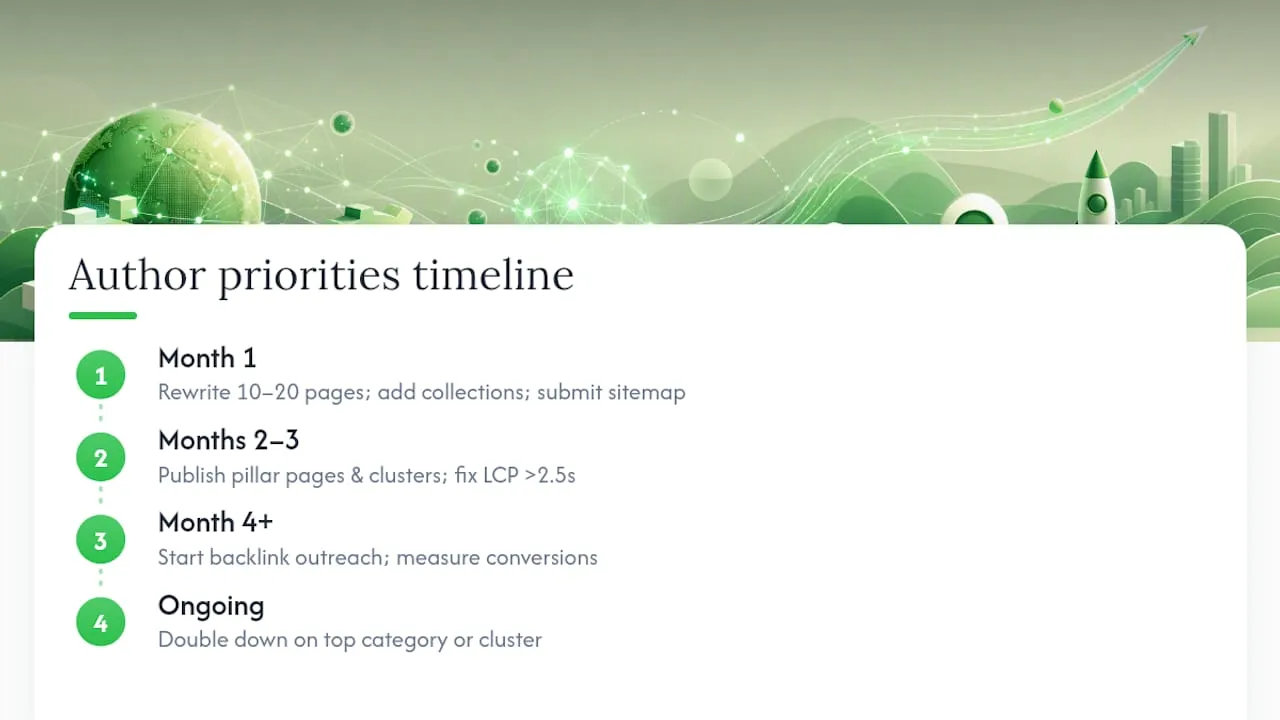
Treat this as the practical sequence, not a rigid schedule. In month one, rewrite your ten to twenty highest-traffic product pages, add category copy across your main collections, and submit an updated sitemap through Search Console. Months two and three are for publishing your first pillar pages with linked clusters, alongside fixing whatever speed issues are dragging your LCP above 2.5 seconds. From month four onward, shift into outreach for backlinks and measure what’s actually converting, then double down on whichever category or cluster is outperforming the rest.
How EcomEye helps you put this into practice
Everything above works, but rewriting hundreds of product pages by hand is where most dropshippers quietly give up around month two. Ecom-eye exists for exactly that gap: import your catalogue from AliExpress, Amazon, Temu, or a competitor’s Shopify store, and generate unique, SEO-ready titles and descriptions for every product in one batch instead of one at a time.
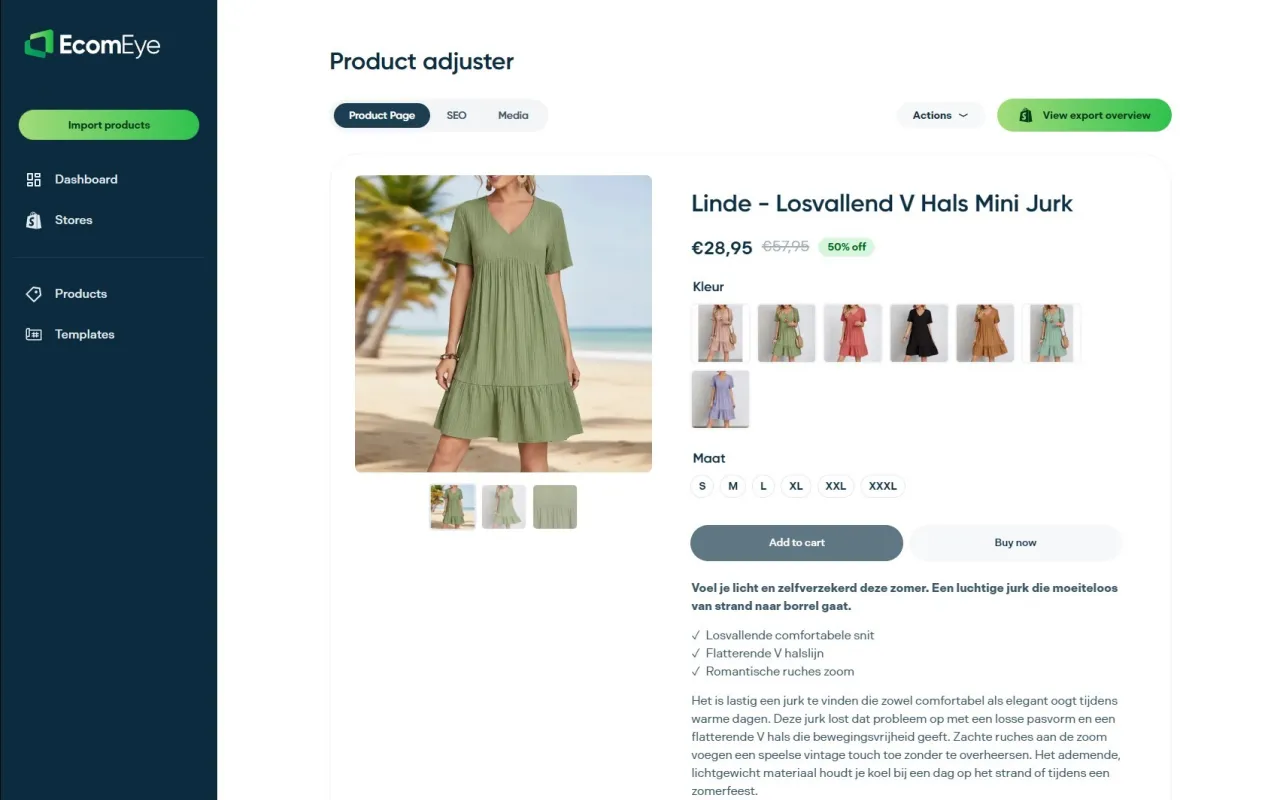
The AI product description generator handles the rewriting work covered in the product page section above, benefit-led copy, keyword-mapped titles, clean metadata, without the copyright risk of lifting supplier text. The AI product image generator solves the identical-photo problem that quietly undermines rankings across an entire category when every competitor is using the same five AliExpress images. Both export straight to Shopify in one click, no manual reformatting required.
If you’re auditing an existing store for copied listings before you start, a tool like Dropship Detector can flag which of your competitor’s pages are running supplier text verbatim, useful context before you decide what to differentiate first. Start with a free trial on Ecom-eye to see how quickly a batch of product pages can go from duplicate supplier copy to something genuinely your own.
Sources
- 15 Dropshipping Tips for a Successful Business (2026) - Shopify
- Improving search engine optimization (SEO) — Shopify Help
- SEO for dropshipping stores: The complete guide | SEOTakeoff
FAQ
Can you do SEO on Shopify?
Yes. Shopify supports sitemaps, metadata editing, image ALT text, and Product schema natively, and Shopify’s own help documentation walks through each of these as standard store maintenance tasks.
Can I make $10,000 a month dropshipping?
It’s possible but far from guaranteed, and SEO alone won’t get you there quickly; sustainable revenue at that level usually combines organic traffic with paid acquisition, strong product margins, and retention, built over many months rather than weeks.
Is dropshipping dead in 2026?
No, but the low-effort version, generic products with copied listings, is increasingly unviable because duplicate-content filtering and rising ad costs punish stores that skip differentiation. Stores that invest in unique product pages and real content continue to compete effectively.
Is $100 enough for dropshipping?
You can technically launch a Shopify store on a tight budget, but limited funds leave little room for paid ads, so SEO becomes your primary growth lever by necessity, not choice, making unique product pages and category copy even more important from day one.
How long does dropshipping SEO take to show results?
Most stores see measurable movement in impressions and rankings within two to three months of rewriting product and category pages, tracked through Search Console, though competitive niches can take longer to show ranking gains.
Ready to boost your product pages?
Generate high-converting, SEO-optimized product pages in bulk using AI automation used by e-commerce experts.
No credit card required