Top Shopify dropship store examples to study in 2026
Discover top Shopify dropship store examples for 2026. Learn key strategies from brands like Gymshark and Pura Vida to boost your success!

Top Shopify dropship store examples to study in 2026

The stores worth studying are Gymshark, Notebook Therapy, Pura Vida Bracelets, Meowingtons, Pillow Slides, BlendJet, Fashion Nova, Haus, SkinnyMe Tea, and Inspire Uplift. Every one of them built trust fast through clean branding and product pages that answer objections before the customer reaches checkout. That single pattern, confirmed across top Shopify dropshipping store analyses, is the thing to copy first.
Here are the top stores to visit right now, and the one thing to take from each:
- Gymshark — study the community-first brand voice and how every product page reinforces identity, not just specs
- Notebook Therapy — copy the niche-down approach and the aesthetic consistency that turns browsers into repeat buyers
- Pura Vida Bracelets — look at the cause-marketing angle and how subscription upsells are woven into the product page
- Meowingtons — note how a single passion niche (cats) scales into a full catalogue with strong social proof
- Pillow Slides — one hero product, one clear value proposition, minimal friction to checkout
- BlendJet — a masterclass in lifestyle photography and benefit-led copy that removes every objection
- Fashion Nova — influencer volume done at scale; study the UGC integration and size-inclusive positioning
- Haus — premium branding on a simple product range; shows what happens when you price for margin, not volume
- SkinnyMe Tea — early influencer marketing and a subscription model that turned a commodity into a brand
- Inspire Uplift — general store done right: fast product testing, strong ad creative, and review-heavy pages
Your immediate next step: pick one product page on your UK Shopify store and rewrite it to match the trust signals you see on these sites — clear shipping timeline, objection-handling copy, and social proof above the fold.
Key takeaways
The single most transferable lesson from every store in this article is that trust, built through clean branding and objection-answering product pages, converts browsers into buyers faster than any product discovery tactic.
| Point | Details |
|---|---|
| Trust signals beat product discovery | Move star ratings above the price and add a five-question FAQ to your top product pages first. |
| State a specific UK delivery window | “2–4 working days” outperforms vague ranges; place it on the product page, cart, and footer. |
| Lock a product page template | Uniform layout across your catalogue builds familiarity and speeds up indexing. |
| Unique pages prevent SEO penalties | Copied descriptions trigger duplicate-content issues; unique copy is the baseline for organic growth. |
| Ecom-eye for bulk page generation | Ecom-eye generates unique, SEO-ready titles, descriptions, and AI images in bulk and exports to Shopify in one click. |
Table of Contents
- Top Shopify dropshipping stores to study right now
- Deeper profiles: what six exemplar stores actually do
- Common patterns and a repeatable dropshipping playbook
- How to build a UK Shopify dropshipping store using these lessons
- Why unique, SEO-ready product pages are what actually scales a store
- An honest view on dropshipping in 2026
- Scale your product pages without the manual work
- Sources
- FAQ
Top Shopify dropshipping stores to study right now
The ten stores below are consistently cited across industry shortlists of exemplar Shopify stores as the most instructive for dropshippers. Each entry tells you what to look for when you visit the live site.
Gymshark sells performance fitness apparel. Visit the site and scroll the product pages: notice how the copy leads with identity (“for those who lift”) before it mentions fabric. The shipping and returns banner sits in the header on every page.
Notebook Therapy targets stationery and East Asian aesthetic fans. The homepage hero image changes seasonally, but the niche never drifts. Look at how the collection pages use consistent flat-lay photography — every image is the same angle, the same background. That visual discipline is what makes the store feel premium despite a modest catalogue.
Pura Vida Bracelets built its brand around a cause: supporting artisans in Costa Rica. On the product page, the story sits directly below the add-to-cart button. Study how they handle the subscription upsell — it is framed as a benefit (“never run out, save 15%”), not a commitment.
Meowingtons is a cat-niche general store. The trust signal to inspect here is the review placement: star ratings appear immediately below the product title, before the price. That ordering matters.
Pillow Slides runs a single-product model. The entire site exists to sell one SKU in multiple colours. Visit the page and count how many times the word “comfort” appears in the first scroll. The answer tells you everything about their SEO and copy strategy.
BlendJet sells a portable blender. The product page opens with a lifestyle video, not a product shot. Scroll to the FAQ section embedded on the page — it handles the top five objections (battery life, cleaning, noise, capacity, warranty) without the customer needing to leave.
Fashion Nova uses influencer volume as its primary channel. The product pages carry hundreds of customer photos submitted via UGC. For UK sellers, the lesson is not the scale — it is the placement: UGC sits between the size guide and the shipping section, exactly where doubt peaks.
Haus sells aperitifs at a premium price point. The product page is sparse by design. There is no discount badge, no urgency timer. The copy earns the price through provenance and flavour notes. Study this if your UK store sells anything in the £30–£80 range.
SkinnyMe Tea grew through early Instagram influencer campaigns before that channel was saturated. The product pages still carry the testimonial-first layout that drove those conversions. The subscription prompt appears on the first scroll, not buried at the bottom.
Inspire Uplift is a general store with thousands of SKUs. The product pages are template-driven, which is the point: consistent layout, consistent trust signals, consistent review placement. Evergreen niches like home organisation, gadgets and pet products dominate their catalogue.
Pro Tip: When you visit any of these stores, open the product page on mobile first. A majority of Shopify traffic is mobile, and the stores above all prioritise the mobile scroll — the add-to-cart button is sticky, the images load fast, and the trust signals appear before the fold.
Beyond these ten, Shopify’s own editorial showcase and design-focused roundups surface additional stores worth bookmarking for visual hierarchy and brand positioning ideas.
Deeper profiles: what six exemplar stores actually do
Gymshark
Niche: fitness apparel. Catalogue: broad niche catalogue (hundreds of SKUs across training, running, and lifestyle). Origin: founded in Birmingham in 2012 by Ben Francis, who started by screen-printing gym wear in his parents’ garage.
The product page formula is consistent: a large lifestyle image, a size guide that opens in a drawer (no page reload), a short benefit paragraph, and a sticky add-to-cart bar. The shipping section states a specific delivery window for UK orders, not a vague “3–7 days.” That specificity reduces pre-purchase anxiety.
Three things to copy:
- Add a sticky add-to-cart bar that follows the user on mobile scroll
- State a specific delivery window (“2–4 working days to UK addresses”) rather than a range
- Lead product copy with identity language before listing features
Notebook Therapy
Niche: stationery and East Asian aesthetic. Catalogue: focused niche catalogue. Marketing: Pinterest, Instagram, and organic search.
The store’s SEO strength comes from consistent product naming. Every title follows the same structure: product type + aesthetic descriptor + variant. That pattern creates natural long-tail keyword coverage without any additional effort. For UK sellers targeting a younger demographic, the lesson is that niche depth beats breadth — improving UX and product experience consistently precedes revenue growth in case studies like this one.
Three things to copy:
- Use a consistent product title formula across your entire catalogue
- Build collection pages around aesthetic themes, not just product categories
- Place a “you might also like” row of four items directly below the add-to-cart button
BlendJet
Niche: portable blending and healthy lifestyle. Catalogue: single hero product with colour and bundle variants. Marketing: Facebook and Instagram video ads, YouTube lifestyle content.
The embedded FAQ on the product page is the standout feature. It covers battery life, cleaning, noise level, capacity, and warranty in five short accordion sections. Each answer is one or two sentences. This structure reduces support tickets and removes the last objections before checkout. For UK sellers, adding a “UK shipping and returns” accordion item to this FAQ section handles the most common pre-purchase question in one place.
Three things to copy:
- Embed a five-question FAQ directly on the product page, above the reviews
- Open with a short autoplay lifestyle video (muted, looped) as the hero media
- Bundle variants (“BlendJet + two bottles”) to increase average order value
Pura Vida Bracelets
Niche: handmade jewellery and accessories. Catalogue: broad niche catalogue. Marketing: cause marketing, email, and subscription model.
The subscription upsell is the commercial engine. It appears on the product page as a toggle (“one-time purchase” vs. “subscribe and save”), not as a separate page. The cause story — supporting artisan jobs — sits in a short paragraph directly below the price. For UK sellers, this model works particularly well for consumables and accessories where repeat purchase is natural.
Three things to copy:
- Add a subscribe-and-save toggle to product pages for any replenishable item
- Place your brand story (why you exist) directly below the price, not in an “About” tab
- Use a cause or community angle to differentiate from generic competitors
Meowingtons
Niche: cat products and accessories. Catalogue: general store within a single passion niche. Marketing: Facebook ads, organic social, email.
The star rating appears immediately below the product title, before the price. That ordering is deliberate: the customer sees social proof before they see the cost, which anchors their perception of value. The product images use lifestyle shots of cats using the products, which drives emotional engagement in a way that white-background images cannot.
Three things to copy:
- Move star ratings above the price on every product page
- Use lifestyle photography that shows the product in use, not just the product alone
- Build collections around occasions (“gifts for cat lovers”) to capture seasonal search traffic
Inspire Uplift
Niche: general store (gadgets, home, lifestyle). Catalogue: thousands of SKUs, template-driven pages. Marketing: Facebook ads, viral video content.
The template consistency is the lesson. Every product page has the same structure: hero image, short benefit headline, bullet-point features, shipping timeline, reviews. That uniformity means a customer who visits two product pages immediately knows where to find the information they need. High-converting templates built around conversion triggers and fast load speeds are exactly what Inspire Uplift uses at scale.
Three things to copy:
- Lock your product page template and apply it to every SKU without exception
- Use bullet points (not paragraphs) for product features — three to five bullets, each starting with a benefit
- Display the shipping timeline as a visual timeline graphic, not a text paragraph
Common patterns and a repeatable dropshipping playbook
Across every store profiled above, six patterns repeat without exception.
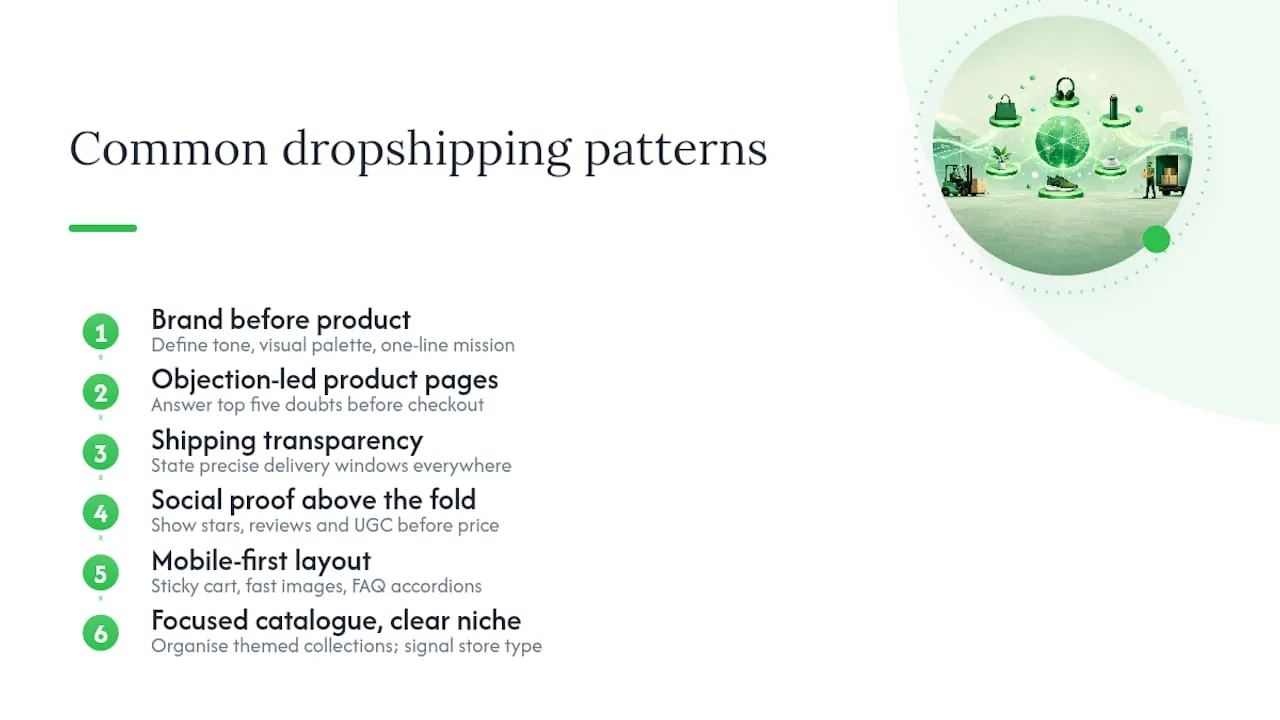
1. Brand before product. The stores that scale are not selling a blender or a bracelet — they are selling a lifestyle, a community, or a cause. The product is the vehicle. Set your brand identity (tone, visual palette, one-line mission) before you list a single product.
2. Product pages that answer objections. Every top store treats the product page as a sales conversation, not a spec sheet. The page anticipates the customer’s top five doubts (does it work, will it arrive, can I return it, is it worth the price, do other people like it) and answers each one before checkout.
3. Shipping transparency as a trust signal. Vague delivery windows (“5–15 business days”) are the single fastest way to lose a UK customer. Every store in this list states a specific delivery window, often in the header, the product page, and the cart page simultaneously.
4. Social proof above the fold. Star ratings, review counts, and UGC images appear early on the page — before the price on the best-performing stores. The sequence matters: proof, then price.
5. Mobile-first layout. Sticky add-to-cart bars, fast-loading images, and accordion sections for FAQs and shipping are standard across every store. If your page requires scrolling past three image carousels before reaching the buy button on mobile, you are losing sales.
6. Focused catalogue or clear niche. Even Inspire Uplift, which carries thousands of SKUs, organises its catalogue into clear themed collections. Customers should always know what kind of store they are in.
Catalogue approach comparison
| Catalogue type | What makes it stand out | Primary marketing channels | Customer-trust tactics |
|---|---|---|---|
| Single-product (e.g. Pillow Slides, BlendJet) | Entire site reinforces one value proposition; no distraction | Paid social video ads, influencer seeding | Embedded FAQ, lifestyle video, bundle variants |
| Focused niche catalogue (e.g. Notebook Therapy, Meowingtons) | Deep product range within one passion niche; strong SEO from consistent naming | Organic social, Pinterest, email | Aesthetic consistency, lifestyle photography, themed collections |
| General store (e.g. Inspire Uplift) | Fast product testing across categories; template-driven pages at scale | Facebook ads, viral video | Uniform page template, review volume, clear shipping timeline |
Your UK dropshipping checklist for today
- Write a specific UK delivery window (“2–4 working days”) on every product page and in the cart
- Move star ratings above the price on your top five products
- Add a five-question FAQ accordion to your best-selling product page
- Replace vague feature paragraphs with three to five benefit-led bullet points
- Check every product page on mobile and confirm the add-to-cart button is visible without scrolling
Pro Tip: Add a dedicated “Shipping & Returns” page and link to it from the product page, the cart, and the footer. UK shoppers check returns policies before buying more often than shoppers in most other markets — a clear, easy-to-find policy reduces abandoned carts and post-purchase disputes.
How to build a UK Shopify dropshipping store using these lessons
Step 1: Choose your niche and validate the product
Pick a niche from the evergreen categories that dominate successful stores: pet products, home organisation, fitness accessories, beauty tools, or lifestyle gadgets. Then validate before you invest. Run a modest-budget Facebook or TikTok ad to a simple landing page and measure click-through rate and add-to-cart rate before ordering inventory or building a full store. A click-through rate above a modest threshold on a cold audience is a reasonable signal of interest.
Tracking Shopify dropshipping trends helps you identify which niches are growing versus saturating before you commit.
Step 2: Select and vet your suppliers
For UK sellers, supplier selection carries additional weight. Import duty applies to goods entering the UK from outside the country, and delivery times from Chinese suppliers can run 10–20 days without a UK-based fulfilment option. Prioritise suppliers who:
- Hold stock in EU or UK warehouses for sub-five-day delivery
- Provide tracking numbers within 48 hours of dispatch
- Have verifiable reviews on third-party platforms (checking supplier reviews on Trustpilot and similar sites before committing is worth the 20 minutes)
- Can supply a product sample within two weeks
Step 3: Build your product page template
Use a conversion-optimised page structure as your starting point. Every product page needs: a benefit-led headline (not just the product name), lifestyle hero image or short video, three to five bullet-point features, a specific UK delivery window, an embedded FAQ (five questions minimum), and star ratings above the price. Lock this template and apply it to every SKU.
Step 4: Write your shipping and returns policy
State your UK delivery window, your returns window (14 days minimum to meet UK consumer rights), and who pays return postage. Put this on a dedicated page and link it from the product page, the cart, and the footer. This single page reduces pre-purchase abandonment more than almost any other change.
Step 5: Launch your first marketing campaign
For month one, run two channels in parallel:
- Paid social: a £30–£50 test budget on Meta or TikTok targeting UK audiences aged 18–35. Use a short video (15–30 seconds) showing the product in use. Measure cost-per-click and add-to-cart rate, not sales, in week one.
- Micro-influencers: identify three to five UK-based creators with 5,000–50,000 followers in your niche. Offer a free product in exchange for an honest post. The reach is modest, but the social proof is permanent.
For month two and three, shift budget towards the ad creative that performed best and begin building SEO metadata on your top ten product pages. Target long-tail keywords (“portable blender for gym UK”) rather than head terms.
A practical Shopify marketing checklist covers the full sequence of launch and post-launch steps in detail.
Week 1 mini-experiment
Post one organic video on TikTok or Instagram Reels showing the product solving a specific problem. Add a tracked link (use a UTM parameter or a short link) in the bio. Measure clicks and profile visits over 72 hours. If you get more than 50 profile visits from a single organic post, the product has enough visual appeal to justify a paid test.
Why unique, SEO-ready product pages are what actually scales a store
Most dropshippers copy product descriptions directly from AliExpress or a competitor’s Shopify store. The result is duplicate content across hundreds of pages, which suppresses organic rankings and triggers Google Merchant Centre disapprovals. The stores that scale past the first few months are the ones that publish unique, keyword-optimised pages from the start.
Ecom-eye’s internal testing of optimised Shopify page layouts shows a c.40% improvement in SEO performance when page layouts are properly structured for dropshipping stores. That is not a marginal gain — at scale, it is the difference between ranking on page one for a long-tail product term and sitting on page four where no one clicks.
The evidence from successful stores reinforces this. Case studies of top dropshippers consistently show that investing in store UX and content quality precedes revenue growth — not the other way around.
| Factor | Impact on SEO and conversions |
|---|---|
| Unique product titles and descriptions | Avoids duplicate-content penalties; improves long-tail keyword ranking |
| Optimised page layout (benefit headline, FAQ, reviews) | Supports dwell time and reduces bounce rate |
| AI-generated product images (copyright-safe) | Eliminates image-duplication issues; improves visual differentiation |
| Multi-language pages | Expands organic reach to non-English UK audiences and export markets |
| Bulk template consistency | Uniform trust signals across catalogue; faster indexing |
Scaling listings without duplicate-content risk
The practical approach is a template-plus-variable model: a fixed page structure (layout, section order, trust signals) with unique copy in every variable field (title, description, FAQ answers, image alt text). Use canonical tags when you create colour or size variants to consolidate ranking signals. For multi-language stores, use hreflang tags to prevent self-competition between language versions.
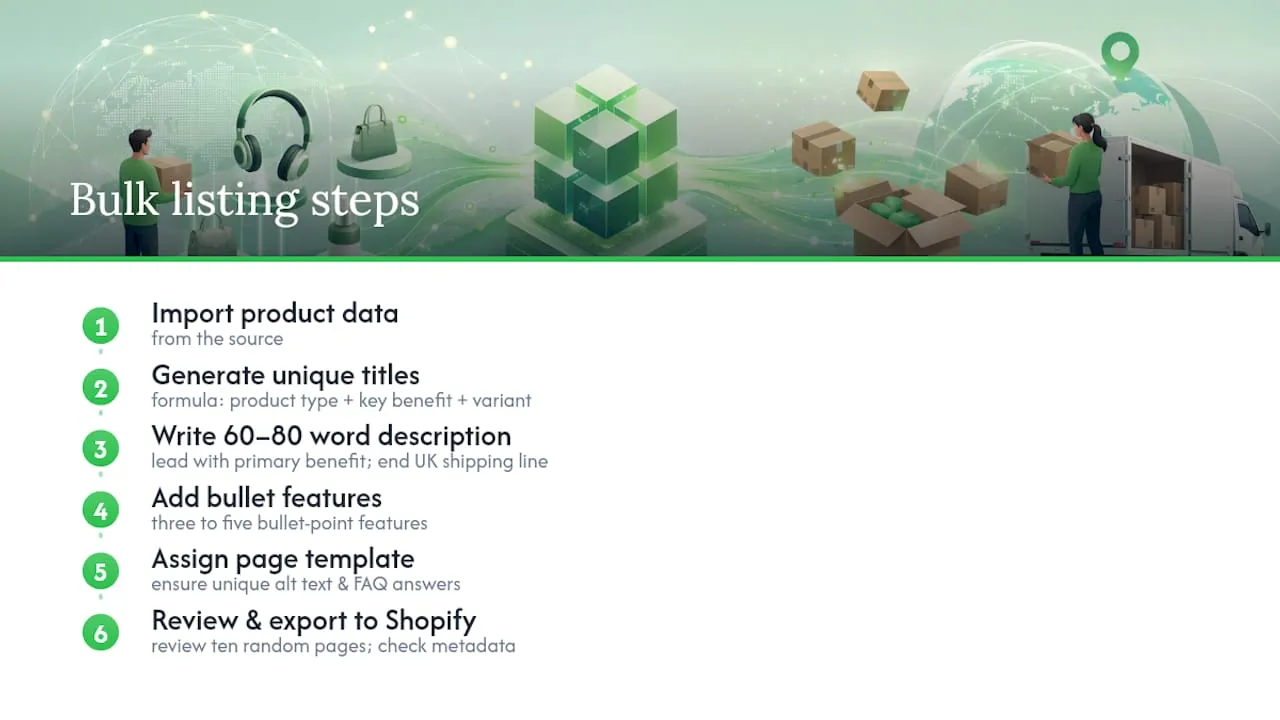
Bulk listing optimisation at scale requires a repeatable process: import product data, generate unique titles and descriptions, assign the correct template, add UK-specific shipping copy, and export. Doing this manually for 50 products takes days. Doing it with a bulk generation tool takes minutes.
A one-paragraph checklist for bulk content creation that keeps quality intact:
Import your product data from the source. Generate a unique title for each SKU using a consistent formula (product type + key benefit + variant). Write a 60–80 word description that leads with the primary benefit and ends with a UK-specific shipping line. Add three to five bullet-point features. Assign the page template. Review ten random pages manually before bulk-exporting to Shopify. Check ecommerce SEO best practices to confirm metadata is complete before publishing.
An honest view on dropshipping in 2026
The opportunity for UK dropshippers is real, but it is narrower than the “passive income” narrative suggests. The stores worth studying in this article did not succeed by finding a secret product — they succeeded by building a brand that customers trusted enough to buy from without a recommendation from a friend. That takes deliberate work on product pages, shipping transparency, and visual consistency. The good news is that the playbook is visible: every tactic used by Gymshark, BlendJet, or Inspire Uplift is inspectable on their live sites right now.
The realistic ceiling for a new UK dropshipper in year one is a profitable niche store with a handful of proven SKUs, not a seven-figure general store. The stores that reach scale do so by systematising what works — locking a product page template, automating content generation, and reinvesting margin into paid traffic rather than chasing the next trending product.
Pro Tip: The fastest way to scale without sacrificing page quality is to automate the content layer — unique titles, descriptions, and images — so you can publish 50 products in the time it currently takes to publish five.
Scale your product pages without the manual work
Copying the product page tactics from Gymshark or BlendJet is straightforward for one or two SKUs. Doing it across 50, 100, or 500 products is where most UK dropshippers stall — rewriting descriptions manually, sourcing copyright-safe images one by one, and still ending up with pages that look like every other store in the niche.
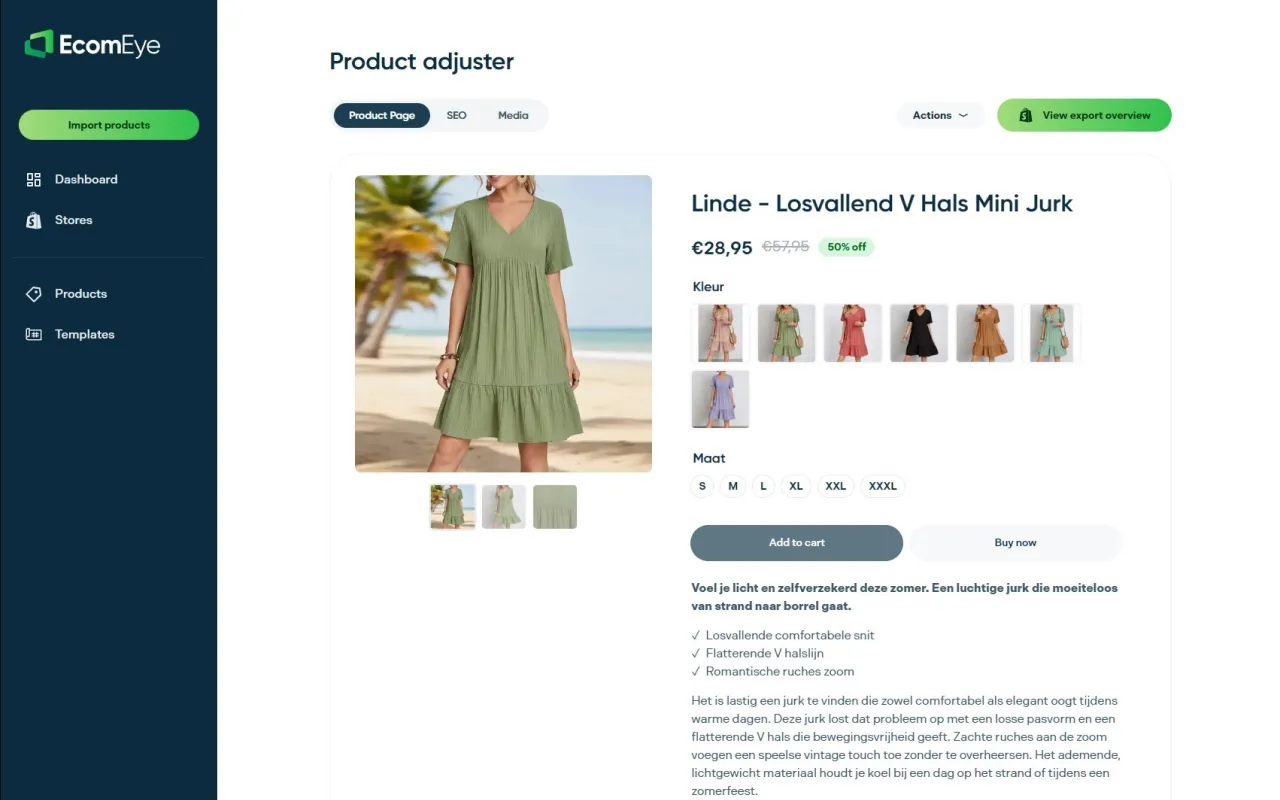
Ecom-eye solves that specific problem. Import products in bulk from AliExpress, Amazon, Temu, or a competitor Shopify link, and the platform automatically generates:
- Unique, SEO-optimised titles and descriptions — no duplicate content, no Google Merchant disapprovals
- High-quality AI product images — copyright-safe and visually differentiated from supplier stock photos
- Multi-language pages — reach non-English UK audiences and export markets without extra work
- One-click Shopify export — the entire catalogue goes live in minutes, not days
New users can start with a free trial and pay-as-you-go credits, so there is no long-term commitment before you see results. Try Ecom-eye and publish your first batch of unique product pages today.
Sources
- Shopify dropshipping stores that are crushing it in 2026
- Top Shopify dropshipping stores that dominate e‑commerce in 2026
- 15 Successful Shopify dropshipping stores in 2026
- 50 best Shopify stores to inspire your own (Shopify blog)
- 35 dropshipping store examples with seriously good branding
FAQ
What is the best type of product to dropship on Shopify?
Pet accessories, home organisation tools, fitness gadgets, and lifestyle accessories consistently perform well. The key criterion is a product with a clear visual benefit that photographs well for social ads and carries enough margin (typically 40–60%) to fund paid traffic.
Are Shopify dropshipping stores profitable?
Yes, but margins depend heavily on niche, supplier terms, and advertising costs. Stores that invest in unique product pages and brand consistency tend to achieve better organic traffic and lower customer acquisition costs over time, which is where sustainable profit comes from.
Why do so many dropshippers fail?
The most common reason is copying product descriptions and images directly from suppliers, which creates duplicate content, suppresses SEO rankings, and triggers Google Merchant Centre disapprovals. The second most common reason is vague shipping information that erodes trust before checkout.
Can you realistically make £10,000 a month dropshipping on Shopify?
It is achievable, but not typical in the first year. The stores that reach that level have usually locked a repeatable product page template, built a recognisable brand, and systematised content generation so they can scale listings without proportionally scaling effort.
How do I apply these store examples to my own UK Shopify store?
Start with one product page: add a specific UK delivery window, move star ratings above the price, and embed a five-question FAQ. Then lock that layout as your template and apply it across your catalogue. Use a bulk content generation tool like Ecom-eye to scale unique pages without manual rewriting.
Ready to boost your product pages?
Generate high-converting, SEO-optimized product pages in bulk using AI automation used by e-commerce experts.
No credit card required