What is an AI-generated listing? A guide for sellers
Discover what an AI-generated listing is and how it boosts e-commerce sales by creating optimized product content quickly and efficiently.

What is an AI-generated listing? A guide for sellers

TL;DR:
- AI-generated listings automatically create product titles and descriptions from structured data, improving SEO and efficiency. Implementing human review and standardized inputs helps mitigate risks like hallucinations and compliance issues. The key advantage is faster, cost-effective catalog growth with consistent and optimized product content.
An AI-generated listing is product content created automatically by artificial intelligence to produce titles, descriptions, and attributes that improve online sales performance. The industry term for this practice is automated listing generation, and it sits at the centre of how modern e-commerce sellers manage large product catalogues. At least 37% of Canadian real estate listings are likely written by AI, which shows how quickly this technology has moved from experiment to standard practice. For e-commerce entrepreneurs, the implications are direct: AI can produce hundreds of product pages in the time it takes a copywriter to finish one. Ecom-eye is built precisely for this use case, generating copyright-safe, SEO-optimised Shopify pages in bulk without manual rewriting.
What is an AI-generated listing and how does it work?
An AI-generated listing is the output of a language model trained to convert raw product data into structured, publishable content. The model receives inputs such as product images, bullet-point attributes, dimensions, materials, and category tags, then produces a complete listing including a title, description, and metadata. The quality of that output depends entirely on what goes in.

Input types that drive listing quality
The most common inputs are:
- Product attributes: dimensions, weight, colour, material, and compatibility
- Image data: AI vision models extract features directly from product photos
- Competitor or supplier text: used as a reference, not copied verbatim
- Category and keyword targets: tell the model which search terms to prioritise
- Brand voice guidelines: short style notes that keep tone consistent across a catalogue
Language models powering this process include large-scale systems such as GPT-4-Turbo and specialised e-commerce LLMs fine-tuned on product data. These models do not simply rephrase source text. They restructure information into a format that both shoppers and search algorithms can read efficiently.
Listing Engineering: the structured framework behind AI listings
Listing Engineering is a disciplined process that turns product facts into structured, AI-readable content optimised for discovery algorithms. Amazon’s COSMO algorithm, for example, evaluates listings as structured content rather than keyword matches. That shift makes traditional keyword stuffing counterproductive. A framework such as the five-stage HELIX model (Ingest, Validate, Analyse, Structure, Engineer) operationalises Listing Engineering by treating each product as a data object before it becomes a listing. This is a significant departure from traditional copywriting, where a writer starts with a blank page and a product brief.
Pro Tip: Before feeding product data into any AI tool, standardise your attribute fields. A consistent schema, such as always capturing colour, material, and compatibility in the same format, produces far more accurate and distinctive listings than freeform notes.
What are the benefits of AI-generated listings for e-commerce?
AI-generated listings deliver measurable gains across four areas: speed, cost, SEO performance, and catalogue consistency. Each benefit compounds when you operate at scale.
Speed and cost reduction
Manual copywriting for a catalogue of 500 products can take weeks and cost thousands of pounds in freelance fees. AI collapses that timeline to hours. AI-generated product descriptions achieve up to 89% higher click-through rates and reduce costs by approximately 68% compared to manual listing creation. That cost reduction does not mean lower quality. It means the AI handles the repetitive structural work while human effort concentrates on strategy and review.
SEO and search visibility
AI tools write to a keyword brief by default. Every title and description can include target search terms at the correct density without the writer having to count manually. This matters because automating product descriptions directly improves SEO rankings by producing consistent, keyword-rich content at a volume no human team can match. Google rewards fresh, unique content. AI-generated listings, when built from original inputs, avoid the duplicate content penalties that plague sellers who copy supplier pages.
Consistency across large catalogues
Brand voice drifts when multiple writers work on the same catalogue. AI eliminates that drift. Every listing follows the same structural template and tone, which builds trust with shoppers who browse multiple products. Small sellers compete with larger operations by matching output quality and consistency, freeing resources for pricing decisions and customer service rather than copywriting.
Click-through and conversion gains
Higher click-through rates come from titles that match search intent precisely. AI models trained on conversion data learn which title structures perform best for a given category. The 89% CTR improvement cited above is not a ceiling. Sellers who combine AI-generated titles with A/B testing and conversion data can iterate faster than any manual process allows.
What are common challenges when using AI-generated listings?
AI-generated content carries real risks. Understanding them before you publish protects your store from compliance problems, customer complaints, and platform penalties.
The hallucination problem
AI can hallucinate inaccurate product features in listings, inventing specifications that do not exist. A listing that claims a phone case is waterproof when it is not creates returns, negative reviews, and potential trading standards issues. This is not a rare edge case. It happens whenever the model lacks sufficient input data and fills gaps with plausible-sounding but fabricated details.
Compliance and regulatory risk
AI tools must exclude lifestyle or demographic assumptions from listings to avoid compliance issues. Listings should describe only verifiable features such as dimensions, materials, and location facts, not assumptions about who will buy the product. In regulated categories such as health, electronics, or children’s products, an inaccurate AI claim can breach advertising standards.
How to mitigate these risks: a practical checklist
- Sanitise your inputs. Remove any personally identifiable information (PII) from product data before it enters the AI system.
- Use structured fields, not freeform notes. Standardised inputs produce distinct, accurate content; unstructured notes produce generic listings.
- Run a compliance filter. Check AI outputs for claims that cannot be verified against your product data.
- Apply a human review step. A final read-through catches hallucinations, tone errors, and regulatory language before publishing.
- Version-control your prompts. When a listing performs poorly, you need to know which prompt produced it so you can fix the root cause.
Pro Tip: Never paste AI output directly into a live product page. Build a staging review step into your workflow. Even a 60-second check catches the errors that damage your store’s credibility.
How can e-commerce entrepreneurs implement AI-generated listings?
Implementation follows a clear workflow. The steps below apply whether you manage 50 products or 50,000.
The standard AI listing workflow
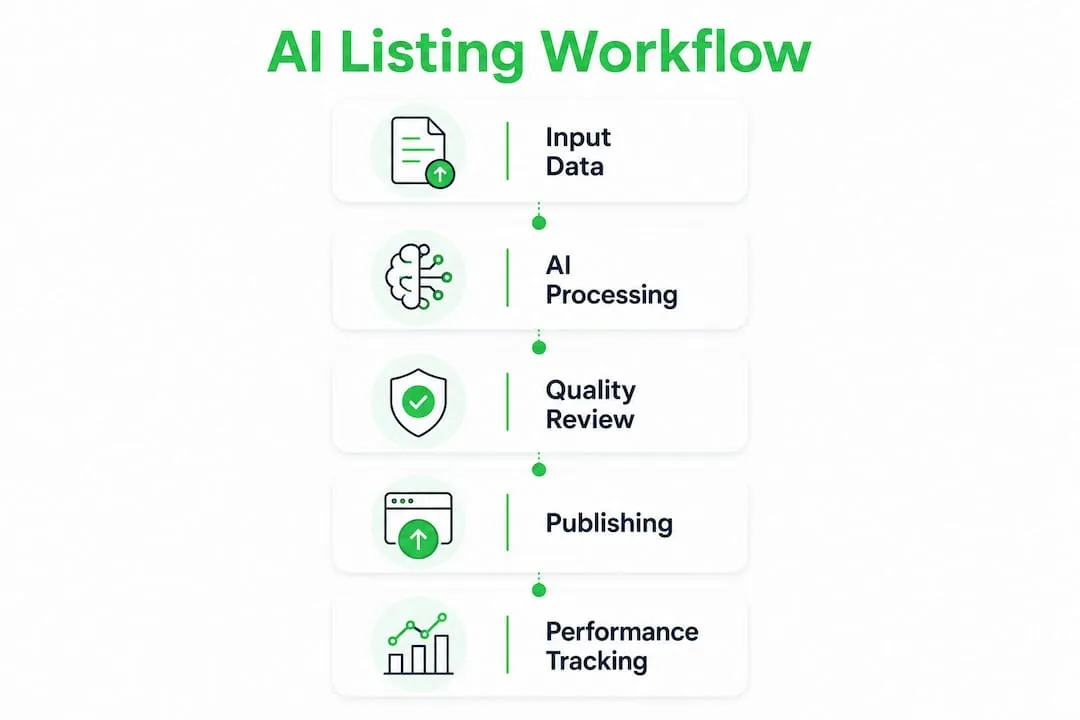
Automated AI workflows integrate data ingestion, prompt crafting, model inference, compliance filtering, and human review for optimal listing generation. In practice, that means:
- Step 1: Data collection. Gather product attributes, images, and keyword targets in a standardised spreadsheet or database.
- Step 2: Prompt engineering. Write a prompt template that tells the AI your brand voice, required fields, and keyword priorities.
- Step 3: Bulk generation. Run the AI model across your full product catalogue in one batch.
- Step 4: Compliance filtering. Automatically flag listings that contain unverifiable claims or prohibited language.
- Step 5: Human review. A team member approves, edits, or rejects each flagged listing before it goes live.
- Step 6: Publish and measure. Export listings to your platform and track click-through rate, conversion rate, and return rate by listing.
Measuring performance
The metrics that matter most are click-through rate from search results, conversion rate on the product page, and return rate linked to inaccurate descriptions. If returns spike after a bulk AI generation run, the hallucination filter needs tightening. If click-through rates drop, the keyword brief needs updating. Treat AI listing performance as a feedback loop, not a one-time task.
Ecom-eye handles this entire process for Shopify dropshippers. You import products from AliExpress or competitor links, and Ecom-eye generates optimised titles, clean descriptions, and SEO-ready content in bulk, then exports directly to Shopify in one click. The advanced product listing capabilities built into the platform mean you never start from a blank page or risk duplicate content penalties.
Key takeaways
AI-generated listings are the most efficient way for e-commerce entrepreneurs to build large, SEO-optimised catalogues without duplicate content risk or manual copywriting costs.
| Point | Details |
|---|---|
| AI listing definition | An AI-generated listing is product content produced automatically by a language model from structured input data. |
| Listing Engineering matters | Structured inputs using frameworks like HELIX produce more accurate, high-converting listings than freeform notes. |
| Measurable gains | AI-generated descriptions achieve up to 89% higher click-through rates and cut costs by approximately 68% versus manual methods. |
| Human review is non-negotiable | AI hallucinations and compliance risks require a human approval step before any listing goes live. |
| Measure and iterate | Track click-through rate, conversion rate, and return rate after each bulk generation run to improve prompt quality over time. |
The shift I think most sellers are still missing
The conversation about AI listings tends to focus on speed. That framing misses the more important change happening underneath. The real shift is from keyword stuffing to structured product knowledge. Search algorithms, whether on Google, Amazon, or any major marketplace, are increasingly evaluating listings as data objects rather than text documents. That means the seller who wins is not the one who generates the most content fastest. It is the one whose product data is the cleanest and most complete before the AI ever touches it.
I have seen sellers run bulk AI generation on messy supplier data and wonder why their listings feel generic. The AI is not the problem. Garbage in, garbage out is as true here as anywhere in data work. The sellers who get the best results treat their product attribute database as a competitive asset, not an afterthought.
The compliance dimension also deserves more attention than it gets. Advertising standards bodies are watching AI-generated content closely. A listing that makes an unverifiable health claim or implies a product is suitable for a use it has not been tested for creates real legal exposure. Human review is not optional overhead. It is the control that keeps your store on the right side of trading standards.
My expectation for the next two years is that AI listing tools will become table stakes for any seller above a few hundred SKUs. The differentiation will shift to who has the best input data, the tightest compliance workflow, and the fastest iteration cycle on underperforming listings. That is where the competitive edge will live.
— Koen
Ecom-eye: bulk AI listing generation for Shopify sellers
Sellers who understand what AI-generated listings can do still face one practical problem: building the workflow from scratch takes time and technical skill most store owners do not have.
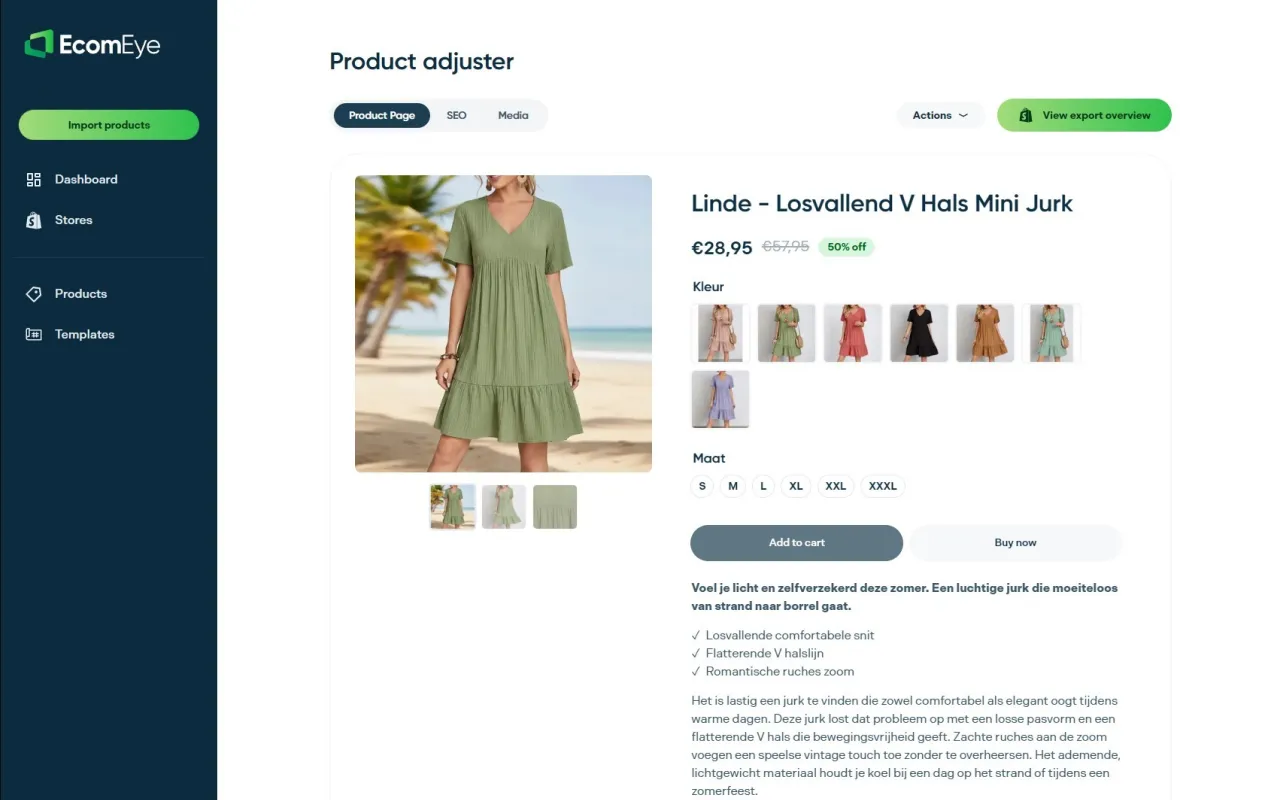
Ecom-eye solves that directly. Import products in bulk from AliExpress or competitor links, and the platform automatically generates SEO-optimised titles, clean descriptions, high-quality AI product images, and multi-language pages. There is no rewriting, no copyright risk, and no manual work. Everything exports to Shopify in one click. For dropshippers who want to scale with AI listings without building a custom workflow, Ecom-eye is the fastest path from product data to live, optimised store pages.
FAQ
What is an AI-generated listing?
An AI-generated listing is product content, including titles, descriptions, and attributes, produced automatically by a language model from structured product data. The goal is to improve search visibility and conversion rates without manual copywriting.
How does AI create product listings?
AI models ingest structured inputs such as product attributes, images, and keyword targets, then generate complete listing content using natural language generation. Frameworks like Listing Engineering structure those inputs for accuracy and AI-readability.
What are the main benefits of AI-generated listings?
AI-generated listings deliver up to 89% higher click-through rates and reduce listing costs by approximately 68% compared to manual methods, while maintaining consistent brand voice across large catalogues.
Can AI listings cause compliance problems?
AI can hallucinate inaccurate product features, and listings that make unverifiable claims risk breaching advertising standards. A human review step and a compliance filter before publishing are the standard safeguards.
How do I measure whether my AI listings are working?
Track click-through rate from search results, conversion rate on the product page, and return rate linked to description accuracy. Rising returns after a bulk generation run signal a hallucination or accuracy problem that requires prompt refinement.
Ready to boost your product pages?
Generate high-converting, SEO-optimized product pages in bulk using AI automation used by e-commerce experts.
No credit card required