What is Shopify dropshipping: boost SEO & avoid penalties
Learn what Shopify dropshipping involves, why copying content fails, and how to create copyright-safe, SEO-optimised product pages that avoid Google penalties and boost rankings.

Many Shopify dropshippers believe copying competitor product pages is a fast route to success. This shortcut triggers copyright claims and Google Merchant suspensions. Understanding dropshipping compliance and SEO best practices protects your store from penalties whilst improving rankings. This guide provides actionable strategies to create original, compliant product content that scales your business safely.
Table of Contents
- Understanding Shopify Dropshipping
- Copyright Risks And Legal Responsibilities In Dropshipping
- Google Merchant Centre Compliance Challenges For Dropshippers
- SEO Best Practices For Shopify Dropshipping Product Pages
- Practical Solutions: Automating Copyright-Safe, SEO-Optimised Content Creation
- Common Misconceptions About Shopify Dropshipping Content And SEO
- Conclusion And Next Steps For Aspiring And Established Dropshippers
- Take The Next Step With EcomEye’s Bulk AI Product Lister
- Frequently Asked Questions
Key takeaways
| Point | Details |
|---|---|
| Dropshipping responsibility | You sell without stock but remain legally liable for all product content and compliance. |
| Copyright infringement danger | Copying pages risks DMCA takedowns and legal penalties despite supplier disclaimers. |
| Google Merchant compliance | Unique, accurate descriptions prevent misrepresentation suspensions and maintain ad eligibility. |
| Modern SEO requirements | Core Web Vitals targets and AI-generated content quality determine rankings. |
| Automation advantage | Bulk AI tools create copyright-safe, multilingual pages whilst reducing manual workload. |
Understanding Shopify dropshipping
Shopify dropshipping is a fulfilment model where you sell products shipped directly from suppliers to customers. You never touch inventory. Your role centres on managing your online store and presenting products effectively. This low-barrier entry attracts thousands of entrepreneurs yearly.
You control product titles, descriptions, images, and overall presentation. Legally, you own responsibility for every piece of content displayed. Suppliers provide products, not legal protection for their marketing materials.
Popular motivations for entering dropshipping include:
- Minimal startup capital compared to traditional retail
- Ability to test products without inventory risk
- Flexible location independence for store management
- Scalability without warehouse or logistics constraints
Common misconceptions endanger many dropshippers. The most damaging belief is that copied content carries no consequences because you did not create the products. Courts and platforms disagree. Another myth suggests supplier disclaimers shield you from liability. They do not. You face full accountability for infringement claims.
Copyright risks and legal responsibilities in dropshipping
Copying competitor or supplier product pages seems efficient but creates severe legal exposure. Copyright law protects original written content and images. Using them without permission constitutes infringement regardless of your business model.

Shopify enforces the Digital Millennium Copyright Act strictly. When rights holders file complaints, Shopify typically removes infringing content within 10-14 business days. Repeat violations risk account suspension. You bear costs for legal defence and potential damages.
Dropshippers remain legally liable despite supplier IP disclaimers. Courts hold store owners accountable for content they publish. Supplier terms rarely provide meaningful protection in litigation.
Common infringement sources include:
- Product photographs lifted from competitor stores
- Descriptions copied verbatim from manufacturer websites
- Trademarked brand names used without authorisation
- Marketing imagery from social media or promotional materials
Pro Tip: Always verify image licencing agreements before uploading. Use royalty-free stock photos or AI-generated images to eliminate infringement risk entirely. Check our copyright risk tips for detailed prevention strategies.
Prevention requires obtaining explicit licences or creating original content. Generic supplier photos often come with unclear usage rights. Investing in unique imagery protects your business long-term.
Google Merchant centre compliance challenges for dropshippers
Google Merchant Centre demands accurate, unique product data. Duplicated descriptions trigger algorithmic flags. Misrepresentation errors often stem from copy-pasted descriptions and incorrect inventory data causing suspensions.
Suspensions halt Shopping ads and reduce organic visibility. Google’s trust metrics penalise stores with misleading information. Recovery requires comprehensive account reviews and content rewrites, costing weeks of lost revenue.
Merchant Centre policies require:
- Original product descriptions reflecting actual offerings
- Accurate pricing, availability, and shipping details
- Transparent return policies and contact information
- Consistent data across your website and feed submissions
Dropshipping stores struggle particularly without automation. Manually creating unique content for hundreds of products becomes unsustainable. Inconsistencies emerge, triggering compliance issues.
Pro Tip: Schedule monthly audits of your product feed against Google’s requirements. Address discrepancies immediately to maintain account health and ad performance.
Maintaining fresh, truthful content builds platform trust. Google rewards stores demonstrating reliability with better ad placements and lower costs per click. Explore AI product page creation methods to scale compliant content efficiently.
SEO best practices for Shopify dropshipping product pages
Modern Shopify SEO centres on user experience metrics and content quality. Core Web Vitals targets include LCP under 2.5 seconds, FID below 100ms, and CLS under 0.1. These technical benchmarks directly influence rankings.

Original product content outperforms duplicated material consistently. Google’s algorithms detect copied text and demote pages accordingly. Proper heading structure and user-focused content reduce disapproval risks whilst improving click-through rates.
Implement these proven tactics:
- Generate unique titles incorporating target keywords naturally within 60 characters
- Write descriptions addressing customer questions and pain points in 150-300 words
- Structure content with H2 and H3 tags for readability and crawlability
- Add schema markup for products to enable rich snippets in search results
- Optimise images with descriptive alt text and compressed file sizes
- Create multilingual versions for international markets and broader reach
Google evaluates AI-generated content quality rigorously. Helpful, original content ranks best. Generic or formulaic AI output receives no preferential treatment. Refine AI outputs to match user intent and natural language patterns.
Avoid these damaging practices:
- Duplicating descriptions across similar products
- Keyword stuffing or unnatural phrasing
- Thin content under 100 words per page
- Missing or poorly optimised meta descriptions
Pro Tip: Use long-tail keywords specific to your niche. “Waterproof hiking boots women size 8” converts better than generic “hiking boots” whilst facing less competition.
Multilingual SEO expands your addressable market significantly. Translated product pages rank in regional search results, capturing traffic competitors miss. Learn more about Shopify page automation SEO strategies that scale internationally.
Practical solutions: automating copyright-safe, SEO-optimised content creation
AI-driven automation transforms dropshipping content creation. Modern tools generate unique titles, descriptions, and images in minutes rather than hours. Automated bulk content generation reduces manual work whilst ensuring copyright-safe, SEO-optimised product pages.
Bulk import workflows enable rapid scaling. Import products from AliExpress or competitor links, then automatically generate compliant content. Consistency remains high across hundreds of listings, maintaining SEO and legal standards.
Multilanguage support dramatically expands market reach. Generate product pages in Spanish, French, German, or dozens of other languages simultaneously. International search rankings improve as you target regional keywords native speakers actually use.
Verify supplier image rights before importing. Many suppliers grant usage permissions, but confirmation protects you legally. Alternatively, use royalty-free stock images or AI-generated product visuals to eliminate infringement risk entirely.
| Approach | Speed | Copyright Safety | SEO Quality | Scalability |
|---|---|---|---|---|
| Manual copying | Fast initially | High risk | Poor (duplicate) | Limited |
| Manual original writing | Very slow | Safe | Excellent | Very limited |
| AI automation | Very fast | Safe (original) | Excellent | Unlimited |
Pro Tip: Test AI-generated content with small batches first. Refine prompts and templates based on conversion data before scaling to your entire catalogue.
The EcomEye bulk AI lister exemplifies modern automation capabilities. Import, generate, and export directly to Shopify in one click. No rewriting. No copyright risk. No manual work per product.
Common misconceptions about Shopify dropshipping content and SEO
Many dropshippers hold beliefs that actively harm their stores. Correcting these misconceptions prevents costly mistakes.
-
Copying is safe if you change a few words: Minor edits do not constitute original content. Plagiarism detection tools and copyright holders identify derivative works easily. Create genuinely unique content or face consequences.
-
Supplier disclaimers protect me legally: You publish the content on your store, making you the liable party. Courts hold store owners accountable regardless of supplier terms. Assume full responsibility for every page element.
-
AI content ranks automatically: Google evaluates quality, helpfulness, and originality. Generic AI output without human refinement performs poorly. Edit and enhance AI drafts to meet user needs and search intent.
-
Google Merchant suspensions are temporary: Suspensions damage your account permanently. Even after reinstatement, trust metrics remain lower. Prevention through compliant practices far exceeds remediation efforts.
-
SEO optimisation is optional for dropshipping: Organic traffic reduces customer acquisition costs dramatically. Ignoring SEO forces complete dependence on paid ads, crushing profit margins as competition increases.
Pro Tip: Document your content creation process. Maintain records proving originality if disputes arise. Timestamps and drafts demonstrate good faith efforts to comply.
Correct approaches involve generating verifiably original content, monitoring compliance continuously, and refining based on performance data. Success requires treating content quality as a competitive advantage, not an afterthought.
Conclusion and next steps for aspiring and established dropshippers
Shopify dropshipping success demands copyright compliance and SEO excellence. Copying content invites legal action and platform penalties. Original, user-centred product pages drive rankings and conversions simultaneously.
Key actions to implement immediately:
- Audit existing product pages for duplicated or infringing content
- Replace copied material with original, AI-generated alternatives
- Verify image licencing or switch to royalty-free sources
- Implement structured data markup for rich search results
- Monitor Google Merchant Centre health weekly
Leverage AI and bulk import tools to scale efficiently. Manual content creation cannot keep pace with competitive markets. Automation maintains quality whilst reducing time investment per product from hours to seconds.
Regularly review store content against evolving platform policies. Google and Shopify update requirements frequently. Proactive compliance prevents suspensions and maintains revenue continuity. These foundational practices strengthen rankings, build customer trust, and support sustainable long-term growth.
Take the next step with EcomEye’s bulk AI product lister
Ready to eliminate copyright risk whilst scaling your product catalogue? EcomEye automates generation of original, SEO-optimised product pages in bulk. Import from AliExpress or competitor links, then export directly to Shopify in one click.
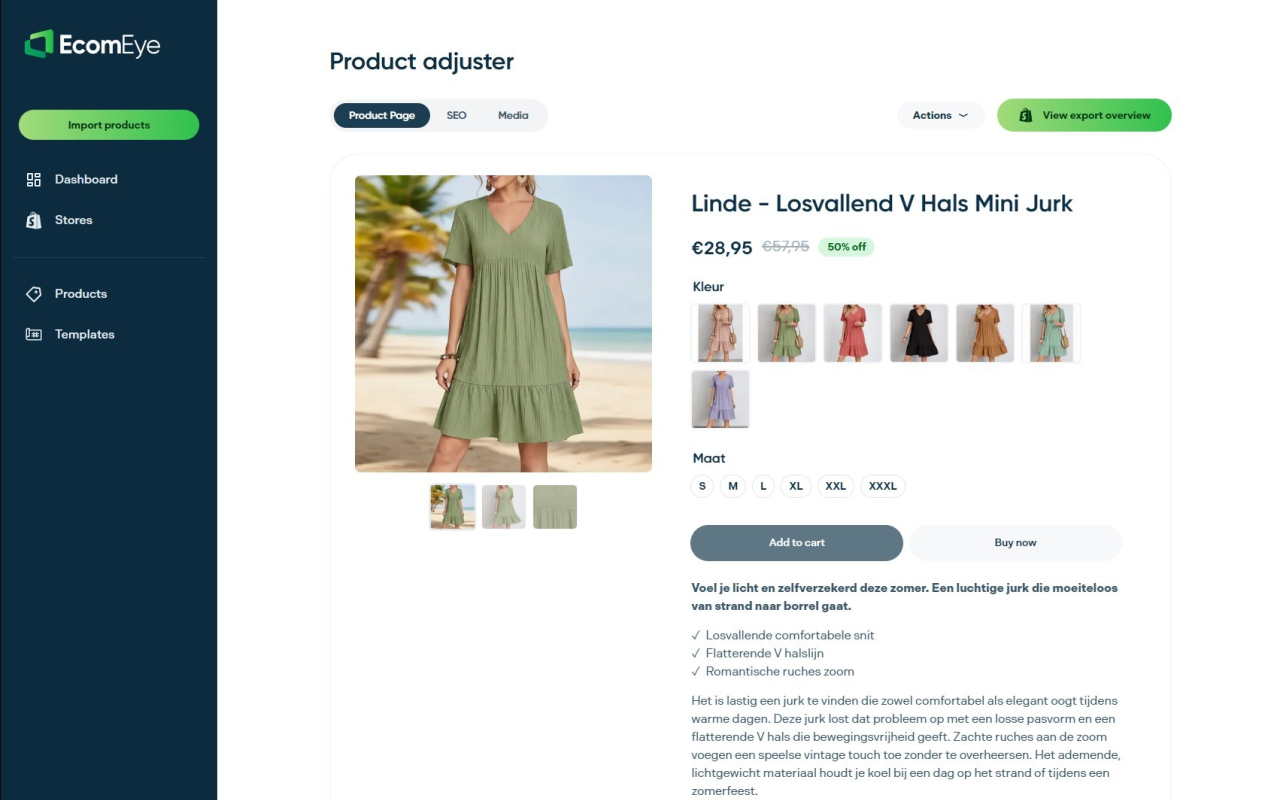
Multilanguage support expands your reach across global markets effortlessly. Generate pages in dozens of languages simultaneously, targeting regional search traffic competitors miss. Reduce manual workload from hours per product to seconds whilst preventing Google Merchant disapprovals.
Flexible pricing plans suit dropshippers at every scale. Start small and grow as your store expands. The EcomEye AI product lister transforms content creation from bottleneck to competitive advantage. Get started today and enhance your Shopify dropshipping store performance immediately.
Frequently asked questions
What is Shopify dropshipping?
Shopify dropshipping is a retail model where you sell products without holding inventory. Suppliers ship directly to customers when orders arrive. You manage the online store, marketing, and customer service whilst suppliers handle fulfilment and logistics.
Why does original content matter for dropshipping stores?
Original content prevents copyright infringement claims and Google Merchant suspensions. Unique descriptions improve SEO rankings by avoiding duplicate content penalties. Search engines reward helpful, original material with higher visibility, reducing your customer acquisition costs significantly.
How can I avoid Google Merchant Centre suspensions?
Maintain accurate, unique product data across all listings. Ensure descriptions reflect actual offerings without exaggeration. Provide transparent pricing, shipping, and return policies. Audit your product feed monthly against Google’s requirements and correct discrepancies immediately to maintain account health.
What role do AI tools play in dropshipping content creation?
AI tools generate unique, SEO-optimised product titles and descriptions at scale. They reduce manual writing time from hours to seconds per product. Quality AI solutions create copyright-safe content whilst maintaining consistency across hundreds of listings, enabling rapid store growth without legal risk.
Can I use supplier product images safely?
Verify usage rights explicitly before publishing supplier images. Many suppliers grant permissions, but assumptions create infringement risk. Consider royalty-free stock photos or AI-generated images as safer alternatives. Document all licencing agreements to defend against potential copyright claims.
Ready to boost your product pages?
Generate high-converting, SEO-optimized product pages in bulk using AI automation used by e-commerce experts.
No credit card required