Generative engine optimization: the practical playbook for 2026
Discover how generative engine optimization can boost your content's visibility in AI responses by 30-40%. Get the practical playbook for 2026.

Generative engine optimization: the practical playbook for 2026

Generative engine optimization (GEO) means shaping content so that ChatGPT, Perplexity, and Google’s AI Overviews will actually quote it, cite it, or recommend it. The single highest-leverage move is making content extractable and machine-readable: front-loaded facts, clean schema, and passages that answer a question in one self-contained chunk. A Princeton and KDD study found this kind of change lifts visibility in AI answers by roughly 30 to 40 percent, and platforms like EcomEye are already building this logic into product-page generation.
TL;DR:
- Adding sourced citations and statistics to product and content pages significantly increases the likelihood of being quoted in AI answers by roughly 30 to 40 percent.
- Structuring content with answer-shaped, extractable paragraphs and clear schema markup helps AI systems easily identify and cite relevant information.
- Consistent, structured product data and off-site corroboration are vital for earning trust and citations from AI models across multiple sources.
- Automation tools like EcomEye can generate unique, schema-ready product pages in bulk, addressing scale challenges without sacrificing GEO fundamentals.
- Regularly testing prompts and tracking inclusion and citation rates are essential to measure and optimize GEO performance over time.
Table of Contents
- What is generative engine optimization (GEO)?
- How does GEO differ from traditional SEO and AEO?
- Core GEO strategies and why they work
- A 30/90/180-day GEO implementation checklist
- How do you measure GEO performance?
- Common GEO mistakes and governance gaps
- How EcomEye applies GEO principles to product pages
- Scale your product pages without losing GEO fundamentals
- Why most GEO advice misses the harder problem
- FAQ
What is generative engine optimization (GEO)?
GEO is the practice of structuring content so AI systems like ChatGPT, Gemini, and Perplexity select it when generating an answer, rather than optimising purely for a ranked blue link. It sits close to answer engine optimization (AEO) and what some call “AI SEO”, and there’s no single point where one term stops and another starts. A Wikipedia summary of the field notes that GEO, AEO, and AI SEO get used almost interchangeably across industry writing, which frustrates anyone hunting for a fixed definition.
The mechanics matter more than the label. Most generative engines run on retrieval-augmented generation: they pull a shortlist of pages, extract relevant passages, then synthesise an answer and often name a source. Success isn’t a ranking position. It’s a mention, a citation, or a quoted line inside someone else’s answer.
- Traditional SEO’s unit of success: rank position and click-through.
- GEO’s unit of success: citation, mention, or direct quotation inside an AI-generated response.
- Overlap: both still depend on crawlability, relevance, and trustworthy signals.
The GEO-bench research from arXiv treats this as a measurable optimisation problem, and several industry guides now publish their own tactical checklists built on that same premise.
How does GEO differ from traditional SEO and AEO?
The goals diverge more than most marketers expect. SEO chases rank and organic clicks; GEO chases inclusion inside a synthesised answer, where there’s often no click at all. That changes what “winning” looks like on a scorecard.
- Metric: SEO tracks rankings and sessions; GEO tracks citation frequency and share of voice inside AI answers.
- Content shape: SEO rewards long, comprehensive pages; GEO rewards short, self-contained, extractable answer blocks.
- Measurement tools: SEO has mature tools (Search Console, rank trackers); GEO measurement is still manual or semi-automated.
- Where SEO still matters: crawlability, page speed, and clean HTML remain the foundation both disciplines depend on.
Practitioners writing for Semrush’s GEO guide make a point worth repeating: GEO isn’t a rival discipline to SEO, it’s built on the same technical foundations, aimed at a different output.
Core GEO strategies and why they work
Five tactics do most of the work, and they’re not equally difficult to implement.
- Structured data and server-side availability. Schema markup (Product, FAQPage, Review) gives AI crawlers an unambiguous read on what a page contains. An industry analysis from HelloRetail found a correlation between the presence of structured data and whether a page gets cited in AI shopping answers.
- Answer-shaped, extractable paragraphs. Put the conclusion first, the supporting detail second. A generative engine grabs the sentence that answers the question cleanly, not the one buried in paragraph four.
- Citations, quotations, and statistics. This is the single most measurable lever available. The GEO-bench experiments found that adding sourced statistics and quotations to a passage raised its odds of being selected by 30 to 40 percent against unsourced text.
- Entity consistency and off-site corroboration. If your brand name, product specs, and claims read differently across your site, your reviews, and third-party mentions, AI models struggle to trust any single version. Search Engine Land’s GEO analysis treats entity clarity as one of the two or three factors that decide whether a passage gets quoted at all.
- Technical reachability. Many storefronts hide specs, prices, or availability behind JavaScript that renders only client-side. A Eevy recommends server-side rendering or a plain-text/.md alternate so AI crawlers can actually read what’s there.
Statistic to remember: sourced citations and statistics lift GEO visibility by roughly 30 to 40 percent in controlled testing, according to the GEO-bench study.
Pro Tip: Don’t rewrite your whole catalogue to chase this. The GEO-bench researchers found small, targeted additions, a stat here, a quoted spec there, outperform wholesale rewrites, because the AI system is scanning for extractable proof points, not prose quality.
A 30/90/180-day GEO implementation checklist
Treat this as a rolling plan, not a one-off audit. Each phase builds on the last.
Days 1 to 30 (quick wins):
- Complete Product and FAQ schema on your highest-traffic pages.
- Rewrite the opening paragraph of key pages into a single extractable answer block, no more than three sentences.
- Run a server-side rendering check: view your page with JavaScript disabled and confirm the core facts still appear.
Days 30 to 90:
- Build dedicated FAQ blocks answering the actual questions customers type into ChatGPT or Google.
- Start a prompt-rotation baseline: pick 10 to 15 realistic buyer prompts and record which brands get named.
- Increase review volume and depth; AI shopping answers quote review language more often than marketing copy.
Days 90 to 180:
- Scale programmatic product pages with consistent schema across the full catalogue.
- Pursue off-site corroboration, press mentions, comparison articles, forum answers, that repeat the same core facts.
- Re-run the prompt-rotation test monthly and track whether mentions increase.
Pro Tip: Bookmark your prompt list. Testing the same ten prompts every month is the only way to know if any of this is actually moving the needle, rather than guessing from vibes.
For teams handling high SKU counts, this checklist becomes a scaling problem fast, and it’s exactly where bulk content generation earns its keep over manual rewrites.
How do you measure GEO performance?
Four metrics matter more than the rest: inclusion rate (how often your brand appears at all in relevant AI answers), citation frequency (how often a specific page gets named), AI share of voice (your mentions versus competitors’ across the same prompt set), and prompt-set coverage (how many realistic buyer questions you’ve actually tested).
Measurement doesn’t require expensive tooling to start. Run the same 10 to 20 prompts through ChatGPT, Perplexity, and Google’s AI Overview monthly, log which sources get cited, and track your own appearance rate over time. A handful of GEO-tracking vendors now offer this as a paid service, but a spreadsheet and a recurring calendar reminder gets you a usable baseline in week one.
- Set a baseline in month one before changing anything.
- Re-test monthly, not weekly. Answers vary run to run, so single snapshots mislead.
- Watch for structural correlation: pages with complete schema tend to get cited more, a pattern several industry analyses have observed independently.
Common GEO mistakes and governance gaps
Optimising purely for AI extraction while ignoring human readers backfires: clunky, keyword-stuffed answer blocks read as spam to people and eventually get filtered by the same models you’re targeting.
- Never fabricate statistics or manufacture reviews to look more citable; this is easily detected and reputationally costly.
- Keep schema markup matched to visible page content; drift between the two is a known trust signal AI systems penalise.
- Assign a named owner for quarterly schema and content audits, not an ad hoc fix whenever someone notices a problem.
- Recheck server-side rendering after any site migration or theme change, since JavaScript-dependent content quietly breaks reachability.
How EcomEye applies GEO principles to product pages
Bulk-generated, genuinely unique product pages solve the extractability problem at scale: each page gets its own schema, its own answer-shaped description, and its own images, none copied from AliExpress or a competitor’s Shopify store. EcomEye’s automation covers titles, descriptions, schema, and images. What it doesn’t replace is the review-building and off-site corroboration work that still needs a human hand.

Scale your product pages without losing GEO fundamentals
Most Shopify dropshippers lose visibility for one avoidable reason: duplicate product pages copied straight from AliExpress or a competitor’s store, which tank Google rankings and trigger Merchant Center disapprovals. EcomEye is built for exactly the gap this article covers, generating unique, schema-ready titles, descriptions, and images in bulk, then exporting straight to Shopify with one click.

For teams running hundreds or thousands of SKUs, manually writing extractable, answer-shaped copy for every product simply doesn’t scale. That’s the specific job the AI product description generator does: it produces SEO-ready, copyright-safe descriptions structured the way this article recommends, front-loaded facts, clean formatting, no duplicate-content risk. Pair it with the AI product image generator for visual completeness across every listing. If you’re managing a growing catalogue and need pages that are both Google-compliant and genuinely readable by AI systems, start a trial and run your first bulk import today.
Why most GEO advice misses the harder problem
Most GEO content online obsesses over schema checklists and ignores the actual bottleneck: consistency at scale. Any marketer can hand-optimise one landing page for extractability in an afternoon. Almost none can do it for 2,000 SKUs without either burning out a content team or falling back on the copy-paste habits that got Shopify stores penalised in the first place.
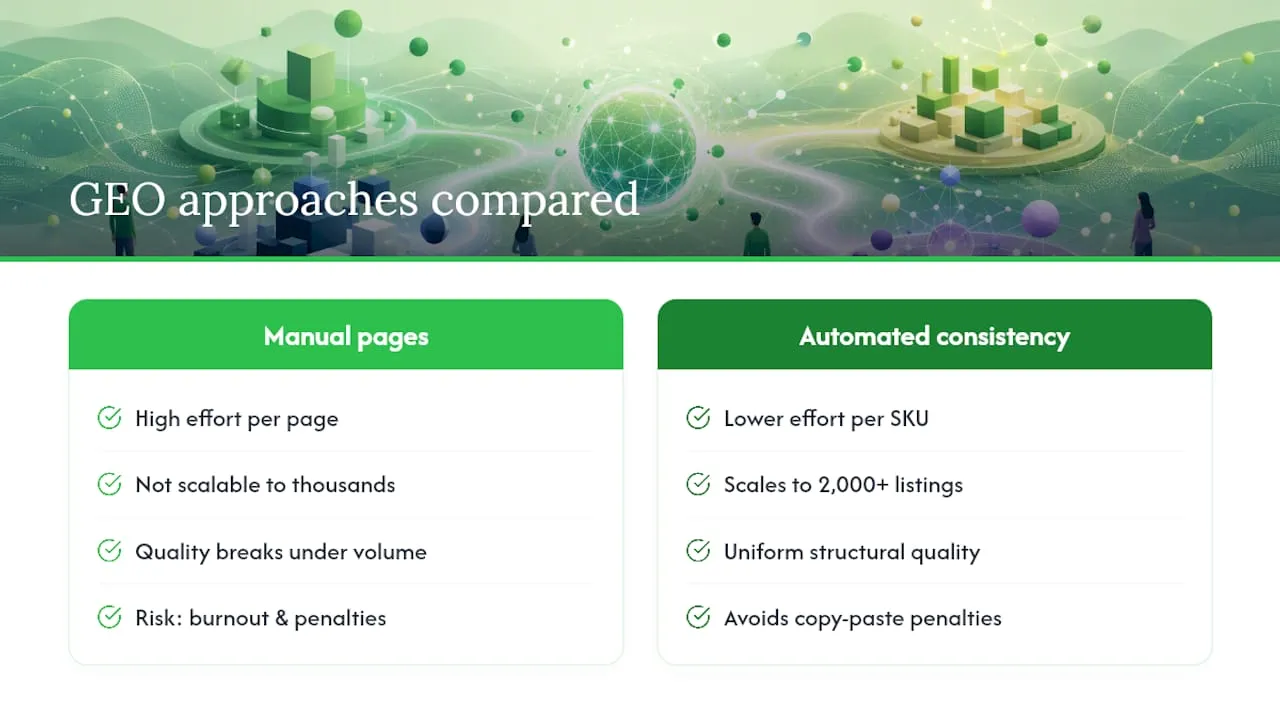
The conventional wisdom treats GEO as an SEO add-on, one more checklist item alongside meta descriptions and alt text. That undersells it. GEO rewards entity clarity and structural consistency precisely the things that break down the moment a human writer is rushing through product page 400 of the day. The stores that will win AI citations in 2026 aren’t necessarily the ones with the cleverest copywriters. They’re the ones whose product data is structurally identical in quality across every single listing, because that consistency is what both search crawlers and AI retrieval systems are actually built to reward.
Where I’d push back on the wider industry take: GEO isn’t really “the new SEO.” It’s SEO’s old, boring fundamentals, crawlability, clarity, structured data, finally being tested by a system that can’t be charmed by keyword density or backlink volume. The tools that automate that consistency at scale, rather than promising a clever hack, are the ones actually built for how these systems work.
— Koen
FAQ
What is generative engine optimization in simple terms?
Generative engine optimization is the practice of structuring content so AI tools like ChatGPT and Perplexity cite, quote, or mention it when answering a user’s question, rather than optimising purely for a search-engine ranking.
Does GEO replace traditional SEO?
No. GEO builds on the same technical foundations as SEO, crawlability, structured data, page speed, but shifts the target metric from ranking position to citation and mention inside AI-generated answers.
What’s the fastest way to improve GEO performance?
Adding sourced citations, quotations, and statistics to existing content is the highest-leverage, lowest-effort change, lifting visibility by roughly 30 to 40 percent in controlled testing according to the GEO-bench study.
How do I measure whether GEO is working?
Track inclusion rate and citation frequency by running the same set of buyer prompts through ChatGPT, Perplexity, and Google’s AI Overviews monthly, and compare your brand’s mention rate against competitors over time.
Can automation help with GEO for ecommerce stores?
Yes. Platforms like EcomEye generate schema-ready, extractable product descriptions and images in bulk, which addresses the duplicate-content and inconsistency problems that undermine GEO performance at scale.
Ready to boost your product pages?
Generate high-converting, SEO-optimized product pages in bulk using AI automation used by e-commerce experts.
No credit card required