How to generate unique product content that ranks
Learn how to generate unique product content that boosts visibility, avoids penalties, and engages your target audience effectively.

How to generate unique product content that ranks

Copying product descriptions from suppliers is the single fastest way to guarantee your store stays invisible on Google. Duplicate content triggers ranking penalties, Google Merchant Centre disapprovals, and a product page that looks identical to every other dropshipper selling the same item. The fix is original content built around three layers: a benefit-focused hook written for your specific buyer, contextualised specifications that explain why a feature matters, and use-case scenarios tailored to real customer situations.
Unique product content goes well beyond rewriting. It means:
- Original benefit hooks that address a specific customer problem, not generic specs
- Contextual specifications that translate technical details into outcomes (“handles a full workday without recharging” beats “8-hour battery”)
- Use-case narratives written for your niche audience, not a generic shopper
- Multimedia assets including original images and video, not supplier stock photos
- Semantic consistency across your title, description, schema, and reviews so AI search engines can confidently surface your products
- Human oversight on any AI-generated draft to catch errors, brand mismatches, and legal risks
- Brand voice applied consistently across every category, not just hero products
At scale, this requires systems, not heroics. A Shopify store with 500 SKUs cannot hand-craft every page from scratch. What it can do is build variable-driven templates, mine customer language from reviews and support queries, and use AI tools with a proper quality-control step. The sections below cover exactly how.
What unique product content actually means for SEO and sales
Unique product content is not simply text that passes a plagiarism checker. It is content that Google’s quality systems read as genuinely useful to a buyer: original framing, contextual relevance, and semantic depth that manufacturer descriptions never provide.

The SEO case is straightforward. Google penalises pages where the bulk of the text matches content found elsewhere, and simply rewriting manufacturer descriptions is not enough. Successful pages align schema markup, FAQs, and body copy semantically so that AI search engines can parse and recommend them with confidence. A page that fails this test gets filtered out of AI Overviews and shopping recommendations before a human ever sees it.
The engagement case is just as strong. Buyers who land on a product page with generic specs and no context leave quickly. Content that addresses the specific problem a buyer is trying to solve, written in language that mirrors how they actually describe that problem, converts at a meaningfully higher rate. Product content should address customer problems and use cases, not just specifications, to rank and convert effectively.
There are also legal considerations. Copying supplier or competitor descriptions without permission is copyright infringement, regardless of how common the practice is in dropshipping. Original content eliminates that risk entirely.
Brand voice consistency matters too, particularly for stores with large catalogues. When your tone shifts between categories, buyers notice, and trust erodes. A consistent voice, applied through editable templates and category-specific vocabulary, keeps the experience coherent across hundreds of pages.
How to generate unique product content: practical strategies
Use the three-layer content framework
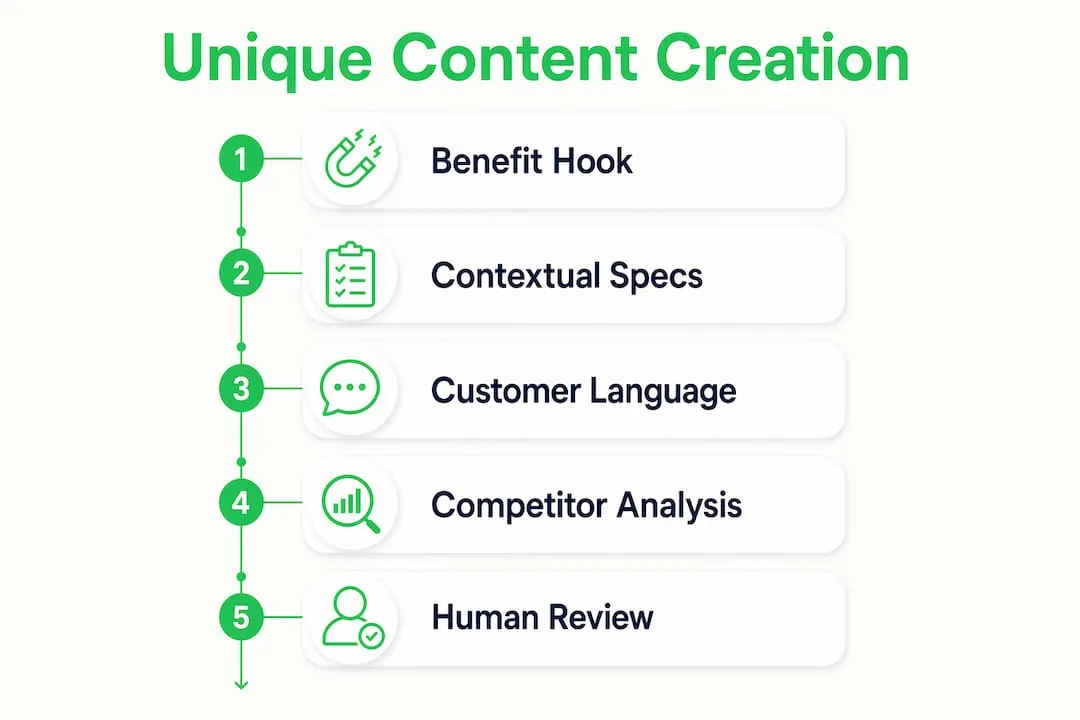
Content differentiation is achieved by layering a unique benefit hook, contextualised specifications, and situational use-case narratives. Each layer does a different job.
The hook (50–75 words) opens with the problem solved or the desire fulfilled. Not “constructed from premium polycarbonate” but “for climbers who need grip security and shock protection on a route.” The specification layer (100–150 words) transforms dry technical data into meaningful outcomes. The use-case layer (75–100 words) describes two or three specific situations where the product excels, written for your audience’s lifestyle, not a generic buyer.
A fitness store and a travel store selling the same wireless earbuds should produce completely different product pages. The framework makes that natural, not laborious.
Mine customer language from reviews and support queries
Your buyers already tell you exactly how they describe your products. Support tickets, on-site search logs, and review text contain the phrases customers actually use when they search. Fold those phrases into your descriptions and FAQ blocks, and you create semantic consistency that AI search engines rely on to surface your products confidently.
Pay attention to the modifiers. “For sensitive skin,” “quiet enough for a flat,” “good for beginners” are not filler. Each one is a filter a buyer applies mentally before purchasing, and each one is a phrase an AI engine can match against your page.
Conduct competitor content analysis to find gaps
Before writing a single word, audit what the top-ranking pages for your target keywords actually contain. Look for what they miss: use cases they ignore, buyer questions they leave unanswered, audience segments they overlook. A phone case listed generically for “smartphone protection” leaves a gap for a page written specifically for construction workers or outdoor photographers.
Gap analysis turns competitor weakness into your content opportunity. You are not trying to write a better version of their page. You are writing for an audience they forgot.
Deploy multimedia assets strategically
Best practices recommend at least five images and two videos per product to improve engagement and SEO performance. Supplier stock photos do not count toward genuine differentiation. Original lifestyle photography, customer-submitted photos, and how-to videos create visual content that no competitor can replicate because it reflects your specific customers and context.
For Shopify stores, AI-generated product images offer a practical route to original visuals at scale, without the cost of a full photography shoot for every SKU.

Pro Tip: Add a “real-world use” photo section to your top 20% of products first. These SKUs typically drive the majority of your traffic, so the return on the effort is highest there.
Use AI-assisted generation with human review
AI-generated product content requires human-in-the-loop review to prevent factual errors, brand voice drift, and legal compliance failures. AI handles first drafts efficiently. Humans provide strategic direction, catch hallucinations, and apply brand tone. Neither alone produces content that is both fast and trustworthy.
Effective AI prompting specifies the target audience, the tone, the key benefits and use cases to cover, the required structure, and the word count. Vague prompts produce generic output. Structured prompts produce drafts that need editing, not rewriting.
Implement product schema and structured data
Product schema markup and structured data help AI search engines index precise product attributes and boost visibility. Clean, complete schema lets crawlers pull dimensions, materials, price, availability, and reviews without guessing. A half-filled schema can be worse than none because it looks complete to you but reads as unreliable to the crawler.
Include every relevant field: name, brand, SKU, GTIN where available, price, availability, shipping, return policy, and aggregateRating. Group related products into clean collections and link variants to a parent product so the crawler understands the product family.
Maintain brand voice with category-specific templates
Variable-driven templating with category-level vocabulary banks maintains uniqueness across variants without requiring bespoke writing for every SKU. A 30-word vocabulary bank per category feeds the adjective and tone slots in your template, preventing every description from reading identically. Vary sentence structure across categories too: the opener for kitchenware should differ syntactically from the opener for apparel.
Rotate FAQ ordering when the same question appears across multiple SKUs. Position rotation reduces the page-similarity score that crawlers calculate, keeping your pages individually indexable.
Avoid keyword stuffing and superficial spinning
Running manufacturer text through a paraphrase tool does not create unique content. Google’s systems detect synonym-swapping and sentence rearrangement easily, and the result wastes time without delivering any SEO benefit. Focus instead on adding substantive new information: a perspective, a use case, a buyer question answered, a comparison to the next product up in your catalogue.
Keyword stuffing carries the same risk. Repeating a primary keyword unnecessarily signals low quality to both readers and search engines. Use long-tail variants and semantic synonyms to cover topical breadth naturally.
Respect copyright when creating product content
Using supplier or competitor descriptions without permission is an infringement, full stop. This applies to images as much as text. Original writing, licensed content, and AI-generated assets with clear ownership terms are the only safe routes. Copyright-safe content practices are not optional for UK ecommerce businesses operating under the Copyright, Designs and Patents Act 1988.
Generating unique content ideas for your product-based business
Answer real customer questions on the product page
The most overlooked source of unique content is the questions buyers actually ask before purchasing. Monitor your support inbox, your on-site search, and your Q&A sections. Then answer those questions directly on the relevant product pages. This creates content that targets long-tail question-based searches while simultaneously reducing support volume.
Structure some product pages around a specific problem: “Struggling to find a yoga mat that grips on a wooden floor?” positions the product as a solution before the buyer has read a single specification. That framing is unique because it reflects your customers, not a generic audience.
Build category hub and spoke pages
Create comprehensive hub pages around major topics in your niche, with spoke articles linking back. A fitness equipment store might build a hub around “home gym setup” with spokes covering equipment selection, space planning, workout routines, and maintenance. Each spoke naturally showcases relevant products in context, generating search-friendly content while building topical authority.
Category pages structured around search intent rather than product type perform significantly better. “Essential iPhone protection” and “travel-friendly phone gear” target specific keyword clusters that “phone accessories” never reaches.
- Identify the three or four major topics your catalogue naturally clusters around
- Build a hub page for each with 400–600 words of original buying guidance
- Create spoke articles addressing specific sub-questions within each topic
- Link spokes back to the hub and to relevant product pages with descriptive anchor text
- Add a common questions section to each hub addressing three to five category-specific FAQs
Reposition generic products for niche audiences
A phone case is generic. A phone case for rock climbers who need grip security and shock protection is specific. Repositioning the same product for a defined audience segment creates natural content differentiation: your descriptions, use cases, and keyword targeting all shift to address niche-specific needs that broader competitors overlook.
This works particularly well for dropshipped products where the item itself is identical across multiple stores. The differentiation lives entirely in the content and positioning.
Use user-generated content as a scalable content source
User-generated content such as reviews and Q&A sections creates fresh, authentic content that Google values highly. Customer photos and detailed reviews provide differentiation that no supplier image can match. Rather than asking for star ratings, prompt customers with specific questions: “How are you using this product?” and “What problem did this solve for you?” generate substantive responses that add genuine content value.
Run monthly contests for the best customer photo. Feature submitted images prominently on product pages. These tactics build a library of original visual content that compounds over time.
Develop educational content that showcases products in context
A store selling yoga mats might publish “5 essential features of a quality yoga mat” that naturally showcases their products as examples. This provides search-friendly content while contextualising products in a helpful framework. Educational content ranks for informational queries that product pages never reach, then funnels readers toward purchase.
The key is genuine utility. Content that exists only to promote a product reads as promotional and performs accordingly. Content that genuinely helps a buyer make a better decision builds trust and earns links.
Add editorial voice through product selection rationale
Position yourself as a curator who selects products based on specific criteria. Explain why you chose to stock a particular item, what makes it preferable to alternatives in your catalogue, and what standards you applied. This “our take” section, even at 100–150 words per product, creates genuinely unique content that no supplier or competitor can replicate because it reflects your specific judgement.
AI applications in ecommerce are increasingly used to generate these editorial sections at scale, with human review ensuring the rationale is accurate and brand-consistent.
Expert insights and best practices for scalable content creation
Treat product content as a funnel, not a page
The title is top-of-funnel: it captures attention and communicates what the product is. The description is middle-of-funnel: it must provide detailed utility and problem-solving context that moves a buyer toward a decision. Treating product content as a funnel changes how you write every element. Titles earn their keep by matching search intent precisely. Descriptions earn their keep by answering the unspoken buyer question before the buyer types it.
“AI search engines prefer semantic consistency across product schema, descriptions, and reviews. Content mined from customer language gives models the conversational context they need to surface your products confidently. Specs alone read as a brochure, and brochures rarely get cited.” — Content marketing trends for 2026, Title Media
Implement template hygiene for large catalogues
For catalogues of 100 or more SKUs, the challenge is not writing quality. It is writing quality at scale without producing duplicate content. Defining content ownership by specialised teams for merchandising, SEO, and compliance prevents drift across large catalogues. Role clarity keeps content consistent across sales channels.
Variable-injection templates are the practical mechanism. Fixed sections cover brand voice, schema structure, and common policies. Dynamic sections inject SKU-specific variables: material, primary use case, dimensions, colour, and one differentiator pulled from the product spec sheet. The dynamic blocks change enough per SKU that no two pages produce identical copy.
Template hygiene rules that prevent duplicate penalties:
- Vary sentence structure across categories, not just vocabulary
- Inject brand-tone words from a per-category bank of around 30 words
- Rotate FAQ ordering so the same question appears in different positions across SKUs
- Keep dynamic, SKU-specific text as the majority of each page’s content
Pro Tip: Run your pages through Copyscape or Siteliner before bulk publishing. Variable-injection templates running with the majority of content as dynamic text typically score well inside the safe range for similarity.
Apply human-in-the-loop quality control to AI workflows
Fully automated AI output without human review tends to repeat patterns across a catalogue. Google’s quality systems notice, and so do buyers. The right workflow uses AI to generate structured first drafts from category-level vocabulary banks and product spec inputs, then applies human review for claims accuracy, tone, and legal compliance. Programmatic QA checks for missing fields, duplicate titles, absent schema, and character limits before bulk publishing.
Scaling unique content generation with AI works when the framework, the scaling logic, and the duplication checks all run in the same workflow. The AI handles volume. The human handles judgement.
Prepare for AI search in 2026 and beyond
AI search engines do not read product pages the way a shopper does. They go straight to the underlying code and pull structured attributes. If your product detail page lacks clean structured data, the crawler moves on. Optimising content for AI search requires treating product descriptions as structured, semantic data feeds built for machine synthesis, not marketing brochures.
The practical steps: complete your product schema with every relevant field, write descriptions using concrete nouns and precise specifications rather than vague adjectives, and fold real customer language into your copy. “100% long-staple Egyptian cotton sheets with a 400-thread-count sateen weave” gives an AI model a clean semantic marker. “Super-soft bed sheets” gives it nothing.
Forward-looking ecommerce SEO in 2026 also means building content that drives sales growth beyond the product page itself, through educational content, category hubs, and review ecosystems that create the dense web of semantic consistency AI engines reward.
How Ecom-eye handles this at scale
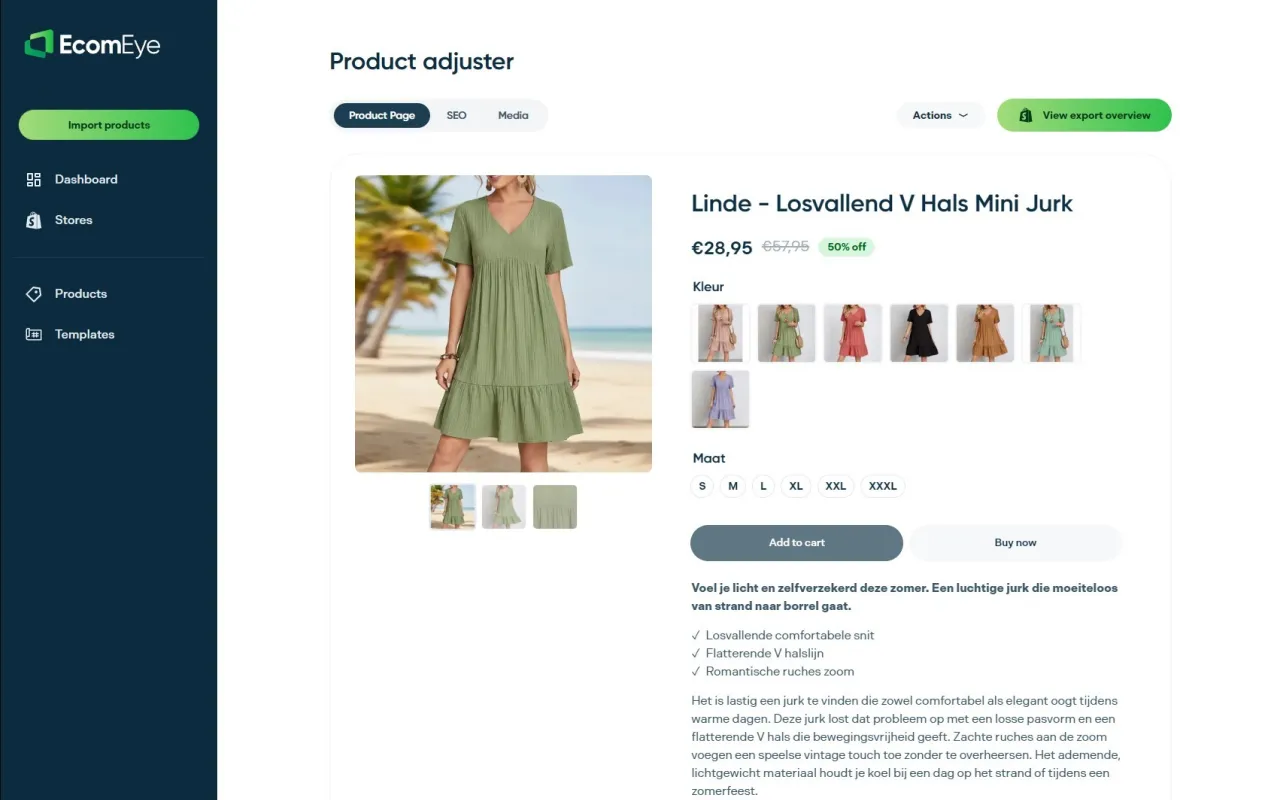
Generating unique product content manually across hundreds of SKUs is where most ecommerce owners stall. Ecom-eye is built specifically for this problem. Import products in bulk from AliExpress or competitor links, and Ecom-eye automatically generates original titles, clean descriptions, SEO-ready content, high-quality AI product images, and multi-language pages. Everything exports directly to Shopify in one click.
No rewriting. No copyright risk. No manual work per SKU. The platform applies the frameworks covered in this article at scale: benefit-focused hooks, contextualised specifications, and original imagery, all generated without duplicating supplier or competitor content.
Ecom-eye’s AI product description generator is the practical tool for UK dropshippers who need volume without the duplicate content penalties that sink most stores. Visit Ecom-eye to see how it works.
Key takeaways
Unique product content built on original hooks, contextualised specifications, and customer-mined language consistently outperforms copied or spun descriptions in both search rankings and conversion.
| Point | Details |
|---|---|
| Use the three-layer framework | Write a benefit hook, contextualised specs, and use-case scenarios for every product page. |
| Mine customer language | Pull real phrases from reviews and support queries to build semantic consistency for AI search. |
| Multimedia matters | Best practices recommend at least five images and two videos per product for engagement and SEO. |
| AI needs human oversight | AI-generated content requires human review to prevent errors, brand drift, and legal risk. |
| Template hygiene at scale | Keep dynamic, SKU-specific content as the majority of each page to avoid duplicate penalties. |
FAQ
How do I create unique content for generic dropshipped products?
Use the three-layer framework: write an original benefit hook for your specific audience, contextualise the specifications as outcomes, and add use-case scenarios tailored to your niche. A product identical to a competitor’s becomes distinct when the content is written for a specific buyer segment rather than a generic shopper.
What is the 3-3-3 rule in marketing?
The 3-3-3 rule is not a single standardised framework; definitions vary across sources. A common version refers to capturing attention in three seconds, communicating the core message in three sentences, and prompting one action within three minutes. Applied to product content, it means your hook must work fast, your description must be scannable, and your call to action must be clear.
Does AI-generated product content hurt SEO?
AI-generated content published without human review tends to repeat patterns across a catalogue, which Google’s quality systems detect. With proper human-in-the-loop review, structured templates, and programmatic QA, AI-assisted content can scale without duplicate penalties. The risk is not AI itself; it is unreviewed, unstructured AI output.
How much unique content does each product page need?
Unique product content should layer a benefit hook (50–75 words), contextualised specifications (100–150 words), and use-case narratives (75–100 words). This combination ensures the dynamic, SKU-specific content makes up the majority of each page’s total text.
How do I maintain brand voice across hundreds of product pages?
Build category-level vocabulary banks of around 30 words per category and inject them into variable-driven templates. Define which team owns which content field, and run programmatic QA before bulk publishing. Consistent sentence structure patterns per category, combined with SKU-specific dynamic blocks, keep the voice coherent without requiring manual editing of every page.
Ready to boost your product pages?
Generate high-converting, SEO-optimized product pages in bulk using AI automation used by e-commerce experts.
No credit card required