The role of conversion-focused pages for Shopify dropshippers
Discover the role of conversion-focused pages for Shopify dropshippers. Boost sales, reduce bounce rates, and optimize your store's performance!

The role of conversion-focused pages for Shopify dropshippers

TL;DR:
- Conversion-focused pages remove distractions and drive Shopify dropshipping sales by matching the ad promise and simplifying actions. Most pages underperform because they leak traffic, have slow load times, or mismatched messaging, which lowers conversion rates. Automating bulk page creation with unique, SEO-friendly content and continuous testing improves rankings and revenue at scale.
Conversion-focused pages are purpose-built conversion engines: they strip out navigation, competing links, and every distraction that bleeds attention away from one single action. For Shopify dropshippers, that means the difference between a visitor who bounces and one who clicks “Add to cart.” The cross-industry median landing page conversion rate is 2.6%, with top-performing pages achieving 5.8%. Most dropshipping stores sit well below that median, not because their products are wrong, but because their pages leak.
Key reasons these pages matter for your store’s economics:
- They match the promise of the ad that sent the visitor, reducing immediate bounce
- They present one primary call to action (CTA), removing decision paralysis
- They lower cost per acquisition (CAC) by converting more of the traffic you already pay for
- Google Core Web Vitals and page speed, particularly Largest Contentful Paint (LCP), act as the primary technical gatekeepers to ranking and staying ranked
- Duplicate supplier descriptions trigger Google Merchant Centre disapprovals and suppress organic visibility
Ecom-eye generates bulk, copyright-safe, SEO-ready product pages with unique titles, descriptions, and AI product images, then exports them to Shopify in one click.
Table of Contents
- What role do conversion-focused pages play in your sales funnel?
- What must every high-converting Shopify product page include?
- Which KPIs should you track to measure page performance?
- How should you run A/B tests on product pages?
- How do you scale conversion-focused pages in bulk on Shopify?
- What red flags kill conversion and how do you fix them fast?
- Key takeaways
- What most people get wrong about scaling product pages
- Scale your Shopify pages faster with Ecom-eye
- Useful sources
- FAQ
What role do conversion-focused pages play in your sales funnel?
A conversion-focused page sits at the end of a specific traffic path: a paid social ad, a Google Shopping result, or an organic search click. Its job is to receive that visitor and convert them before they leave. Landing pages outperform general site pages precisely because they are built around a single conversion goal rather than general exploration.
The mechanism is message-match: the headline on the page must reflect the promise in the ad or search result that brought the visitor there. Break that match and you create a promise mismatch, which registers as distrust in under three seconds. Message-match, headline clarity, and measurable traits drive conversion far more than design aesthetics.
Micro-conversions matter too. Add-to-cart and initiate-checkout events tell you where visitors stall before the primary conversion (purchase). Tracking both lets you isolate whether the problem is the page itself or the checkout flow. Trust signals placed above the fold, such as review counts or a named testimonial, reduce uncertainty before a visitor has scrolled at all.
**Benchmark context: The cross-industry median landing page conversion rate is 2.6%; top-quartile pages convert at 5.8%. Mobile accounts for the majority of e-commerce traffic, so a page that converts at 3% on desktop but 1.2% on mobile is a mobile problem, not a product problem.
What must every high-converting Shopify product page include?
The structure below is a build and QA checklist. Each element earns its place by removing a specific leak or adding a specific reason to act.
- Outcome-first headline (6–10 words): mirrors the traffic source and states the benefit, not the feature
- Single primary CTA: repeated in a sticky bar or above the fold; one clear CTA repeated consistently outperforms multiple competing asks
- Specific social proof near the CTA: a named review count or a short testimonial with a real name, not a generic star rating floating at the bottom
- Benefit-led bullet points: scannable, three to five lines, each tied to a product-specific outcome
- High-quality product visuals: AI-generated or native photography with LCP-optimised file sizes; product-specific hero content outperforms generic stock imagery in large-sample tests
- Minimal navigation: remove header menus and footer links from product landing pages to eliminate leaks
- SEO essentials: unique title tag, meta description, structured data (Product schema), and a canonical tag to prevent duplicate-content penalties
- Friction-reduced checkout path: keep form fields minimal; fewer fields measurably improve conversion
- Mobile-first layout: sub-2.5s LCP target; LCP improvements directly lift retail conversion rates
Pro Tip: Write your hero headline last. Draft the bullet points and CTA first, then distil the single strongest benefit into a six-to-ten-word headline. Pages built this way tend to have tighter message-match because the headline reflects what the page actually delivers, not what you hoped it would.
Which KPIs should you track to measure page performance?
| KPI | What it measures | Watch for |
|---|---|---|
| Page conversion rate | Primary goal completions ÷ sessions (exclude bots) | Below 2.6% median warrants investigation |
| Add-to-cart rate | Visitors who add a product | Low rate signals page or product issue |
| Checkout-start rate | Add-to-carts that reach checkout | Drop here points to price or trust friction |
| Bounce rate | Single-page sessions with no interaction | High bounce often means message mismatch |
| LCP (page speed) | Time to render the largest visible element | Target sub-2.5s; above 4s causes measurable CR loss |
| Mobile vs desktop CR | Conversion split by device | A noticeable gap usually indicates a layout issue |
| CAC and AOV | Downstream business health | Rising CAC with flat CR means traffic quality is declining |
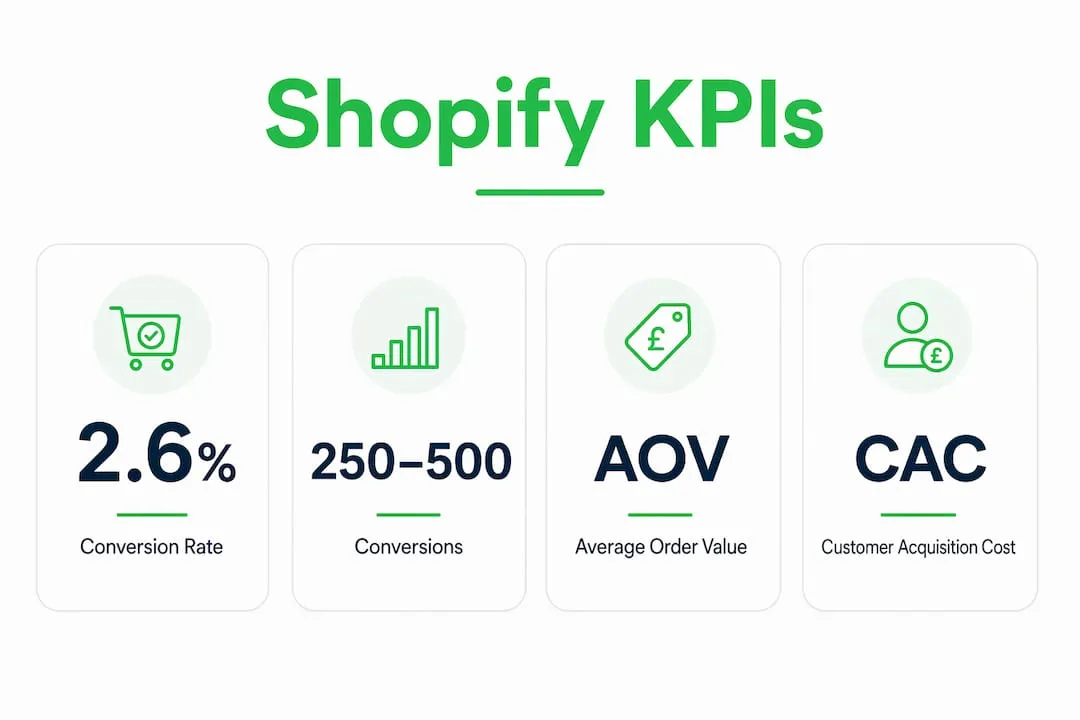
Connect page-level metrics to business metrics. A conversion rate that improves while AOV falls may mean you are attracting lower-intent buyers. LTV matters as much as the initial conversion.
Pro Tip: Wait for 250–500 conversions per variant before drawing conclusions from an A/B test. Calling a winner at 40 conversions is how false positives become permanent page changes.
How should you run A/B tests on product pages?
Testing without a hypothesis is just guessing with extra steps. Before you split traffic, write one sentence: “Changing X to Y will increase [metric] because [reason].” That discipline alone filters out most low-value tests.

Prioritisation matrix: score each test idea on impact (how much could it move the needle), ease (how long to implement), and risk (could it hurt other metrics). Run high-impact, low-risk tests first.
Concrete test types suited to Shopify product pages:
- Headline copy: benefit-led vs feature-led vs social-proof-led
- CTA copy: “Add to cart” vs “Get yours today” vs a price-anchored variant
- Social proof format: star rating count vs named testimonial vs “X sold this week”
- Hero image: lifestyle vs product-only vs annotated product with benefit callouts
- Mobile CTA placement: sticky bar vs inline above the fold on a 375px viewport
Single-variable vs multivariate: change one element per test. Multivariate testing requires substantially more traffic to reach significance and makes it harder to isolate what moved the needle. For most dropshipping stores, single-variable weekly iteration compounds faster than quarterly multivariate experiments.
Pair quantitative results with qualitative signals. Session replays and heatmaps explain why a variant won or lost. A headline that lifted conversion but showed users scrolling straight past the product images tells you the next test to run. Continuous weekly iteration consistently outperforms one-off redesigns.
How do you scale conversion-focused pages in bulk on Shopify?
The end-to-end workflow for dropshippers producing hundreds of pages looks like this:
- Import: pull product data from AliExpress, Amazon, Temu, or competitor Shopify URLs via feed or direct link
- Template mapping: assign headline structure, bullet format, and schema fields to product categories
- AI-assisted generation: produce unique titles, benefit-led descriptions, and high-quality AI product images per SKU
- Uniqueness checks: run duplicate-content detection before export; identical descriptions across SKUs trigger Google Merchant Centre disapprovals
- SEO fields: auto-generate long-tail title variants, canonical tags, hreflang for multi-language pages, and alt-text for every image
- QA and micro-edits: a 20–60-second human review per page to remove generic marketing-speak and inject product-specific details; small human edits to AI-generated content are what preserve trust at scale
- Bulk export to Shopify: one-click deployment with all SEO fields and structured data intact
- Post-publish monitoring: track search impressions, organic clicks, and Merchant Centre disapprovals within the first two weeks
For Shopify SEO at scale, keyword grouping by product category and canonical-first templates prevent cannibalisation across large catalogues.
Pro Tip: Validate your template on 100–200 pages before bulk-publishing thousands. Monitor search impressions and Merchant Centre for early disapprovals. Fixing a structural issue across 200 pages costs a fraction of fixing it across 5,000.
Ecom-eye handles the import, generation, SEO fields, AI images, multi-language output, and one-click Shopify export, mapping directly to every step above.
What red flags kill conversion and how do you fix them fast?
Run this audit on any product page in under five minutes:
- Generic supplier description: replace with two to three product-specific benefit statements; supplier copy is usually duplicated across dozens of stores
- LCP above 2.5s: compress hero images, defer non-critical scripts, and use a CDN; slow pages lose conversions before the visitor reads a word
- Navigation links left in: remove header menus from product landing pages; every exit link is a leak
- Missing message-match: check that the page headline reflects the ad or search term that sent the visitor
- No social proof above the fold: add a named review count or a short testimonial before the scroll; proof buried at the bottom rarely gets seen
- Multiple competing CTAs: keep one primary action; a secondary “Save for later” link is fine, a second “Shop all products” button is a leak
- Mobile CTA below the fold on a 375px viewport: test on a real device, not just a browser resize; sticky CTA bars solve this without redesigning the page
- Tiny tap targets: buttons under 44px height on mobile cause mis-taps and frustration
The button-colour myth deserves a direct rebuttal. Changing a CTA from green to orange rarely moves conversion by more than noise. What moves it is message-match, specific proof, and speed. Fix those three before touching colours.
Key takeaways
Conversion-focused pages lower CAC and raise revenue by removing leaks, matching intent, and presenting one clear action, making them the highest-leverage asset in a Shopify dropshipping store.
| Point | Details |
|---|---|
| Message-match first | Align your headline to the ad or search term that sent the visitor before testing anything else. |
| Single CTA, repeated | One primary action repeated above the fold and in a sticky bar consistently outperforms multiple competing asks. |
| Speed is a conversion lever | Target sub-2.5s LCP; slow pages lose measurable conversion before a visitor reads the headline. |
| Test with sufficient data | Wait for 250–500 conversions per variant before calling a winner to avoid false positives. |
| Ecom-eye for bulk scaling | Ecom-eye automates bulk import, copyright-safe generation, SEO fields, AI images, and one-click Shopify export across hundreds of pages. |
What most people get wrong about scaling product pages
The conventional wisdom says “just use a template and automate everything.” That advice is half right and half dangerous.
Templates give you structural consistency, which matters for SEO and QA. But when every page uses the same sentence skeletons and the same marketing-speak, Google’s quality signals and real visitors both notice. Duplicate phrasing across thousands of pages is a subtler version of the same problem as duplicate supplier descriptions: it signals low effort, and low effort pages rank poorly and convert poorly.
The stores that scale well treat AI generation as a structural tool, not a content tool. The AI handles the scaffold: headline format, bullet structure, schema fields, image generation. A human spends 30 seconds per page injecting one product-specific detail, removing one generic phrase, and checking that the headline actually matches the traffic source. That 30 seconds is what separates a page that ranks and converts from one that sits in a crawl queue.
The other thing people underestimate is the compliance side. UK advertising standards require that claims on product pages are substantiated and not misleading. GDPR applies the moment you collect an email address or run retargeting pixels. Neither of these is a reason to avoid automation; they are reasons to build a QA step that checks claims and data-collection consent before pages go live, not after a complaint arrives.
Weekly iteration beats quarterly redesigns. The stores I see stall are the ones waiting for a “big enough” change to justify a test. Run small, hypothesis-driven tests every week. The compounding effect over six months is substantial.
Scale your Shopify pages faster with Ecom-eye
Producing hundreds of unique, Google-compliant product pages manually is where most dropshipping growth stalls. Ecom-eye cuts that bottleneck by automating the entire workflow: bulk import from AliExpress, Amazon, Temu, or competitor Shopify links; copyright-safe title and description generation; high-quality AI product images; multi-language page creation; and one-click export directly to Shopify with SEO fields and structured data intact.
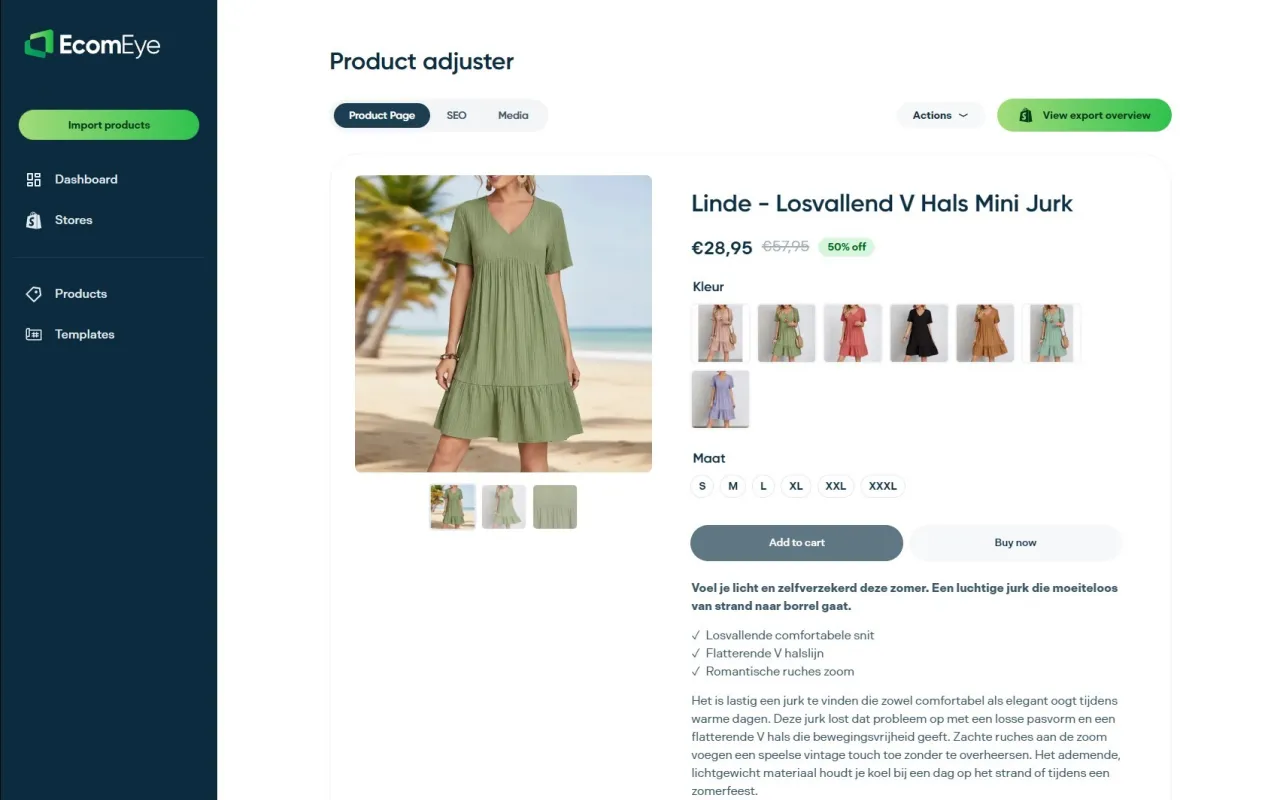
A typical batch of 100 pages, including generation, QA, and export, takes a fraction of the time manual rewriting would require. Volume discounts and pay-as-you-go credits mean you scale at the pace your store demands, without committing to a fixed monthly seat you may not need. New users can start with a free trial to test output quality before committing to a larger run.
Start generating pages on Ecom-eye and see how many you can publish this week.
Useful sources
The claims and benchmarks in this article draw on the following primary sources. Use them when designing your own tests and setting realistic performance targets.
- Landing page conversion benchmarks 2026, Lead2More: cross-industry median (2.6%) and top-quartile (5.8%) conversion rates; form-length and LCP data
- Landing page conversion study, DigitalApplied: large-sample evidence on hero imagery, AI micro-edits, and product-specific proof above the fold
- High-converting landing pages, Shopify blog: single-CTA principle and leak-removal framework
- Landing page conversion rate, Shopify blog: continuous optimisation and weekly A/B testing cadence
- How to build a high-converting landing page, Leadpages: message-match, headline clarity, and the button-colour myth
- High-converting landing page examples, Leadpages: single-CTA teardowns and leak analysis
- Landing page conversion guide, Kissmetrics: sample-size guidance (250–500 conversions per variant) for statistically reliable test conclusions
FAQ
What is the role of conversion-focused pages for dropshippers?
Conversion-focused pages act as dedicated endpoints for a specific traffic source, removing navigation and competing links so visitors have one clear action to take, which lowers CAC and raises purchase rate.
What conversion rate should a Shopify product page aim for?
The cross-industry median conversion rate is 2.6%, with top-quartile pages showing 5.8% performance. Most dropshipping stores below the median have a message-match or speed problem rather than a product problem.
How many conversions do you need before ending an A/B test?
Wait for 250–500 conversions per variant before calling a winner. Ending tests earlier produces false positives that can permanently damage page performance.
How does Ecom-eye help with bulk product page creation?
Ecom-eye imports products from AliExpress, Amazon, Temu, or competitor Shopify links, generates unique copyright-safe titles, descriptions, and AI product images, and exports everything to Shopify in one click, including SEO fields and structured data.
What is the biggest mistake dropshippers make on product pages?
Using unmodified supplier descriptions is the most damaging single error: it creates duplicate content across multiple stores, suppresses organic rankings, and triggers Google Merchant Centre disapprovals.
Ready to boost your product pages?
Generate high-converting, SEO-optimized product pages in bulk using AI automation used by e-commerce experts.
No credit card required