Bulk Shopify product-page generator: UK dropshipper's guide
Discover how to streamline your Shopify store with a powerful product-page generator, ensuring quick, unique listings without copyright risks.

Bulk Shopify product-page generator: UK dropshipper’s guide

For UK dropshippers who need to publish hundreds or thousands of unique, Google-compliant product pages fast, Ecom-eye is the tool to start with. It handles the full workflow: bulk import from AliExpress, Amazon, Temu, or competitor Shopify links. It then generates unique titles, descriptions, and AI product images, and exports everything to Shopify in one click. No rewriting. No copyright risk.
The single most important action you can take today: import a test batch of 20 SKUs, generate pages, and push a live experiment of 5–10 products. That one test will show you exactly what the workflow produces before you commit to scaling.
Here is what Ecom-eye automates for you:
- Bulk import from AliExpress, Amazon, Temu, and competitor Shopify links
- Unique, keyword-optimised titles and descriptions per SKU
- High-quality AI product image generation with commercial licence
- Multi-language page output and size system conversion
- One-click export directly to your Shopify store
Key takeaways
Bulk AI generation with a human QA layer and correct schema is the fastest, most cost-effective route to unique, Google-compliant Shopify product pages at scale.
| Point | Details |
|---|---|
| Unique copy is non-negotiable | Supplier copy, even lightly rewritten, is treated as a near-duplicate by Google and AI search agents. |
| Schema and page structure matter as much as copy | Product schema (name, image, SKU, offers) offsets ambiguity and improves machine readability alongside unique descriptions. |
| Prioritise top 20% SKUs first | Rewrite your highest-revenue pages first; AI handles the long tail with a similarity-check gate before publishing. |
| Expect results in 6–12 weeks | Top-SKU experiments typically show measurable organic signals within 6–12 weeks; mass low-quality edits rarely move the needle. |
| Ecom-eye for UK dropshippers | Ecom-eye automates import, unique copy, AI images, schema, and one-click Shopify export, with 40% better SEO reported for optimised page layouts. |
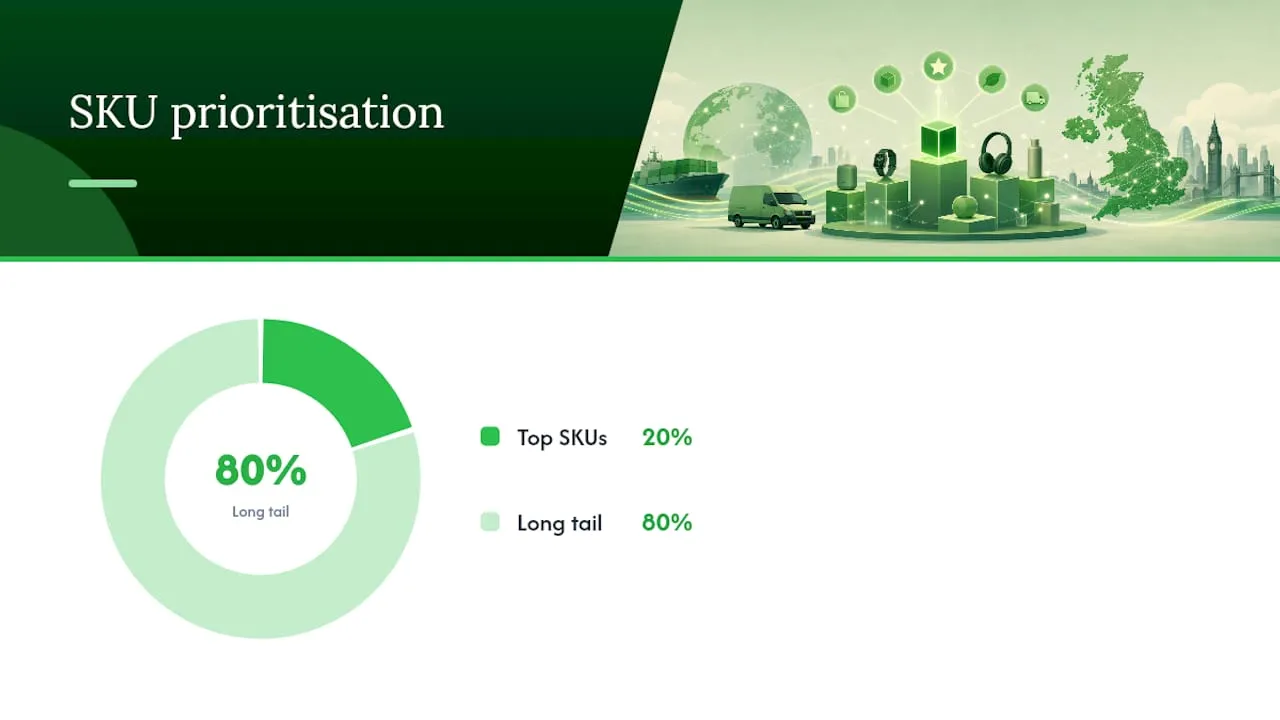
Table of Contents
- What features must a Shopify website builder offer for bulk pages?
- Why do unique product pages matter for Shopify SEO and Google Merchant?
- How do you choose the right bulk product-page generator?
- How to publish 1,000 unique Shopify product pages step by step
- What does bulk product-page generation actually cost?
- UK compliance and image rights checks before you publish
- What results can you realistically expect from optimised product pages?
- The honest view on what actually works for UK dropshippers
- Ecom-eye: built for UK dropshippers who need pages at scale
- Sources
- FAQ
What features must a Shopify website builder offer for bulk pages?
Not every tool marketed as a bulk product-page generator actually delivers at scale. Before you trial anything, run it against this checklist.
Core import and generation:
- Bulk import from multiple sources: AliExpress, Amazon, Temu, supplier feeds, and competitor Shopify URLs
- Per-SKU unique title and description generation with keyword inputs and template control, not a single global prompt applied to every product
- AI product image generation with explicit commercial licence and ownership documentation
- Structured data output covering Product, Offers, and AggregateRating schema properties (name, description, image, SKU/GTIN, brand, offers) to improve machine readability, as product schema guidance confirms
Export and integration:
- One-click export to Shopify with template mapping, variant support, and canonical tag verification — critical for custom themes where canonical handling for variants needs manual checking
- Bulk editing, multi-language output, size conversion, and revision history
Operational:
- Audit logs and content provenance tracking per generated page
- Review and approval queues for human QA before publishing
Pro Tip: Test field mapping on a 10–20 SKU import before scaling. Check that your product title template, schema fields, and variant URLs all populate correctly. Fixing a mapping error at 20 SKUs costs minutes; at 10,000 it costs days.
Why do unique product pages matter for Shopify SEO and Google Merchant?
Copying manufacturer or supplier copy is the single most common reason UK dropshipping stores stall in search. Google treats lightly spun supplier text as a near-duplicate, which means no featured snippets, lower rankings, and frequent Google Merchant disapprovals. AI agents used in modern search behave the same way: they cite sources with original, specific copy, not pages that echo the same manufacturer paragraph across fifty stores.
“Lightly spun supplier copy is still treated as a near-duplicate by search engines. A three-move operational process — rewrite unique store details, check uniqueness with a plagiarism tool, humanise AI drafts — is the practical remedy.” (Debutify)
Ecom-eye’s page layout optimisation approach is associated with up to 40% better SEO performance compared with unoptimised pages, based on Ecom-eye’s own case material. That figure reflects what happens when you combine unique copy with a properly structured page skeleton and schema, not just a rewrite of the description field.
The distinction that matters in practice:
- Factual/spec fields (dimensions, GTIN, weight, materials): safe to carry over from the supplier feed
- Persuasive creative copy (benefits, use cases, tone, opening hook): must be original to your store
How do you choose the right bulk product-page generator?
Choose the tool that passes import fidelity, uniqueness capability, schema completeness, image rights, Shopify export reliability, and scale economics. Here is how to score options during a trial.
Technical questions to ask:
- Which data sources does it connect to natively, and how does it handle missing fields?
- Can you set per-SKU prompt variables (category, audience, tone) or is it one global template?
- Does it include a plagiarism or similarity check before publishing?
- What schema properties does it generate, and does it handle variant canonical URLs?
- Does the one-click Shopify export preserve your existing theme’s template mapping?
- What bulk scheduling and rollback options exist if a batch generates poorly?
Red flags:
- Only rewrites manufacturer text at the sentence level (still a near-duplicate)
- No image licence documentation or ownership guarantee
- Opaque per-page pricing with no volume discount structure
- Missing schema or variant canonical handling
- No audit log or content provenance record
Operational questions:
- Is there a human review layer or approval queue built in?
- Does it support A/B testing between page templates?
- Can it integrate with Google Analytics or Search Console for post-publish monitoring?
Hybrid AI+human workflows consistently outperform pure-AI publishing. The automation handles scale; the human layer handles quality.
How to publish 1,000 unique Shopify product pages step by step
The repeatable workflow is: prepare data, generate templates, batch generate, human QA, export, and monitor. Top-performing tools in 2026 build page skeletons and import supplier data to output a near-publishable page in under a minute for long-tail products; human review is reserved for top revenue SKUs.
- Map your source fields (Day 1–2): Connect your supplier feed or AliExpress/Temu import. Map title, description, images, GTIN, price, and variant fields to your Shopify template. Fix any missing fields before generating.
- Build and test templates (Day 2–3): Create per-category prompt templates with tokenised SKU variables. Generate a 20–50 SKU sample. Run a similarity check and review schema output. Adjust before scaling. See how to build unique product catalogues for field-mapping guidance.
- Batch generate in 1,000-SKU blocks (Week 1–2): Start with your top 20% revenue SKUs. A focused rewrite of the persuasive layer takes roughly 20–30 minutes per 350-word product page when done manually; AI generation cuts that to seconds, with human QA adding 5–10 minutes per high-priority SKU.
- Human QA pass (ongoing): One editor reviewing 50–100 pages per day is a realistic throughput for top SKUs. For the long tail, run an automated similarity check as a gate: flag anything above a set threshold for manual review before it publishes.
- Export and monitor (Week 2 onwards): Push to Shopify via one-click export. Verify canonical tags on variants. Connect Google Search Console and track impressions and clicks per page over 4–12 weeks. Measure Merchant approval rates as a secondary signal.
Pro Tip: Integrate a plagiarism or similarity check as an automated gate in your publishing pipeline, not a manual ad-hoc task. Log the source URL, generation prompt, editor initials, and similarity score for every page. That audit trail is your defence if a Merchant disapproval arrives.
What does bulk product-page generation actually cost?
Pricing typically comes as pay-as-you-go credits per generated page or image, monthly subscriptions, or hybrid plans with volume discounts. The right model depends on catalogue size and how often you refresh content.
Typical budget shapes:
- Small catalogue (100 SKUs): Pay-as-you-go credits are usually the most cost-effective. Expect to pay per text generation and per AI image, with no monthly commitment.
- Medium catalogue (1,000 SKUs): A monthly subscription with bundled credits usually works out cheaper per page than pay-as-you-go at this volume. Look for plans that include template support and bulk editing.
- Large catalogue (10,000+ SKUs): Volume discount tiers or enterprise plans with dedicated credit pools. Prioritise tools that offer rollback and audit logs at this scale.
| Catalogue size | Typical model | What to expect |
|---|---|---|
| 100 SKUs | Pay-as-you-go | Credits per page and per image; no subscription needed |
| 1,000 SKUs | Monthly subscription | Bundled credits, template support, bulk editing |
| 10,000+ SKUs | Volume/enterprise plan | Discount tiers, audit logs, rollback, priority support |
Budgeting note: Include QA and human editing hours in your cost model. A hybrid AI+human workflow, where AI generates the long tail and a human reviews top SKUs, delivers the best return. Pure AI without review risks generic pages that rank poorly and attract Merchant flags.
UK compliance and image rights checks before you publish
Verify image licence and commercial use rights, confirm which factual data you are permitted to carry from the supplier feed, and make sure all creative copy is original. These are not optional steps for UK dropshippers.
Pre-publish compliance checklist:
- Confirm supplier image licence covers commercial use and resale; AI-generated images must come with explicit ownership documentation for Google Merchant submissions
- Check your store’s returns and shipping policy wording complies with UK Consumer Rights Act 2015 obligations
- Verify cookie and privacy notices cover any analytics tools used in your AI publishing pipeline
- Store provenance for each generated page: source feed URL, generation prompt, editor initials, and similarity score
Copying manufacturer persuasive prose, even lightly reworded, can reduce your citation likelihood in AI-powered search and increase the risk of Google Merchant content disapprovals. The spec fields are yours to use; the marketing copy is not.
What results can you realistically expect from optimised product pages?
Unique copy combined with improved page layouts can deliver measurable SEO uplift. Ecom-eye’s own case material points to 40% better SEO performance from optimised page layouts compared with unoptimised pages. That figure covers the combined effect of unique copy, correct schema, and a structured page skeleton, not copy alone.
A small-scale experiment rewriting top SKUs and removing manufacturer prose tends to show earlier measurable organic gains than bulk, low-value changes across the entire catalogue. Real-world practitioners report that top-SKU experiments reveal actionable signals within 6–12 weeks, while mass low-quality edits often show no improvement.
A realistic mini-case: revise your top 25 SKUs with unique copy, correct schema, and AI images. Track organic impressions and clicks in Google Search Console weekly. By week 8–12, you should see a measurable shift in those pages’ impressions. If you do not, the bottleneck is likely site speed, backlinks, or indexing, not the copy itself.
Set expectations clearly: page optimisation is one lever. Site speed, internal linking, backlink profile, and Merchant feed health all contribute. Measure them in parallel using Shopify analytics to isolate the copy effect.
The honest view on what actually works for UK dropshippers
Focus on creating pages that only your store can own. Return policies, packaging details, delivery timelines specific to your UK fulfilment setup, and customer Q&A are all quick ways to add genuine uniqueness that no supplier feed can replicate. That specificity is what AI search agents cite; generic benefit copy is not.

Prioritise your top revenue SKUs for human review. Use AI generation for the long tail, but keep a human QA gate.
The temptation to mass-publish lightly rewritten manufacturer copy is real, especially when you have 5,000 SKUs to launch. Resist it. That approach tends to reduce visibility rather than build it, and recovering from a Merchant disapproval or a manual penalty costs far more time than getting the copy right the first time.
Ecom-eye: built for UK dropshippers who need pages at scale
Scaling to thousands of unique, Google-compliant product pages without a content team used to mean months of manual work or expensive agency fees. Ecom-eye cuts that to days.
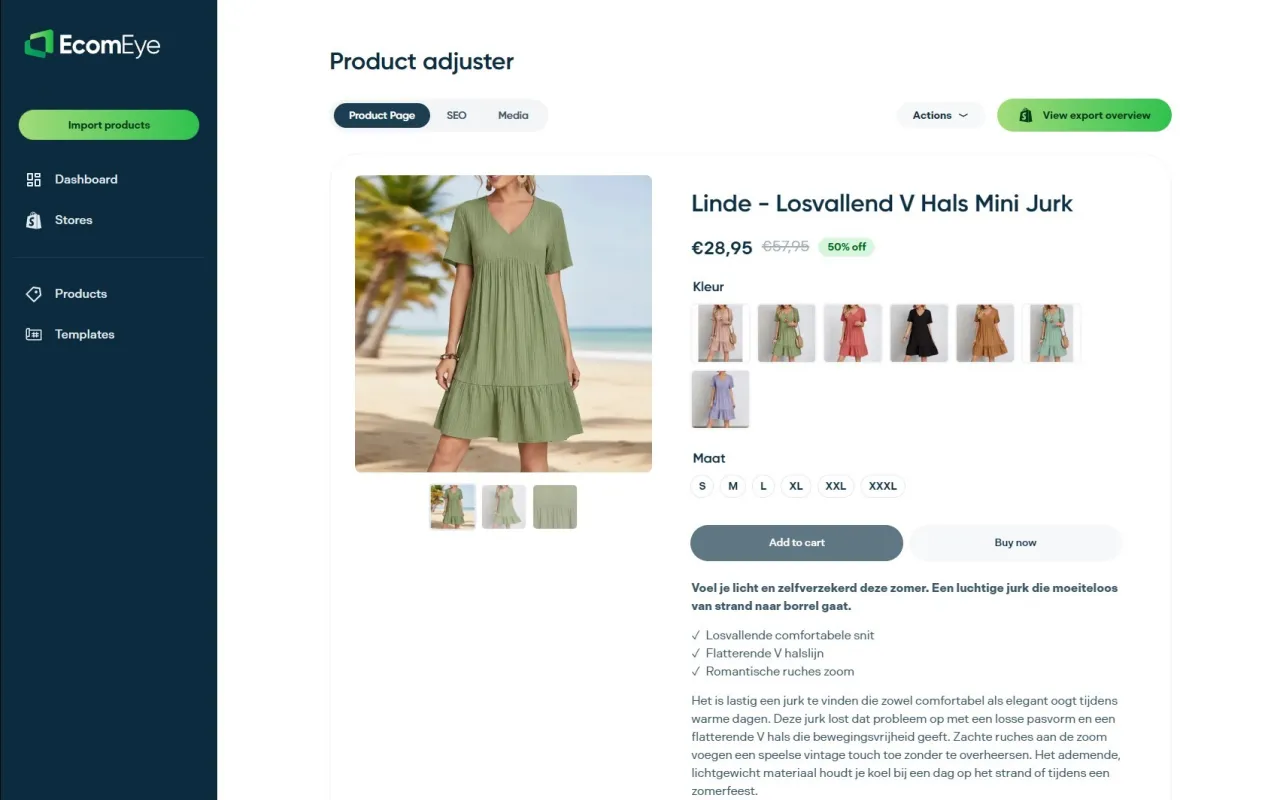
Import products in bulk from AliExpress, Amazon, Temu, or competitor Shopify links. Ecom-eye generates unique titles, descriptions, and AI product images with commercial licence, adds schema markup, and exports everything to Shopify in one click. Multi-language output and size conversion are built in. Every generated page includes provenance tracking so your audit trail is ready if a Merchant query arrives.
Pricing is transparent: pay-as-you-go credits for smaller catalogues, subscription plans for volume. No long-term lock-in before you have seen the output.
Start with the AI product description generator: import 20 SKUs, generate pages, and push a 5–10 item live experiment. You will have real data on traffic and Merchant approval within two weeks.
Sources
- AI Product Descriptions Shopify SEO Guide - XeeDevelopers
- Techsslaash
- Why Copying Manufacturer Descriptions Silently Kills Your Shopify SEO
- Duplicate Product Descriptions Hurt Shopify SEO | Fix Guide · Debutify
- Are AI‑Written Product Descriptions Good for Shopify SEO? The Truth About AI Content | SEOBaby Blog
FAQ
What is a bulk Shopify product-page generator?
A bulk Shopify product-page generator is an AI SaaS that imports product data from supplier feeds or competitor links, creates unique titles, descriptions, and images per SKU, and exports finished pages to Shopify in one click. It is distinct from Shopify’s own theme and storefront editor.
How many pages can you generate per day with Ecom-eye?
Ecom-eye generates pages at scale, with the practical limit set by your QA capacity rather than the tool itself. Long-tail SKUs can be produced in under a minute each; top-revenue SKUs benefit from a 5–10 minute human review pass.
Does AI-generated content hurt Shopify SEO?
Pure AI content without human review risks generic, low-value pages that rank poorly. A hybrid workflow, where AI generates the draft and a human edits top SKUs, consistently outperforms both fully manual and fully automated approaches, according to SEOBaby’s analysis.
How long before optimised product pages show results in Google?
Top-SKU experiments typically show measurable organic signals within 6–12 weeks. Mass low-quality edits across an entire catalogue rarely produce the same effect; focus rewrites on your highest-revenue pages first.
Are AI product images safe to use on Google Merchant?
AI-generated images are safe for Google Merchant submissions only when the generating tool provides explicit commercial licence and ownership documentation. Verify this before publishing any AI image to a Merchant feed.
Ready to boost your product pages?
Generate high-converting, SEO-optimized product pages in bulk using AI automation used by e-commerce experts.
No credit card required