Why granular product details drive better marketing outcomes
Discover why granular product details are crucial for marketing. Boost customer trust, improve discoverability, and drive sales effectively.

Why granular product details drive better marketing outcomes

Over 83% of global consumers will abandon a site if they cannot find sufficient product information. That single figure tells you everything about the stakes. Granular product details are the precise, highly specific data points that describe a product beyond its name and price: exact dimensions, materials, usage attributes, care instructions, compatibility notes, and leaf-level category assignments. For marketers and product managers, they are the difference between a listing that converts and one that gets scrolled past.
Why do granular product details matter so much in practice? Several reasons compound each other:
- They improve product discoverability through accurate categorisation and filter matching.
- They reduce purchase uncertainty, which builds customer trust and lowers bounce rates.
- They feed AI recommendation engines with the structured data needed to surface the right product to the right shopper.
- They enable precise customer segmentation for targeted campaigns.
- They protect brand perception: 75% of consumers form a negative opinion of a brand when they encounter incomplete or inaccurate product information online.
What does product data granularity actually mean in marketing?
Granularity in data refers to the level of detail at which information is captured and stored. In marketing and data analytics, it describes how finely a dataset is broken down. A product assigned to “Furniture” is low granularity. The same product assigned to “Furniture > Storage > Dressers > Ball-bearing slide dressers” is high granularity.
That distinction has real consequences for product categorisation and visibility. Leaf-level categories unlock tailored attribute fields on marketplaces and ad platforms. A dresser listed under a generic furniture category loses access to structured fields for drawer count, slide type, and interior finish. Those fields are precisely what shoppers use to filter. Misclassification leads to invisibility even when the product is exactly what the shopper wants.
Granular data also enables precise customer segmentation. When you know a customer bought a ball-bearing slide dresser in white with a felt-lined interior, you can target them with coordinating bedroom furniture, not a generic “you might also like furniture” prompt. That specificity is what separates personalised experience from noise.
Key dimensions of granularity in product data include:
- Taxonomy depth: how many levels exist between the root category and the product.
- Attribute completeness: whether all relevant fields are populated for each category.
- Attribute consistency: whether the same attribute uses the same values across the catalogue.
- Data accuracy: whether the values reflect the actual product.
How granular product details benefit your business
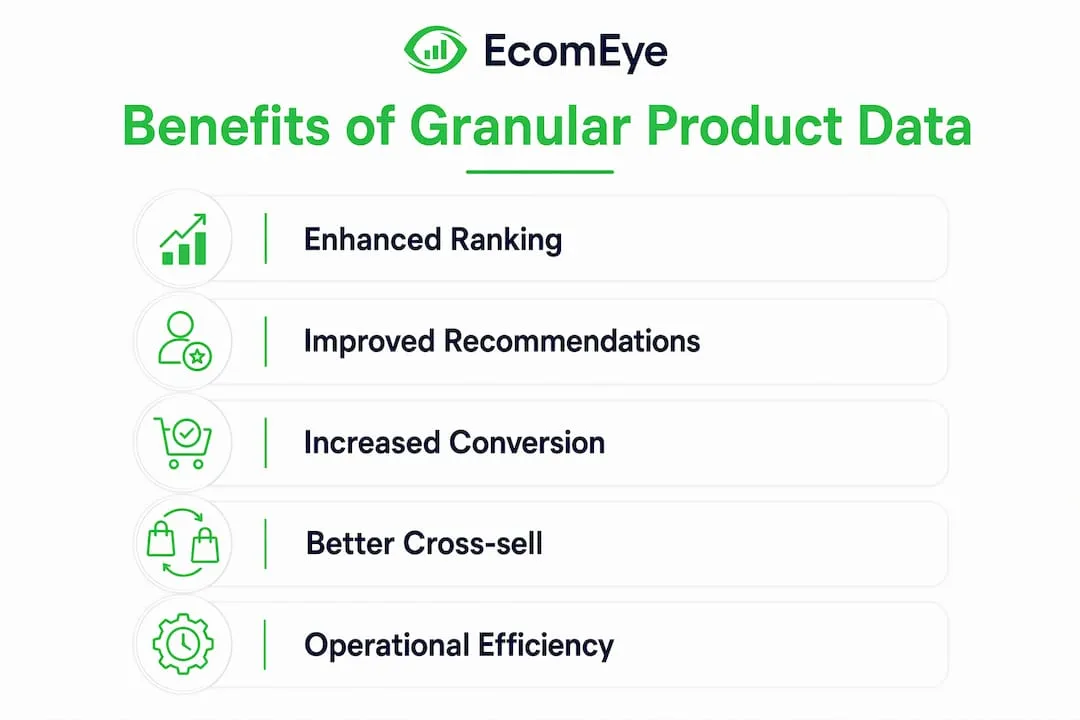
The business case for detailed product information is well evidenced. Retailer search algorithms treat complete, granular attribute data as the price of admission for visibility and ranking. Walmart’s algorithm, for example, weights product attributes heavily. Fill every available field and your product surfaces in the right browse experiences. Leave fields empty and you are effectively invisible, regardless of how good your enhanced content looks.
The research by Amsl et al. makes a point that many retailers miss: low product information quality does not just reduce conversions. It actively damages retailer perception and reduces willingness to return. For high-involvement purchases such as electronics or furniture, the effect is sharper still, because shoppers invest more effort in information search and demand correspondingly detailed data to justify the decision.

Operational benefits compound the customer-facing ones. Consistent granular categorisation improves cross-sell accuracy, sharpens campaign targeting, and produces cleaner internal reporting. When your taxonomy is structured and your attributes are complete, you can track performance by category, identify assortment gaps, and make pricing decisions grounded in actual data rather than gut feel.
Pro Tip: Before enriching product attributes, audit your existing catalogue for attribute consistency first. Inconsistent values, such as “Blue”, “blue”, and “BLUE” for the same colour field, corrupt segmentation and search filtering just as badly as missing data.
Best practices for collecting and managing granular product data
Getting granular product data right is a structural challenge as much as a content one. These steps give you a practical framework.
-
Build a taxonomy with 3–5 levels. A well-structured hierarchy moves from broad categories to specific product types. Each end-level category should contain genuinely similar products. Avoid the common mistake of a flat, two-level tree that forces dissimilar products into the same bucket.
-
Define an attribute schema per end-level category. For each leaf category, specify which attributes are required and which are recommended, along with their data types and permitted values. A “T-Shirts” category might require Size, Colour, and Material while recommending Fit Type and Care Instructions.
-
Use a Product Information Management system. A PIM system governs data quality and consistency across channels. Inconsistent product information across channels frustrates shoppers, erodes brand trust, and increases return rates. A PIM is the practical solution for managing that risk at scale.
-
Keep taxonomy manageable; use attributes for variation. Excessive subcategories signal an architectural problem. If you find yourself creating a new category for every product variant, use granular attributes or metafields instead. The category tree should reflect how shoppers browse; attributes should capture the fine-grained differences.
-
Start from an industry-standard taxonomy. Google Product Category, UNSPSC, and GS1 GPC all provide solid baselines. Customise from there rather than building from scratch. This simplifies marketplace compliance and makes cross-platform data exchange far less painful.
-
Audit regularly for completeness and consistency. Review a sample of categorised products periodically. Look for products sitting in overly broad categories, missing required attributes, or duplicate category paths. Data quality metrics for completeness and consistency give you an ongoing signal.
-
Use AI classification to scale. AI can classify products based on titles, descriptions, and images, dramatically cutting manual effort while improving consistency. For dropshipping stores managing large catalogues, this is the only realistic path to maintaining granular data at volume. Tools that generate structured product data with AI reduce the manual overhead considerably.
Pro Tip: When integrating granular data with AI recommendation systems, prioritise attribute consistency over attribute volume. An AI system that receives 20 clean, consistent attributes outperforms one receiving 50 noisy, contradictory ones.
Privacy and ethical considerations matter here too. Granular product data itself carries no personal data risk, but when you combine it with granular customer behavioural data for segmentation, you move into territory governed by UK GDPR. Ensure your data governance policies cover how product interaction data is collected, stored, and used for targeting.

Research evidence on granular product details and customer experience
The academic and industry evidence on this topic is unusually consistent, as detailed in marketing gothic products strategies. Amsl et al. (2023) identified product information quality (PIQ) as a direct indicator of e-service quality, finding that low PIQ is perceived as service failure and negatively affects both customer attitudes and willingness to return. The three most critical PIQ criteria were product images, title readability, and attribute consistency.
The AI dimension adds a newer layer of urgency. AI shopping assistants parse titles, attributes, bullet points, and descriptions to understand what a product is, who it is for, and whether it matches a shopper’s query. Ambiguous descriptions and missing attributes make it harder for AI systems to recommend your product confidently. Salsify’s consumer research found that 31% of shoppers were most likely to trust AI recommendations when detailed product descriptions and specifications were provided.
For UK marketers specifically, the Syndigo data carries a pointed finding: UK consumers report being “much more likely” to return to a brand after a positive product content experience at twice the rate of German shoppers. The UK market rewards good product content more visibly than most European markets.
Ecommerce page authenticity and detailed product content are closely linked in how search algorithms and shoppers evaluate listings. High-quality enhanced content cannot rescue a product with weak structured data. It will simply sit there, unranked. The underlying metadata decides eligibility first; the visible page content closes the sale.
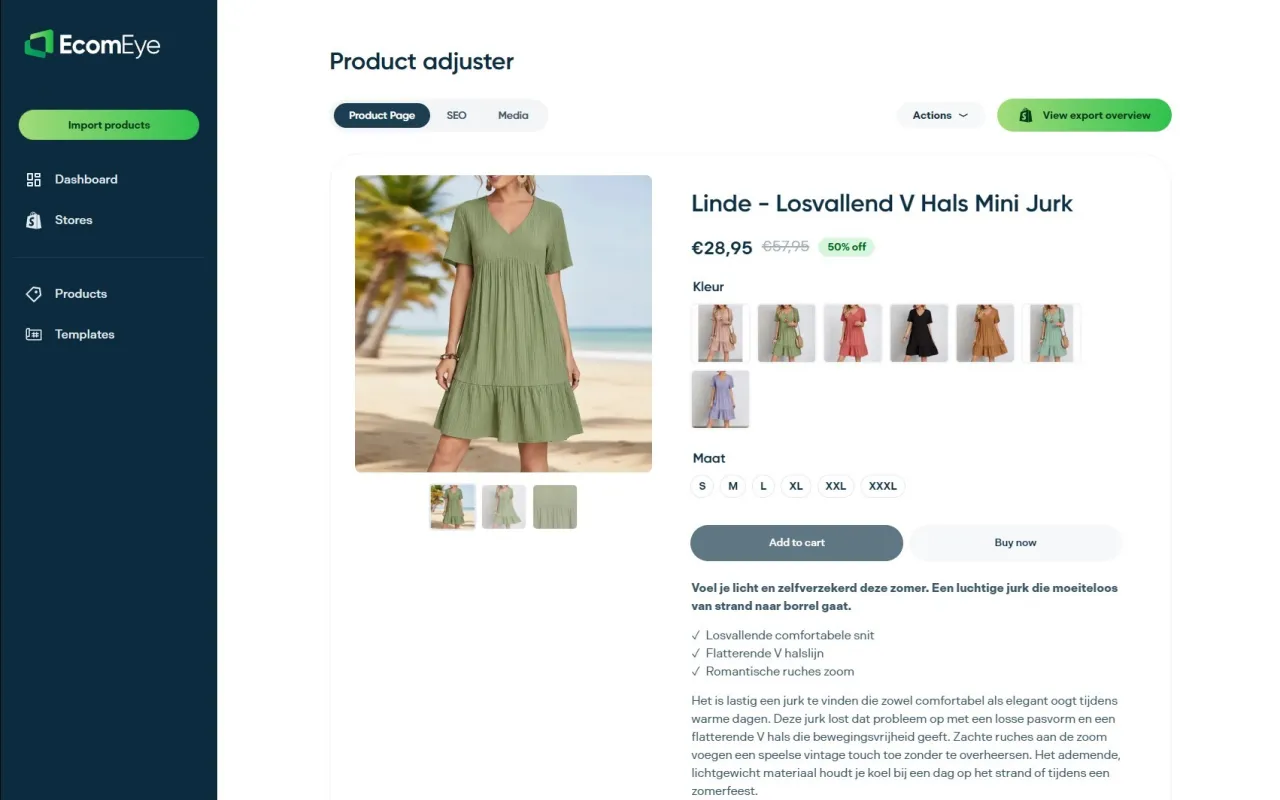
Ecom-eye generates bulk AI product listings with SEO-ready titles, clean descriptions, and structured attributes, exported directly to Shopify in one click. No rewriting, no copyright risk, no manual data entry.
Key takeaways
Granular product details directly determine whether your listings rank, convert, and build the customer loyalty that drives repeat purchases.
| Point | Details |
|---|---|
| Abandonment risk is high | Over 83% of global consumers will switch sites if product information is insufficient. |
| AI needs structure | Nearly a third of shoppers trust AI recommendations most when detailed specifications are provided. |
| Attribute consistency is critical | Amsl et al. (2023) identify attribute consistency as one of the three most important product information quality criteria. |
| Taxonomy depth drives visibility | Leaf-level categorisation unlocks tailored attribute fields that power marketplace filtering and search placement. |
| Brand perception is at stake | A significant majority of consumers form a negative opinion of a brand when they encounter incomplete or inaccurate product information online. |
FAQ
What does “granular details” mean in product data?
Granular details are highly specific data points about a product, such as exact dimensions, materials, compatibility, and category-level attributes, that go beyond a basic name and description.
Why is granular product data important for e-commerce?
Granular data determines how products rank in marketplace search, how accurately AI systems recommend them, and whether shoppers find enough information to buy with confidence.
What is an example of granular product categorisation?
Assigning a product to “Furniture > Storage > Dressers” rather than just “Furniture” is a granular categorisation. It unlocks specific attribute fields like drawer count and slide type that drive filter-based discovery.
What does it mean for product data to be granular?
It means the data captures fine-grained distinctions, such as specific subcategories, individual attribute values, and precise specifications, rather than broad, generic descriptions that apply to many products at once.
Ready to boost your product pages?
Generate high-converting, SEO-optimized product pages in bulk using AI automation used by e-commerce experts.
No credit card required