Shopify website cost guide 2026: what new owners should budget
Discover the costs of building a Shopify website in 2026. Learn about DIY, freelancer, agency, and custom options to budget effectively.

Shopify website cost guide 2026: what new owners should budget

A basic Shopify store you build yourself can go live for under $500 in Year One. A professionally designed store with custom features and Shopify Plus can run past $100,000. Most new store owners land somewhere in the middle, and where you land depends almost entirely on which of four build paths you choose.
Here’s the quick map:
- DIY build: roughly $0 to $468 in Year One, using free themes, Shopify’s own tools, and minimal apps.
- Freelancer build: $500 to $10,000 depending on complexity, covering custom design and product setup.
- Small agency build: $2,500 to $25,000, typically including strategy, conversion optimisation, and staff training.
- Full custom / Shopify Plus: $15,000 to $100,000+, reserved for high-volume merchants needing headless architecture or bespoke integrations.
Those figures cover platform subscription, design, and basic build work. They don’t include ongoing marketing spend, paid advertising, or the cost of professional photography unless a section says otherwise. Think of them as the price of getting the shop open, not the price of getting it busy.
Key Takeaways
Building a Shopify store costs anywhere from under $500 DIY to over $100,000 for enterprise Plus builds, with content preparation as the single biggest lever on both price and timeline.
| Point | Details |
|---|---|
| Match budget to build path | DIY, freelancer, agency, and Plus builds sit in distinct cost bands; pick the one that fits your catalogue size and timeline. |
| Separate one-time from recurring costs | Platform fees, apps, and payment processing continue monthly long after the build invoice is paid. |
| Prepare content before development starts | Ready product copy and images can cut build time by 30 to 50%. |
| Add contingency to every quote | Budget 15 to 25% above any freelancer or agency estimate for scope creep. |
| Automate product pages to cut hidden costs | Ecom-eye generates bulk, SEO-ready Shopify product pages and images to reduce the content bottleneck that inflates most quotes. |
For a deeper breakdown of ongoing platform and app costs, see the full Shopify pricing cost stack.
Where the numbers and recommendations came from
- Shopify’s ecommerce cost guide — Year One DIY cost estimates and ongoing monthly cost bands by business stage.
- Shopify’s official pricing page — subscription tiers, Shopify Plus pricing, and content-readiness time savings.
- FactoryJet’s Shopify cost breakdown — market-wide agency pricing ranges and the small business sweet spot.
- ShopExperts’ Shopify setup cost guide — tiered setup costs by engagement type, from DIY to enterprise.
- Webgility’s Shopify fees guide — advice on evaluating agency quotes, contingency budgeting, and avoiding low-ball work.
Table of Contents
- How much does it cost to build a Shopify website: the monthly fees
- What does it cost to build a Shopify website upfront?
- What factors actually change your Shopify quote?
- How much does a Shopify store cost to run every month?
- How long does it take to launch a Shopify store?
- What should you pay a freelancer or agency, and what should you ask?
- Where does the hidden cost usually hide?
- Why total cost of ownership matters more than the sticker price
- Cut your build costs with bulk product page automation
- Sources
- FAQ
How much does it cost to build a Shopify website: the monthly fees
Every Shopify store carries recurring costs regardless of how the site was built, and this is where a lot of new owners underestimate their real annual spend. Shopify’s published pricing runs from entry-level plans through to Shopify Plus, with each tier unlocking more features, higher transaction allowances, and better support.
Standard plans sit in a range starting around twenty-nine dollars to nearly three hundred dollars per month when billed annually, and annual billing typically works out cheaper per month than paying monthly. Shopify Plus, aimed at high-growth and enterprise merchants, starts at $2,300 per month, which reflects the jump in checkout customisation, API limits, and dedicated support that larger operations need.
Hosting is bundled into every plan. You won’t get a separate server bill the way you might with an open-source platform, and that’s one of Shopify’s genuine advantages for a first-time store owner who doesn’t want to manage infrastructure.
Payment processing is the other recurring cost that catches people out. Using Shopify Payments avoids the extra transaction fee that applies when you connect a third-party processor like PayPal or Stripe instead. That third-party fee, plus the standard card processing rate, can quietly add a percentage point or two to every sale if you haven’t checked your plan’s terms via Shopify’s own billing documentation.
Pro Tip: Run your numbers on annual billing before you commit. The monthly saving looks small on paper, but across 12 months it can cover an app subscription or two.
What does it cost to build a Shopify website upfront?
This is the number most people actually want, and it splits cleanly into four tiers based on who does the work.
DIY, using Shopify’s free themes and your own labour, typically costs $0 to $350 or more once you add a paid theme or a couple of apps. You’re trading money for time, and for a solopreneur testing a product idea, that trade often makes sense.
Basic freelancer work runs $500 to $2,500 for straightforward builds: theme customisation, product upload, and basic setup. Move into mid-complexity freelance territory, with custom sections or app integrations, and you’re looking at $2,500 to $10,000.
Boutique agencies charge $10,000 to $25,000 for a fuller service, and many small business builds cluster in a $2,500 to $10,000 sweet spot once you factor in agencies that scale their offer down for smaller clients. A Shopify marketing agency package at this level usually bundles design, launch support, and some conversion work into one quote.
Enterprise and Plus projects start around $15,000 and can exceed $100,000, particularly where headless commerce or complex custom checkout logic is involved.
| Build tier | Upfront cost | Monthly fees | Time to launch | Best for | Typical deliverables |
|---|---|---|---|---|---|
| DIY | $0–$350+ | $29–$29 | 1–3 weeks | Solopreneurs testing an idea | Free theme, basic apps, self-managed setup |
| Freelancer | $500–$10,000 | $29–$299 | 3–8 weeks | Growing stores needing custom touches | Theme customisation, product upload, basic SEO |
| Small agency | $2,500–$25,000 | $29–$299 | 6–12 weeks | Established merchants wanting strategy | Custom design, training, conversion optimisation |
| Enterprise/Plus | $15,000–$100,000+ | $2,300+ | 3–6 months | High-volume or headless commerce needs | Custom architecture, integrations, dedicated support |
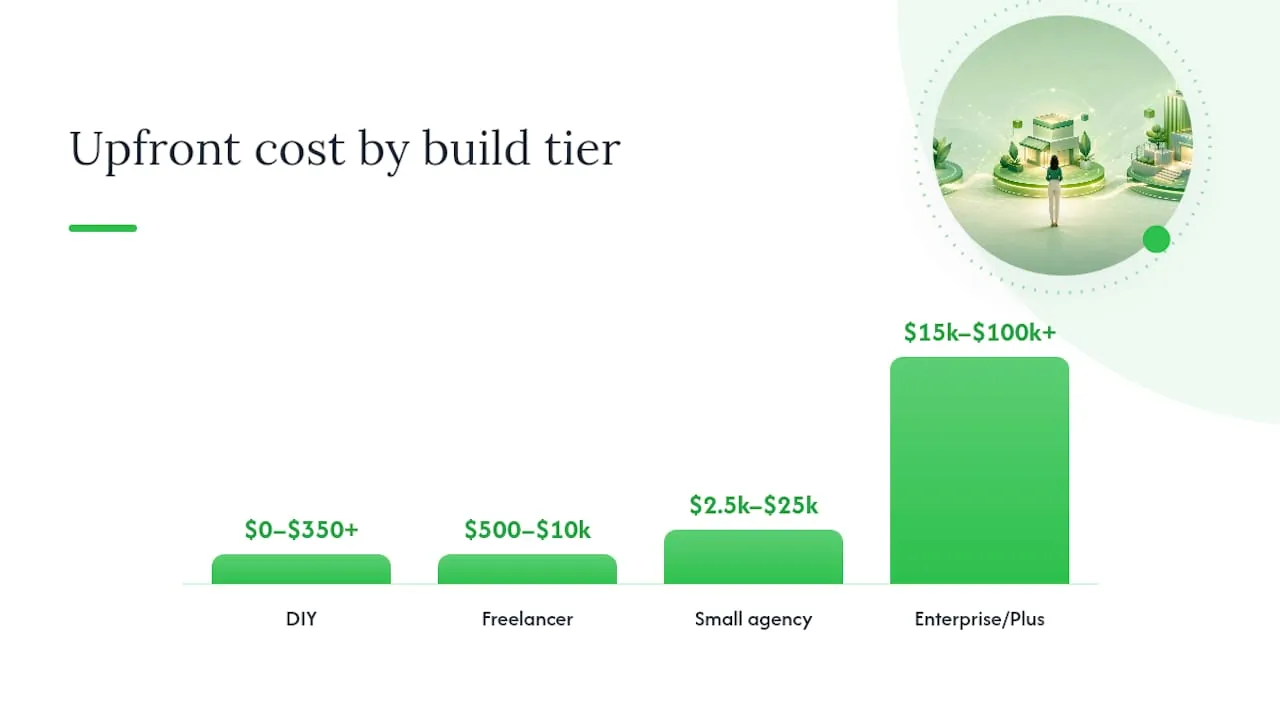
A 50-SKU jewellery brand with a standard theme might sit near the bottom of the freelancer tier. A 2,000-SKU homeware retailer needing custom filtering and a wholesale portal will push straight into agency or enterprise pricing, regardless of how simple the original brief sounded.
What factors actually change your Shopify quote?
Every quote you get back from a freelancer or agency is built from the same handful of variables, and understanding them lets you negotiate scope instead of just haggling on price.
- Number of SKUs and product complexity: a 20-product store and a 2,000-product store with variants (size, colour, material) take very different amounts of setup time, even on identical themes.
- Custom features and integrations: subscription billing, loyalty programmes, or a live shopping feature all add development hours that a template can’t absorb.
- Headless or Shopify Plus requirements: decoupling the frontend from Shopify’s backend is powerful for high-traffic brands but adds real engineering cost, often justified only once revenue crosses a certain threshold.
- Photography and copywriting: professional images and unique product descriptions for hundreds of SKUs can quietly become the single largest line item in a quote.
- Migration complexity: moving from WooCommerce, Wix, or another platform means mapping old data, redirects, and order history, which takes longer than most owners expect.
Agencies often price in strategy and training alongside pure technical build time, which is why two quotes for what looks like the same job can differ by thousands of dollars.
Pro Tip: Control scope by locking your product catalogue and photography before you request quotes. Freelancers and agencies price based on what they can see, and a moving target always costs more than a fixed one.
How much does a Shopify store cost to run every month?
Launch day is the beginning of your spending, not the end of it. Ongoing costs fall into predictable categories: platform subscription, app stack, payment processing, and basic maintenance or monitoring.
Rough monthly bands by business stage, excluding paid advertising, look like this:
- Solopreneur: $30 to $100 a month, covering the Basic plan and one or two lightweight apps.
- Growing business: $100 to $500 a month, once you’ve added inventory management, email marketing, and reviews apps.
- Established merchant: $500 to $2,500+ a month, reflecting a larger app stack, higher-tier plans, and possibly a support retainer.
Payment processing typically sits around standard card rates plus a small per-transaction fee, and that percentage matters more than most new owners assume once monthly revenue climbs into five figures. A solopreneur doing $3,000 a month in sales barely notices the processing fee. A growing store doing $50,000 a month feels every fraction of a percent.
Build your app budget around necessity, not novelty. It’s easy to install ten free-trial apps in the first month and forget that six of them convert to paid subscriptions after 14 days.
How long does it take to launch a Shopify store?
Timeline expectations vary wildly by build path, and the gap between “I could launch this weekend” and “this will take four months” usually comes down to who’s doing the work and how ready your content is.
- DIY: 1 to 3 weeks for someone comfortable with basic web tools, assuming products and copy are already written.
- Freelancer: 3 to 8 weeks, with most of that time spent on custom design and back-and-forth revisions.
- Small agency: 6 to 12 weeks, stretched by strategy sessions, design approval rounds, and testing.
- Full custom or Shopify Plus: 3 to 6 months, driven by custom development, integration testing, and staged rollouts.
The phases that most commonly blow past their estimated dates are content preparation, product data import, app configuration, and pre-launch testing. Design almost never causes the delay. Missing product descriptions and unformatted spreadsheets usually do.
If you want to accelerate launch without cutting corners, get your product content finished before development starts, not during it. A developer waiting on copy is a developer you’re paying to wait.
What should you pay a freelancer or agency, and what should you ask?
Pricing models generally split three ways: hourly, fixed price, or phased milestones. Hourly rates for Shopify specialists typically range from $50 to $150 depending on experience and location, fixed price suits well-defined small builds, and phased milestones work best for anything agency-scale where scope might shift.
Before you sign anything, run through this checklist:
- What exactly is included in the deliverables list, in writing?
- How many rounds of design revisions are covered in the price?
- Is there a warranty period for bug fixes after launch?
- Who owns the theme code and any custom development once the project ends?
- Will you receive training on how to manage the store yourself?
- What does the handover process look like, and how long does it take?
- Can they show past Shopify projects, ideally in your product category?
- Is product upload and basic SEO setup included, or billed separately?
- What happens if the project runs over the agreed timeline?
- How do they handle scope changes requested mid-project?
A simple budget template for your spreadsheet should separate four buckets: one-time build cost, monthly platform and app fees, contingency, and marketing spend. Keep marketing entirely separate from build cost. It’s a different budget with a different purpose.
Red flags worth walking away from: quotes with no itemised breakdown, prices dramatically below every published range you’ve seen, and anyone unwilling to put deliverables in writing. Low-ball quotes routinely deliver templated work that needs costly rework within six to twelve months, which defeats the purpose of choosing the cheap option in the first place.
Where does the hidden cost usually hide?
Ask almost any Shopify developer what actually eats the budget on a “simple” build, and most won’t say design. They’ll say content.

Product descriptions, titles, structured data, and imagery for a full catalogue take far longer to produce than owners expect, and that time gets billed. Having product content ready before development starts can cut build time by 30 to 50%, because developers stop waiting on copy that hasn’t been written yet.
Here’s what that looks like at scale, comparing a 500-product catalogue built two different ways:
| Approach | Time required | Estimated cost | Main bottleneck |
|---|---|---|---|
| Manual content creation | Several weeks of writing and formatting | Thousands of dollars in freelance copywriting and design hours | Copywriter and photographer availability |
| Bulk automated generation | Hours to a few days | A fraction of manual cost, scaling with credits used | Import mapping and quality review |
The manual route means briefing a copywriter, waiting on drafts, sourcing or shooting images, and formatting everything for upload, one product at a time, five hundred times over. The automated route means importing product data and letting generation tools produce titles, descriptions, and images in bulk, then reviewing the output before publishing. Ecom-eye’s SEO content generation approach is built specifically around this gap.
Pro Tip: Before committing to any content automation tool, run a small batch of 10 to 20 products first. Check for accurate specifications, natural phrasing, and correct sizing conversions before you commit your full catalogue.
Why total cost of ownership matters more than the sticker price
Most first-time store owners fixate on the upfront number and forget that a cheap build with poor conversion rates costs more over a year than a mid-range build that actually sells. Total cost of ownership thinking, not the invoice total, is the number that should guide your decision.
My honest recommendation for a small business budget: spend in the $2,500 to $10,000 freelancer or small-agency band rather than chasing the absolute floor. That range buys you a store that’s been built by someone who understands conversion, not just someone who can install a theme.
Whatever quote you settle on, add 15 to 25% contingency on top. Scope creep is close to universal in ecommerce builds, and a contingency fund is the difference between a stalled project and a delayed but finished one.
If you can only afford to optimise one part of the store properly, make it the product pages. That’s where visitors decide to buy or leave, and it’s the area most worth getting right before you spend another dollar on anything else.
Cut your build costs with bulk product page automation
Freelancers and agencies charge real money for one job in particular: writing and formatting product content one item at a time. Ecom-eye removes that line item entirely by generating copyright-safe, SEO-optimised product pages in bulk, straight from your AliExpress, Amazon, or competitor Shopify links.
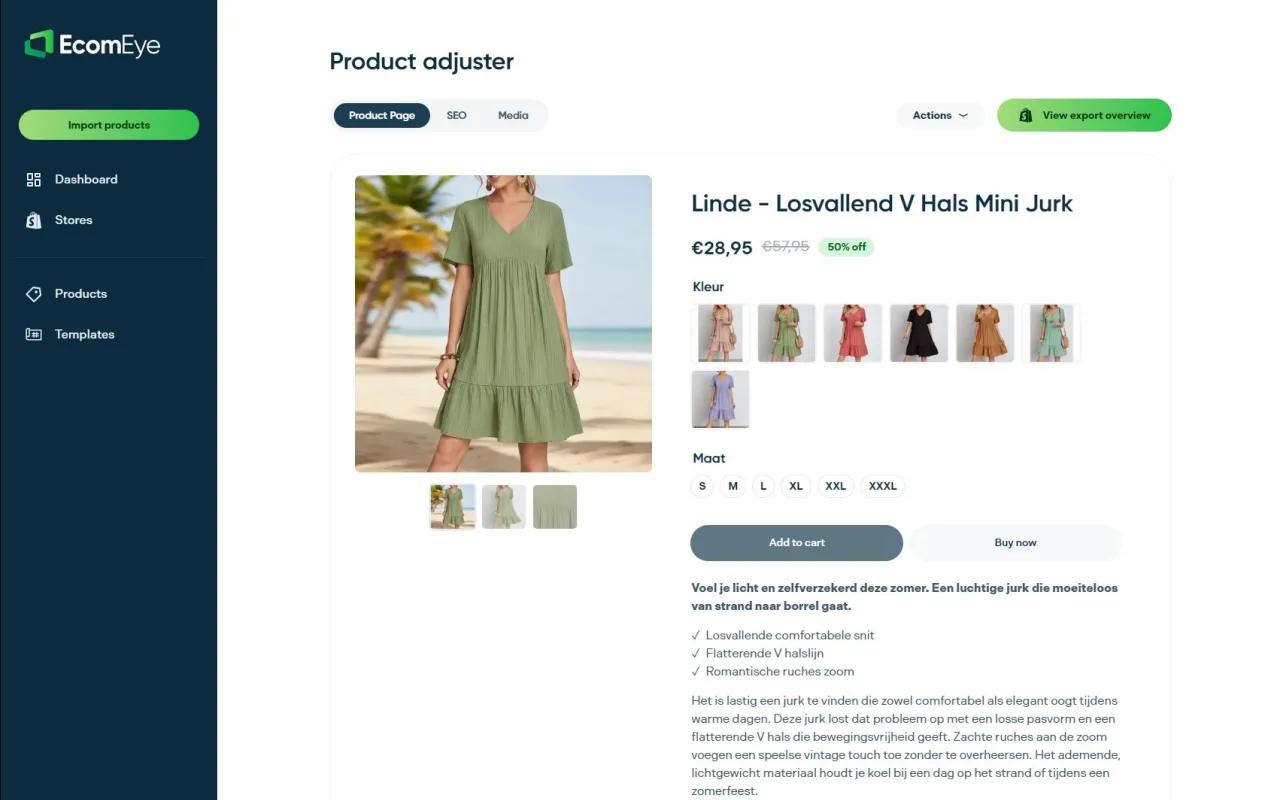
For a 500-product catalogue, manual content creation typically means weeks of copywriter and photographer time before a developer can even start building pages around it. Ecom-eye generates unique titles, clean descriptions, and AI product images for that same catalogue in a fraction of the time. It then exports directly to Shopify with one click. No duplicate content, no Google Merchant disapprovals, no waiting on a freelancer’s calendar. Try the AI product description generator on your own product list and see how much build time it takes off your next launch.
Sources
- Ecommerce Website Cost: Full Guide for 2026 - Shopify
- Shopify Pricing: Find the Right Plan for Your Business - Shopify
- How Much Does a Shopify Website Cost in 2026? (Real Numbers)
- Shopify Store Setup Cost: What You Should Actually Pay (2026 Guide) | ShopExperts
- Shopify fees guide — Webgility
FAQ
How much should I pay someone to build a Shopify website?
Expect $500 to $2,500 for a basic freelancer build, $2,500 to $10,000 for mid-complexity work, and $10,000 to $25,000 for a full small agency service with strategy and training included.
Is Shopify still worth it in 2026?
Yes, for most small to mid-sized merchants. Hosting is included, plans start at $29 a month on annual billing, and the platform scales up to Shopify Plus as revenue grows, so you rarely need to migrate platforms as you succeed.
Is building a website on Shopify worth it compared to alternatives?
Shopify’s bundled hosting, security, and app ecosystem generally make it more cost-effective than assembling an open-source stack yourself, particularly once you factor in developer time saved on infrastructure and maintenance.
How much should a Shopify website cost overall?
A realistic Year One budget for most new store owners falls between $500 and $25,000 all in, depending on whether you build it yourself, hire a freelancer, or work with a small agency.
How can I reduce the cost of building a Shopify store?
Tools like Ecom-eye automate this step in bulk for catalogues that would otherwise take weeks to write manually.
Ready to boost your product pages?
Generate high-converting, SEO-optimized product pages in bulk using AI automation used by e-commerce experts.
No credit card required