How to develop international product pages that convert
Learn how to develop international product pages that convert by localizing content, enhancing SEO, and boosting customer satisfaction. Drive sales now!

How to develop international product pages that convert

TL;DR:
- International product pages require full localization beyond translation, including culture, SEO, and technical setup.
- Proper infrastructure, market research, and adaptation to local language, imagery, and operational details are essential.
Developing international product pages is the process of localising and optimising e-commerce listings so they resonate with buyers in specific markets and drive conversions. 76% of online consumers prefer to buy when product information appears in their own language. That single fact reframes the entire challenge: international product pages are not a translation exercise. They are a full localisation effort covering language, culture, SEO, pricing, and technical setup. Personalising e-commerce sites with local currency, language, and content increases conversion rates by 10–15% and customer satisfaction by 20%. The merchants who treat this as a one-off task consistently underperform those who treat it as an ongoing operational discipline.
How to develop international product pages: foundations first
Before writing a single word of localised copy, you need the right infrastructure. Three categories of requirement matter most: market research, localisation tooling, and platform capability.
Market research means per-market keyword research, not a translated keyword list. Search intent shifts across borders in ways that catch merchants off guard. A shopper in the United States searches for “sneakers” while a shopper in the United Kingdom searches for “trainers.” Direct translation misses this entirely, and a page optimised for the wrong term will rank for nothing. Use local keyword tools and, where possible, native speakers to map the actual terms your target audience uses.
Localisation tooling covers translation management platforms such as Crowdin or Lara Translate. These platforms store glossaries, style guides, and translation memories so your brand voice stays consistent across every language. Without them, you end up with inconsistent terminology and repeated translation costs every time you update a product description.
Platform capability determines what is technically possible. Your e-commerce platform must support multi-language storefronts, regional currency display, and geo-targeting. On the SEO side, hreflang tags and URL structures are non-negotiable. Hreflang tells search engines which version of a page to serve to which audience. A missing or malformed hreflang annotation sends the wrong page to the wrong market, destroying both rankings and user experience.
| Requirement category | What you need | Why it matters |
|---|---|---|
| Keyword research | Per-market research tools | Captures local search intent accurately |
| Translation management | Platforms like Crowdin or Lara Translate | Maintains brand consistency across languages |
| SEO implementation | Hreflang tags, localised URL structures | Prevents search engine indexing errors |
| Platform support | Multi-language and currency features | Enables regional personalisation at scale |
Pro Tip: Place hreflang annotations inside your XML sitemap rather than in the HTML head. This keeps page code clean and makes managing large catalogues significantly easier.
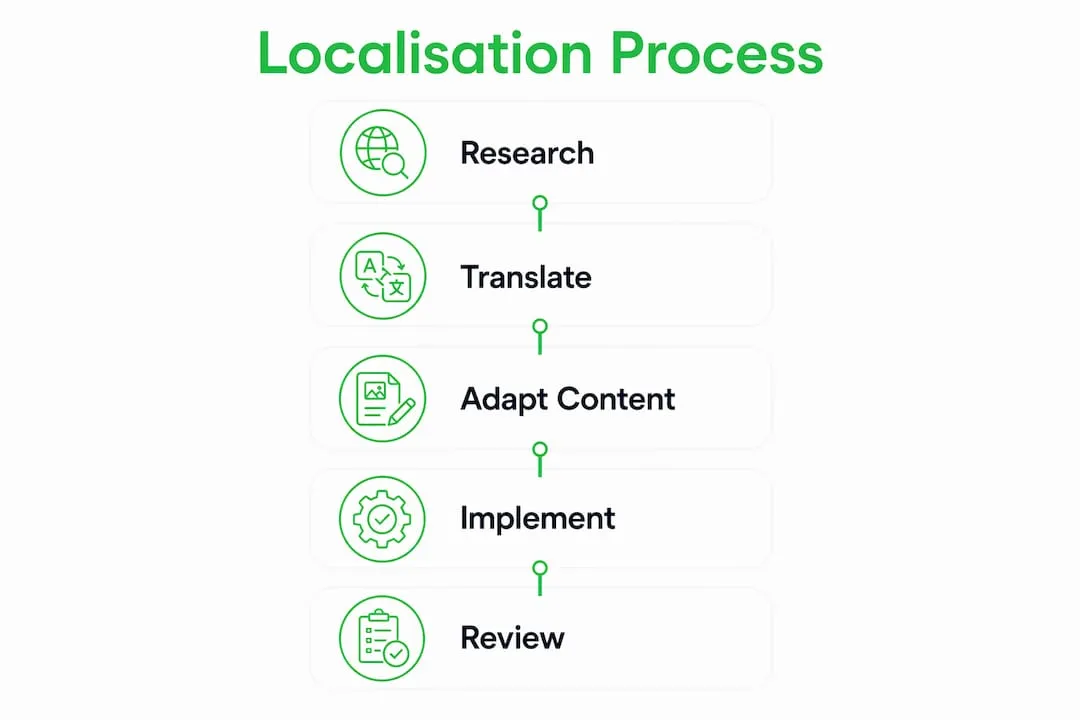
How do you localise product content for different markets?
Localisation of product content goes well beyond swapping words from one language to another. The industry term for this deeper process is transcreation: adapting the meaning, tone, and cultural references of your content so it feels native to the target market.

Start with product titles and descriptions. A title that performs well in Germany may be grammatically correct in French but completely miss the local buying trigger. Work with professional translators who understand the product category, not just the language. Provide them with a glossary of your brand terms and a style guide that defines your tone. Translation management platforms with glossary support ensure that “free returns” is always translated the same way, and that your brand name is never accidentally localised.
Product imagery requires the same scrutiny. Cultural adaptation of product images means adjusting colours, symbols, and even the people shown to match regional preferences and avoid unintended offence. The number 8 is considered lucky in several Asian markets; the number 4 carries negative associations in others. A product packaged in sets of four may need repackaging or repositioning for those markets. These details are invisible to a merchant working from a single-market mindset and obvious to a local buyer.
Metadata follows the same rules. Your meta titles and descriptions must use locally researched keywords, not translated versions of your home-market terms. A page with a German-language description but English-market keywords will rank poorly in German search results. Treat metadata as a separate localisation task, not an afterthought.
Pro Tip: Ask your translators to flag any product claims that may be regulated differently in the target market. Certain health, safety, or environmental claims that are legal in one country may require modification or removal in another.
For a deeper look at how language choices affect buyer behaviour across markets, the role of language in global e-commerce is worth reading before you brief your translation team.
Which technical elements must you adapt for international pages?
Technical localisation covers the operational details that buyers notice immediately when they land on a product page. Get these wrong and even perfect copy will not save the sale.
Pricing and currency sit at the top of the list. Displaying prices in local currency with automatic location detection removes a major source of friction. Shoppers should never have to calculate an exchange rate. Dynamic tax handling matters equally: a price shown excluding VAT in a market where buyers expect tax-inclusive pricing creates distrust at checkout.
Measurements and sizing are a frequent source of returns and negative reviews. A clothing merchant selling into the United States, the United Kingdom, and continental Europe needs three different size charts. A hardware merchant needs to present dimensions in imperial units for American buyers and metric units for European buyers. Build these conversions into your product page template so they apply automatically by region.
Shipping information must be accurate and specific. Vague delivery estimates damage conversion. A buyer in Australia needs to see Australian delivery times and costs, not a generic global shipping note. Localisation as an operational strategy means connecting your logistics data to your product pages so this information updates dynamically.
Customer reviews add a layer of complexity that most merchants overlook. A product page in French should surface French-language reviews prominently. Showing only English reviews to a French buyer signals that the product has not been tested by people like them. Filter and display reviews by language and market where your platform allows.
On the technical SEO side, your domain structure choice has lasting consequences. Subfolders (yourstore.com/fr/) are easier to manage and consolidate domain authority. Subdomains (fr.yourstore.com) offer more flexibility but dilute SEO signals. Country-code top-level domains (yourstore.fr) send the strongest geo-targeting signal but require separate SEO investment per domain. Most growing merchants start with subfolders. Pair your chosen structure with correct hreflang implementation and a locale-specific XML sitemap for each market.
What is the right process for rolling out international pages?
A staged rollout prevents the most common failure mode: spreading effort across too many markets before any single market is done properly.
- Audit your existing pages. Identify your highest-traffic and highest-converting product pages. These are the pages that will deliver the most return when localised first.
- Prioritise product detail pages, navigation, and checkout flows. These three page types have the greatest impact on conversion and search visibility. Localise them before touching blog posts, FAQs, or policy pages.
- Run per-market keyword research before writing. Feed the results to your translators as context. A translator who knows that “running shoes” outperforms “sports shoes” in a given market will make better decisions throughout the copy.
- Implement hreflang and URL structures before publishing. Launching localised pages without correct hreflang in place means search engines may index the wrong version or treat your pages as duplicate content.
- Publish one market at a time. Resist the temptation to launch five languages simultaneously. A single well-executed market launch gives you data to refine your process before scaling.
- Monitor traffic, conversion rates, and bounce rates by locale. These three metrics tell you whether your localisation is working or whether a market needs further attention.
The most common mistakes follow a predictable pattern. Merchants skip hreflang because it feels technical and optional. They translate keywords rather than researching them locally. They launch too many markets at once and end up with thin, inconsistent localisation across all of them. They also forget to update localised pages when the source page changes, creating version drift that confuses both buyers and search engines.
Pro Tip: Set a quarterly review cycle for each localised market. Check that product descriptions, pricing, and shipping information still reflect current conditions. Markets change, and a page that was accurate at launch can become misleading within months.
For a practical workflow that covers the full lifecycle of managing global listings, the workflow for global product listings guide covers the operational steps in detail.
Key takeaways
Effective international product pages require localisation across content, technical setup, and operations. Treating any one of these as optional produces pages that rank poorly and convert worse.
| Point | Details |
|---|---|
| Localise, do not translate | Use transcreation and per-market keyword research to match local search intent. |
| Fix technical SEO first | Implement hreflang tags and localised URL structures before publishing any page. |
| Prioritise high-impact pages | Start with product detail pages, navigation, and checkout flows for maximum return. |
| Adapt operational details | Show local currency, accurate shipping times, and market-relevant sizing automatically. |
| Roll out one market at a time | A single well-executed market gives you data to improve before scaling further. |
What I have learned from watching merchants get this wrong
Most merchants approach international expansion the same way they approached their first product page: write something, publish it, and see what happens. That works when you are testing a single market. It fails badly when you are trying to serve buyers in France, Germany, Japan, and Brazil at the same time.
The merchants I have seen succeed treat localisation as a permanent operational function, not a project with an end date. They assign someone to own each market. They build review cycles into their calendar. They invest in local keyword research before they invest in translation. The ones who struggle do it the other way around: they spend heavily on translation and then discover that the keywords they translated were never the ones their target buyers were searching for.
Cultural adaptation is the part that surprises people most. A product image that performs well in northern Europe can feel cold or impersonal in southern European or Latin American markets, where warmer, more lifestyle-oriented imagery tends to outperform. These are not guesses. They show up clearly in conversion data when you test by locale. The localisation of e-commerce content is where the real competitive advantage sits, because most merchants stop at language and never get to culture.
My honest advice: pick one market, do it properly, and measure everything. The data from that first market will teach you more than any guide can.
— Koen
Ecom-eye makes bulk international listings faster
Building localised product pages at scale is the part where most Shopify merchants stall. Writing, translating, and formatting hundreds of listings by hand takes weeks and produces inconsistent results.
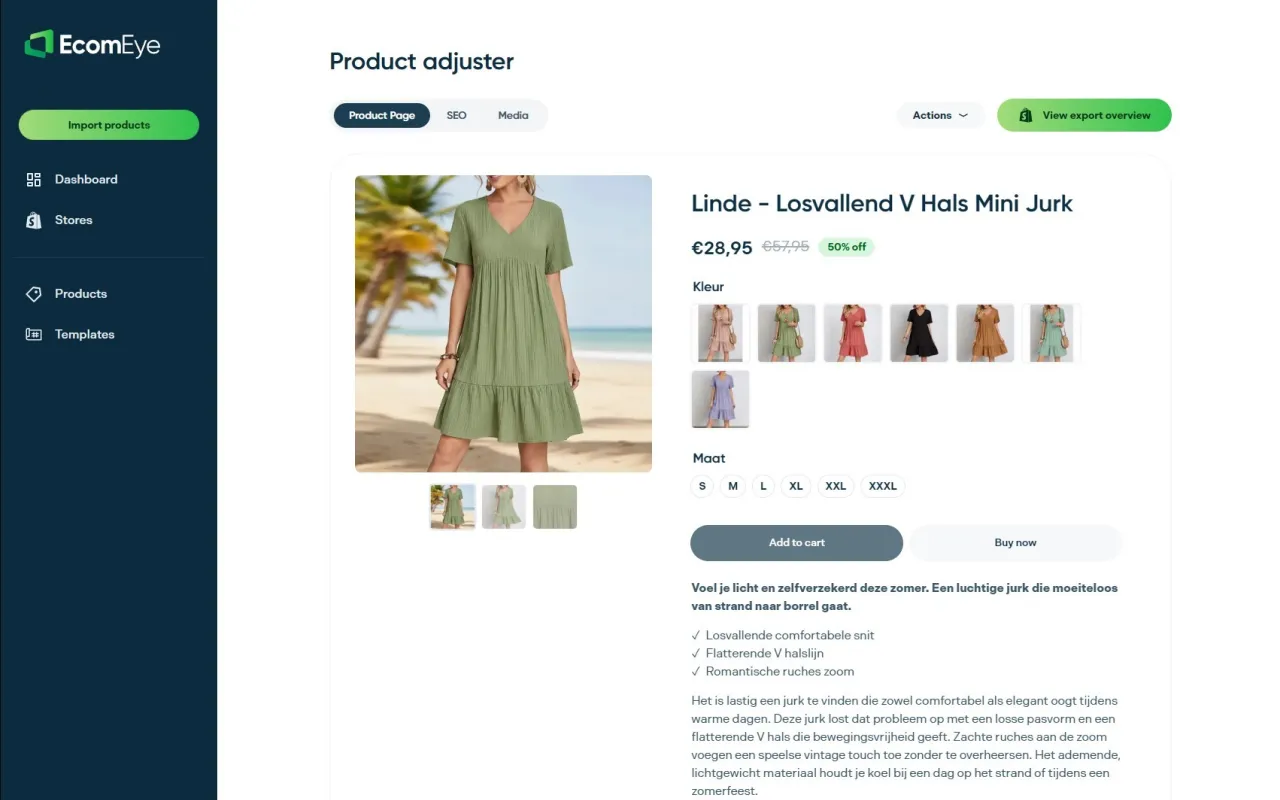
Ecom-eye’s Bulk AI Product Lister generates SEO-ready product pages in multiple languages directly from AliExpress imports or competitor URLs. The tool produces original titles, clean descriptions, and AI-generated product images, all copyright-safe and ready to export to Shopify in one click. There is no manual rewriting, no duplicate content risk, and no Google Merchant disapprovals. For merchants who need to build or refresh international catalogues without a large content team, Ecom-eye removes the bottleneck entirely.
FAQ
Why should you localise product pages rather than just translate them?
Translation converts words. Localisation adapts meaning, keywords, pricing, imagery, and cultural references to match what buyers in a specific market actually expect. 40% of shoppers actively avoid English-only sites, so language alone is not enough.
What are hreflang tags and why do they matter?
Hreflang tags tell search engines which language and regional version of a page to show to which audience. Without them, search engines may serve the wrong page to the wrong market or treat localised pages as duplicate content.
Which pages should you localise first?
Product detail pages, navigation menus, and checkout flows deliver the greatest impact on conversion and search visibility. Localise these before secondary content such as blog posts or policy pages.
How does local currency display affect sales?
Displaying prices in local currency with automatic location detection removes the friction of manual currency conversion. Dynamic tax handling further increases buyer confidence by showing the price buyers expect to pay at checkout.
How do you avoid keyword errors when localising for SEO?
Run per-market keyword research before briefing translators. Search terms vary significantly between markets, and local SEO requires transcreation rather than direct translation to capture the right search intent.
Ready to boost your product pages?
Generate high-converting, SEO-optimized product pages in bulk using AI automation used by e-commerce experts.
No credit card required