Sizetables for dropshippers: your 2026 guide
Discover how sizetables can boost your dropshipping business in 2026. Reduce returns, increase trust, and enhance conversions today!

Sizetables for dropshippers: your 2026 guide

TL;DR:
- Effective size tables translate specific body measurements into clear size labels, reducing confusion and returns. They should include regional conversions, garment measurements, and detailed instructions for accurate measurement. Building category-specific, mobile-friendly charts with transparent fit guidance enhances customer trust and minimizes international shipping costs.
Size tables are structured charts that translate body measurements into standardised sizes, enabling customers to select the correct product fit when shopping online. For e-commerce entrepreneurs and dropshippers, sizetables are not optional extras. They are the single most effective tool for reducing returns, building customer trust, and converting browsers into buyers. Category-specific size charts significantly increase conversion accuracy, and the brands that do this well share a common approach: precise measurements, regional conversions, and clear instructions.
What makes sizetables effective for product listings?
A size table is a reference chart that maps body measurements such as chest, waist, and hips to labelled sizes like XS, S, M, L, or numeric equivalents. The industry term is “size chart” or “sizing guide,” and both phrases are used interchangeably across retail. The key distinction between a basic size label and a proper size chart is specificity. A label tells a customer nothing. A chart tells them exactly where to measure and what number to look for.
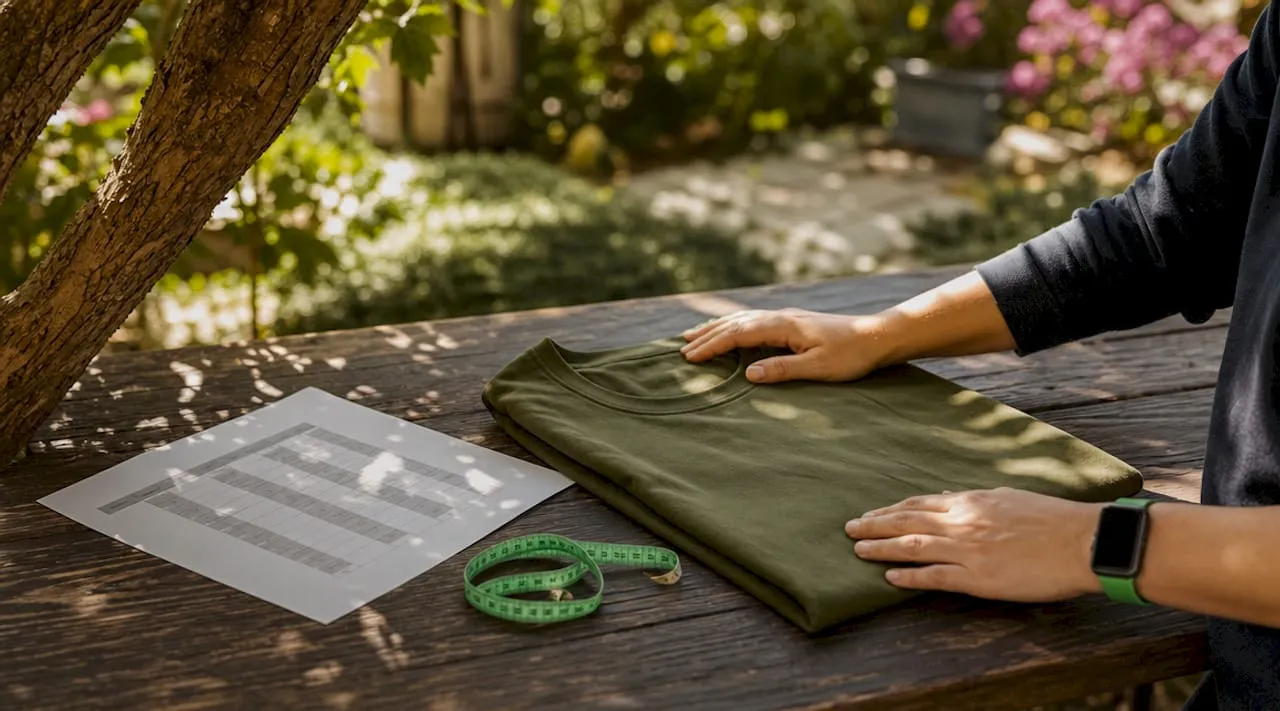
The most common mistake dropshippers make is treating size tables as an afterthought. A single generic chart pasted across every product listing creates confusion, not confidence. Customers buying a fitted blazer need different measurement columns than customers buying a pair of trainers. The measurement points differ, the fit tolerances differ, and the regional standards differ. One chart cannot serve all three.
Fashion Nova’s 2026 size guides separate apparel into distinct categories: Tops and Dresses, Bottoms and Skirts, Swimwear and Lingerie, and Shoes and Boots. That separation is not cosmetic. It reflects the reality that a customer who wears a size 12 dress may wear a size 14 in trousers. Treating those as the same measurement is a guaranteed return.
What key elements should every size chart include?
The most effective clothing size guides include both body measurements and garment measurements. Body measurements tell the customer what size to order. Garment measurements tell them how the item will actually fit when worn.
ARKET’s 2026 size guide includes measurement columns for chest, waist, hips, and arm length, presented in both centimetres and inches. That dual-metric approach removes ambiguity for customers who think in different units. A customer in the United States measuring in inches and a customer in Germany measuring in centimetres can both use the same chart without converting anything themselves.
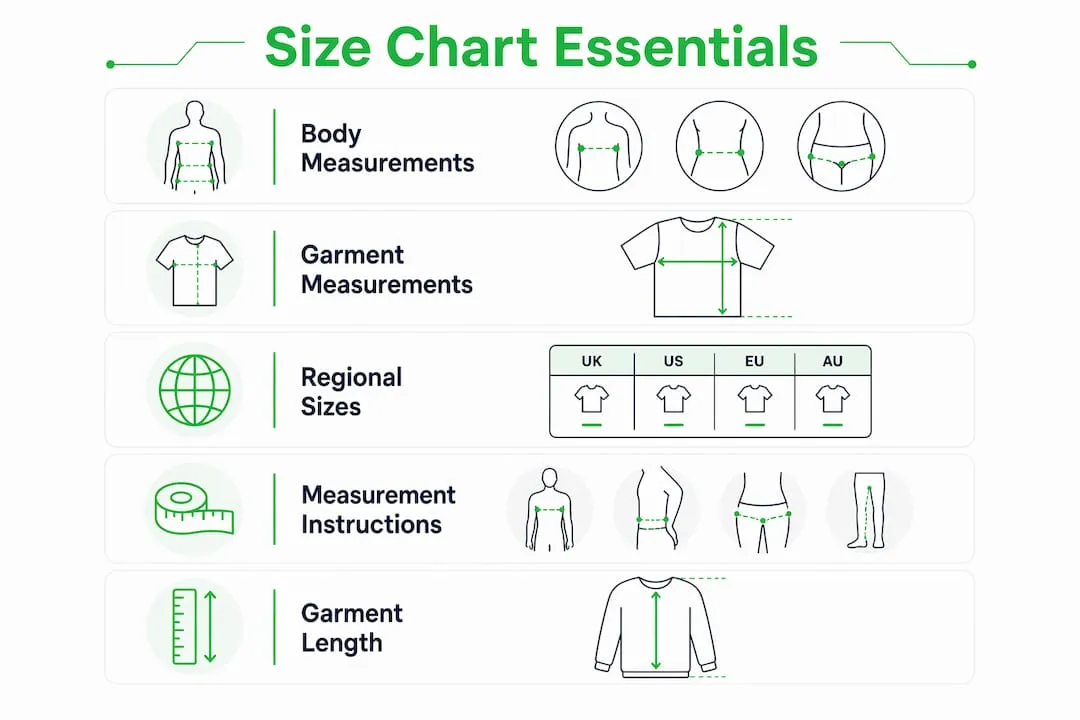
COS size guides go further, incorporating up to 10 columns per table: regional sizes, bust, waist, arm length, and low hip measurements. That level of detail helps customers predict fit beyond their basic body dimensions. It also reduces the cognitive load of comparing an unfamiliar brand’s sizing to what they already own.
The table below shows the core columns a well-structured clothing size guide should include:
| Column | What to include |
|---|---|
| Regional size label | UK, US, EU, AU equivalents |
| Chest or bust | Measurement in cm and inches |
| Waist | Measurement in cm and inches |
| Hips | Measurement in cm and inches |
| Arm length | Measurement in cm and inches |
| Garment length | Actual finished length of the item |
Pro Tip: Always add a garment length column. Customers frequently return items not because the chest measurement was wrong, but because the finished length was shorter or longer than expected.
For footwear, a shoe size table requires a different set of columns entirely. Heel-to-toe length in centimetres is the most reliable measurement. Pair that with UK, US, and EU size equivalents, and you have a shoe size table that works for a global audience.
How do regional size conversions reduce international returns?
Regional sizing standards are not uniform. A UK size 10 is a US size 6 and an EU size 38. A customer who does not know that will order the wrong size every time. Missing or inconsistent regional conversion data creates preventable returns in international e-commerce. That is a direct cost to your business.
The solution is a size conversion chart that lists regional equivalents in a single row, alongside the body measurements that correspond to each size. Dropshippers selling to customers across the UK, United States, Europe, and Australia need all four regional standards visible in the same table. Hiding conversions in a separate page or footnote is not enough. Customers need to see the conversion at the point of decision.
Effective size guides list US, UK, EU, and AU size standards alongside body measurements for clarity. That structure removes the need for the customer to open a second tab, do mental arithmetic, or guess. Each of those friction points is a reason to abandon the purchase.
- Include US, UK, EU, and AU size columns in every international product listing.
- Present measurements in both centimetres and inches within the same table.
- Label each column clearly so customers know exactly what they are reading.
- Never assume a customer knows how regional sizes differ.
Pro Tip: If you source products from AliExpress, the supplier’s size chart is almost always based on Chinese sizing standards, which run smaller than UK and EU equivalents. Always recheck measurements against a standardised size conversion chart before publishing.
The multi-country dropshipping workflow for 2026 treats regional size conversion as a non-negotiable step in product listing preparation, not an optional addition.
How do measurement instructions improve customer accuracy?
A size chart is only useful if the customer measures themselves correctly. Most customers do not know how to take a chest measurement, where exactly to measure their waist, or how to measure heel-to-toe for shoe sizing. Without clear instructions, even a detailed size table produces wrong results.
ARKET provides step-by-step measurement graphics showing exactly where to place the tape measure for chest, waist, hips, arm length, and heel-to-toe foot length. Those graphics reduce user error at the most critical point in the purchase decision. A customer who measures correctly and orders the right size does not return the item.
The most effective measurement instructions follow this structure:
- Name the body part clearly (“chest,” not “bust/chest”).
- State where to position the tape measure (“measure around the fullest part of your chest, keeping the tape parallel to the floor”).
- Specify whether to measure over clothing or against bare skin.
- Include a simple diagram showing the measurement point on a body outline.
Diagrams matter more than most dropshippers realise. A written instruction and a visual together reduce errors far more than either does alone. Customers who are uncertain about where to measure will either guess or abandon the purchase. A clear diagram removes that uncertainty in under three seconds.
Pro Tip: Add a short note telling customers to measure twice and round up to the nearest half-centimetre. That single instruction prevents the most common measurement error: rounding down and ordering a size too small.
For a broader view of how accurate guides affect customer satisfaction, the role of guide articles in e-commerce is well documented. Customers who receive clear guidance before purchase return fewer items and leave better reviews.
What practical tips help dropshippers build better size tables?
The most effective size tables for dropshipping product pages share five characteristics. They are category-specific, they include garment measurements, they display regional conversions, they are readable on mobile, and they are honest about fit.
-
Separate your size tables by product category. A tops chart, a bottoms chart, and a footwear chart are three separate documents. Combining them into one table creates confusion and increases the chance of a wrong order.
-
Add physical garment measurements. COS explicitly lists garment measurements alongside body size ranges to counter vanity sizing. Customers can hold a tape measure against their own clothing and compare directly. That comparison is more reliable than body measurements alone.
-
Test your tables on mobile. A table with 10 columns that looks clean on a desktop becomes unreadable on a phone screen. Use a scrollable table format or a condensed mobile version that shows the three most critical columns: size label, chest, and waist.
-
Be transparent about fit. If a product runs small, say so. A note reading “this style runs one size small; we recommend sizing up” prevents returns and builds trust. Customers appreciate honesty far more than they appreciate a brand that pretends every size is perfect.
-
Use dynamic conversion tools where possible. Category-specific conversion tools eliminate ambiguity in regional sizing standards for dropshippers selling to global audiences. A tool that automatically displays the correct regional size based on the customer’s location removes the conversion step entirely.
For advice on smarter sizing in online fashion, the principle is consistent: customers who understand their measurements before they order return fewer items and spend more per visit.
The international dropshipping success steps for 2026 place size table accuracy alongside product photography and pricing as a core conversion factor. That ranking reflects how much a poorly structured size chart costs in returns and lost sales.
Key takeaways
Accurate, category-specific size tables with regional conversions and clear measurement instructions are the most direct way to reduce returns and increase conversion in dropshipping.
| Point | Details |
|---|---|
| Category separation | Use separate size charts for tops, bottoms, and footwear to prevent ordering errors. |
| Garment measurements | List physical garment dimensions alongside body measurements to counter vanity sizing. |
| Regional conversions | Include UK, US, EU, and AU size equivalents in every table for international customers. |
| Measurement instructions | Provide step-by-step instructions and diagrams so customers measure correctly. |
| Mobile readability | Test every size table on a phone screen and use scrollable formats for wide tables. |
Why most dropshippers get size tables wrong
I have worked with a lot of online retailers and dropshippers, and the pattern is almost always the same. The product page gets careful attention: good images, a solid title, a clean description. Then the size table gets a single screenshot copied from the supplier’s listing, usually in Chinese sizing, sometimes blurry, and never updated.
That approach costs more than most people realise. A return is not just a refund. It is a shipping cost, a restocking cost, a customer who will not come back, and a review that warns others away. The maths on a bad size table are brutal.
What I have found actually works is treating the size chart as part of the product page, not an appendix to it. The best dropshippers I have seen build category-specific charts from scratch, verify measurements against physical samples, and update them when supplier specs change. That takes time upfront, but it pays back in lower return rates and higher repeat purchase rates.
The technology side is moving fast. Dynamic sizing tools that detect a customer’s location and display the correct regional standard automatically are becoming standard practice, not a premium feature. Dropshippers who do not adopt that approach by the end of 2026 will be at a measurable disadvantage against those who do.
The uncomfortable truth is that size tables are not glamorous. They do not get the attention that product photography or ad creative gets. But in my experience, fixing a broken size chart delivers a faster return on investment than almost any other product page improvement.
— Koen
How Ecom-eye handles size table integration at scale
Building accurate, category-specific size tables across hundreds of product listings is the kind of work that stops most dropshippers from scaling. Ecom-eye removes that bottleneck.
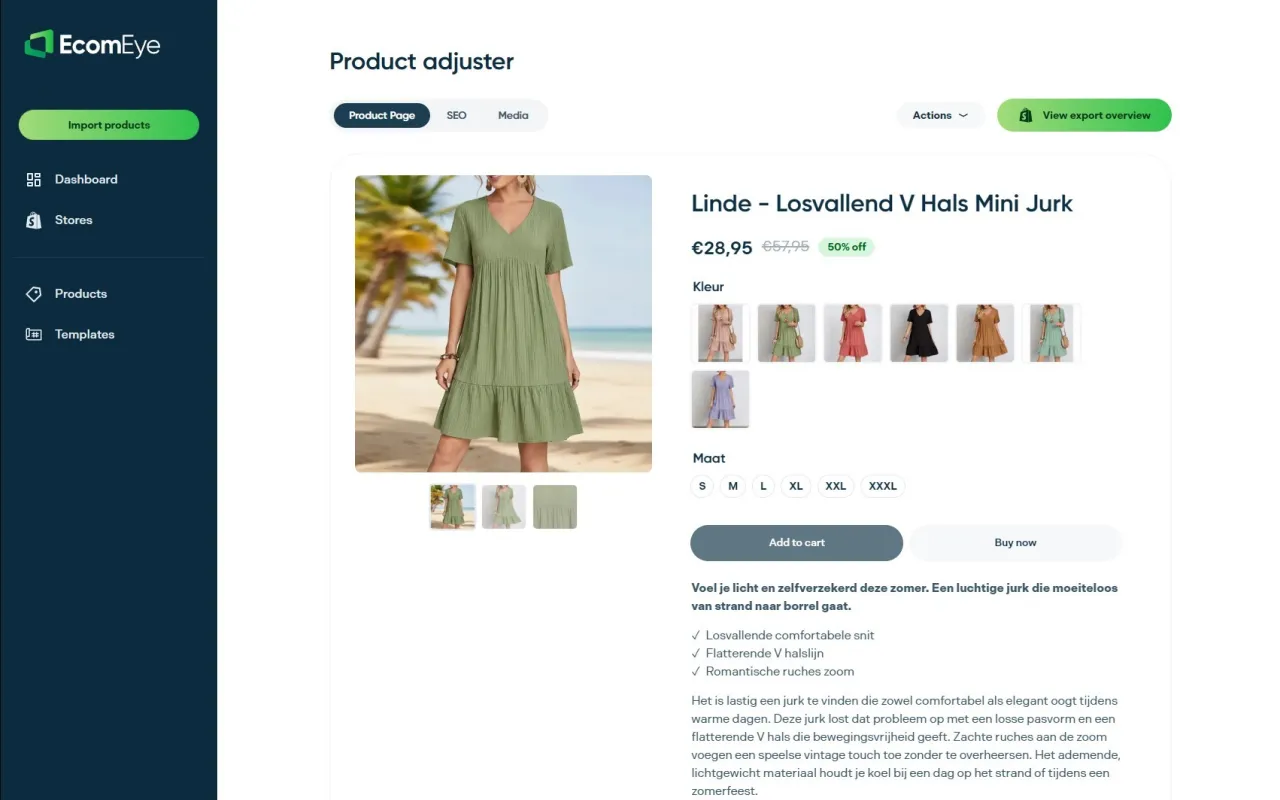
Ecom-eye is an AI platform built for Shopify dropshippers who need to generate product pages in bulk without copying competitor content. Import products directly from AliExpress, and Ecom-eye automatically generates SEO-ready product listings with clean descriptions, optimised titles, and structured content ready for export to Shopify in one click. No rewriting, no copyright risk, and no manual work on individual listings. For dropshippers managing large catalogues across multiple markets, that means consistent, accurate product content at a scale that manual methods cannot match.
FAQ
What is a size table in e-commerce?
A size table is a structured chart that maps body measurements to standardised size labels such as XS, S, M, or numeric equivalents. It helps customers select the correct size when shopping online without trying the item on.
Why do dropshippers need category-specific size charts?
Different product categories use different measurement points. A tops chart measures chest and arm length, while a bottoms chart measures waist and hips. Using one generic chart across all categories produces sizing errors and increases returns.
How do I include regional size conversions in a size table?
Add separate columns for UK, US, EU, and AU size equivalents alongside the corresponding body measurements. Present all measurements in both centimetres and inches so customers in any market can use the table without converting units themselves.
What is vanity sizing and how do garment measurements help?
Vanity sizing is the practice of labelling garments with smaller size numbers than their actual dimensions. Listing physical garment measurements alongside body size ranges lets customers compare the item directly against clothing they already own, removing the uncertainty that vanity sizing creates.
How should a shoe size table be structured?
A shoe size table should include heel-to-toe foot length in centimetres as the primary measurement, paired with UK, US, and EU size equivalents in separate columns. That structure works for customers in any region without requiring them to know how international shoe sizes relate to each other.
Ready to boost your product pages?
Generate high-converting, SEO-optimized product pages in bulk using AI automation used by e-commerce experts.
No credit card required