What is automated product enrichment: a 2026 guide
Discover what automated product enrichment is and how AI enhances product data for seamless listings. Perfect your catalog now!

What is automated product enrichment: a 2026 guide

Automated product enrichment is the process of using AI to analyse sparse or inconsistent product data and fill the gaps automatically, producing structured, complete, channel-ready listings without manual intervention. Where a supplier feed might arrive with a product name, a SKU, and a vague description, automated enrichment adds the missing attributes, rewrites the copy for search, assigns the correct taxonomy, and standardises formatting across every SKU in the catalogue. The core components are:
- Attribute extraction: pulling material, dimensions, colour, compatibility, and care instructions from raw text or PDFs
- Description generation: producing consistent, buyer-facing copy at scale
- Specification completion: normalising units and naming conventions so “10 inches,” “10in,” and “10"” become a single standard value
- Taxonomy classification: assigning the right categories, tags, and structured fields for filtering, search, and syndication
Platforms such as OdooPIM, Inriver, and Ecom-eye each sit within this ecosystem, handling enrichment at different points in the product lifecycle. The goal in every case is the same: consistency, completeness, and content that performs across every channel where it appears.
Why automated product enrichment matters for ecommerce sales
Poor product data costs sales in ways that are easy to underestimate. 75% of online shoppers never scroll past the first page of search results, so a listing that lacks structured attributes or keyword-relevant copy simply will not be found. Enriched data is what gets a product onto that first page.
The revenue case is direct: automated enrichment normalises diverse supplier units into a single standard system, reducing shopper confusion and the returns that follow from mismatched expectations.
The benefits of product enrichment extend well beyond search rankings:
- Conversion uplift: clear specs and complete descriptions reduce the uncertainty that causes shoppers to abandon a listing
- Returns reduction: poor product information is a leading driver of rising return rates; accurate, detailed data sets the right expectations before purchase
- Scale without headcount: automation handles thousands of SKUs and variants in hours rather than weeks
- Channel compliance: marketplaces like Amazon and Google Shopping have strict data requirements; enriched, structured feeds meet those requirements consistently
- Content governance: a single enrichment layer enforces brand standards across every channel simultaneously
For UK ecommerce teams managing large catalogues across multiple platforms, the SEO impact of enriched data is particularly pronounced. Structured attributes feed directly into Google’s product knowledge graph, improving eligibility for rich results and Shopping ads.
How automated product enrichment works in practice
AI enrichment transforms incomplete supplier feeds into structured, consistent SKU data at scale, removing the need for endless spreadsheet cleanup. The process is not a one-off batch job. Top-performing teams treat it as a continuous product data lifecycle that monitors incoming supplier data in real time and triggers re-enrichment whenever gaps appear.
The operational steps typically run as follows:
- Gap detection: AI scans the catalogue and flags products that fall below completeness thresholds or are missing fields required by specific channels
- Attribute extraction: the model pulls structured values from unstructured text, such as extracting “cotton 80%, polyester 20%” from a long product description
- Copy generation: AI drafts titles, descriptions, and feature bullet points using the structured data already in the catalogue, brand guidelines, and channel requirements
- Specification standardisation: units, naming conventions, and value formats are normalised across the entire catalogue
- Category assignment: products are classified into the correct taxonomy hierarchy based on attributes and descriptions
- Validation and review: enriched content moves into an approval workflow before syndication, with human review applied to priority categories
Pro Tip: Set completeness thresholds by category rather than applying a single catalogue-wide score. A garden tool and a fashion item require entirely different attribute sets, and a blended threshold will miss gaps in both.
Best practices for implementing automated product enrichment

The most common failure in automated enrichment is not the AI. It is the absence of governed taxonomy rules before the AI is switched on. Without clear taxonomy governance, automated enrichment generates inconsistent content that damages brand authority rather than building it.
Practical steps for a sound implementation:
- Define taxonomy standards first: document the attribute sets, value formats, and category hierarchies for each product type before configuring any automation
- Automate rule-based attributes first: dimensions, weight, material composition, and unit standardisation are predictable and safe to automate without review; descriptive copy requires more judgement
- Apply human-in-the-loop review for high-value SKUs: AI drafts the content; a product manager or copywriter validates brand voice and accuracy for priority lines
- Set channel-specific requirements explicitly: what Google Shopping requires differs from what an Amazon feed or a Shopify storefront needs; configure enrichment rules per destination
- Monitor continuously, not periodically: real-time gap detection catches problems before a listing goes live rather than after a channel rejection surfaces them
The taxonomy design decisions made at the outset determine how well every downstream enrichment step performs. Revisit them whenever a new supplier, category, or channel is added.
How product enrichment differs from data cleansing and augmentation
These three terms appear together often enough that the distinctions blur, but they solve genuinely different problems.
Product data enrichment adds what was never there: missing attributes, marketing copy, imagery, and logistical details that were never captured in the original feed. It expands sparse data into complete, customer-facing content.
Data cleansing fixes what already exists. It corrects errors, removes duplicates, and standardises inconsistent formatting. A product with a misspelled title, a duplicated SKU, or a weight recorded in both kilograms and pounds needs cleansing, not enrichment. Cleansing is the prerequisite; enrichment is what follows.
Data augmentation is a different concept again, originating in machine learning. It refers to transformations applied to existing data, such as image flipping, noise addition, or scaling, to increase the variety of training examples. It alters or multiplies what exists rather than adding genuinely new information.
The practical sequence for most ecommerce teams is: cleanse first to remove errors and duplicates, then enrich to add the missing content that turns a clean record into a converting listing.
What AI actually contributes to product enrichment

AI changes the economics of enrichment by handling the volume and repetition that make manual work unsustainable. AI-powered gap detection flags missing or incomplete fields proactively within platforms, so problems surface before they affect live results rather than after a channel rejection.
The specific contributions AI makes to product information enhancement:
- Bulk attribute extraction: pulling colours, materials, certifications, and compatibility details from unstructured descriptions and supplier PDFs simultaneously across thousands of SKUs
- Copy generation at scale: drafting titles, descriptions, and structured bullet points in bulk, queued for human review in a fraction of the time manual writing would require
- Auto-categorisation: analysing attributes and descriptions to classify products accurately and consistently across the catalogue
- Real-time updates: automation supports triggering new content based on localisation needs or channel requirements, surpassing what static manual updates can achieve
- Structured data for discoverability: enriched, attribute-rich listings give search engines and AI-driven discovery tools the extractable specs they need to surface products in relevant results
AI requires clear taxonomy and governance to produce consistent output. It augments human judgement rather than replacing it, particularly for nuanced marketing copy where brand voice and audience tone matter. The most effective teams use AI to handle the predictable, rule-based work and reserve human review for the content decisions that carry the most commercial weight.
Integrating automated enrichment into your ecommerce workflow
Enrichment does not sit in isolation. It connects upstream to supplier data sources and downstream to every channel where products appear. The integration points that matter most are:
- PIM systems: a product information management platform centralises enriched data and governs distribution; Inriver, for example, moves AI-generated content directly into an approval workflow rather than requiring external drafting and re-import
- ERP and supplier feeds: connecting enrichment tools to ERP systems keeps inventory, pricing, and specifications in sync as supplier data changes
- Ecommerce platforms: on Shopify, core product fields and metafields handle the enriched data; bulk generation tools apply enrichment changes across large SKU sets without opening every product record manually
- Feed and syndication layers: enriched data is pushed to Google Shopping, Meta, and marketplace channels in the correct format for each destination
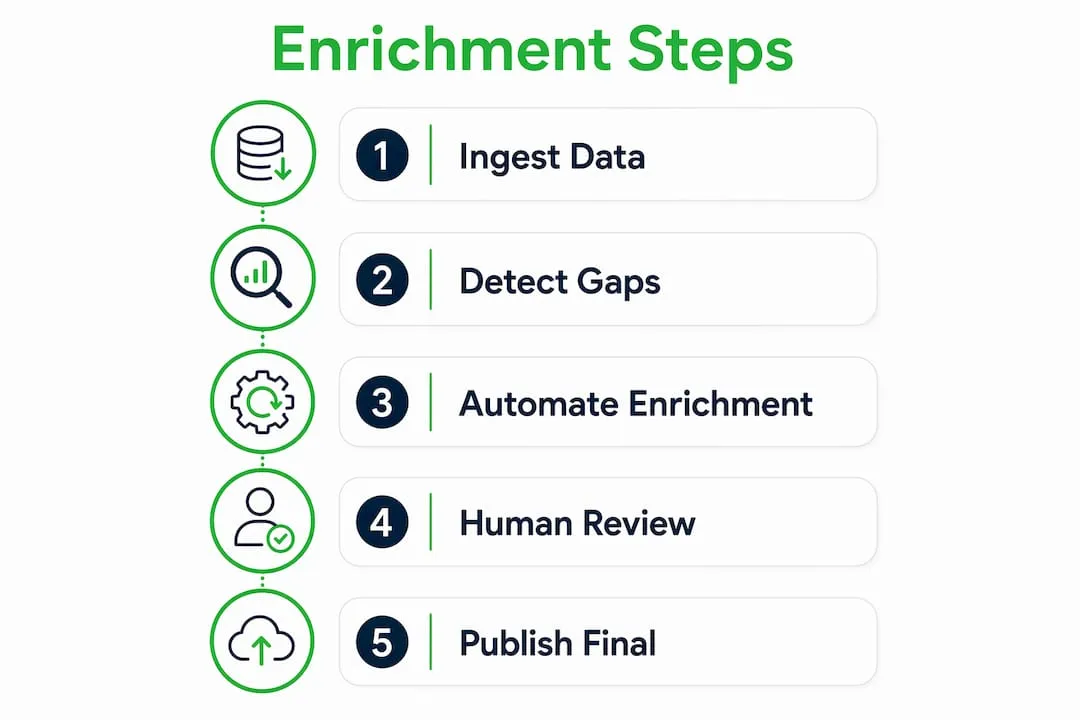
The workflow sequence that works at scale runs: ingest supplier data, detect gaps, enrich automatically, route to human review for priority SKUs, validate against channel requirements, then syndicate. Re-enrichment triggers automatically when source data changes, such as when a new variant is added or a supplier updates a specification. Treating enrichment as a continuous automated workflow rather than a periodic project is what separates teams that maintain catalogue quality from those that accumulate debt.
Pro Tip: Build approval steps into the workflow for any SKU above a defined revenue threshold. Automating the draft and manually approving the final copy takes minutes per product and prevents brand-voice errors from reaching high-traffic listings.
Automated product enrichment for Shopify dropshipping with Ecom-eye
The challenge for Shopify dropshippers is specific: supplier feeds from AliExpress and similar sources arrive with generic, often duplicated descriptions that trigger Google Merchant disapprovals and suppress organic rankings. Copying a competitor’s product page compounds the problem with duplicate content penalties. Ecom-eye was built to solve exactly this.
Ecom-eye is an AI SaaS platform that automates the full enrichment pipeline for Shopify dropshipping stores, from import through to export. Its core features address the most common product data failures in dropshipping:
- Bulk import: products are pulled directly from AliExpress or competitor URLs in bulk, with no manual data entry
- SEO-optimised titles and descriptions: AI generates unique, keyword-relevant copy for every product, removing duplicate content risk and improving search rankings
- AI product images: high-quality images are generated automatically, replacing low-quality supplier photos that underperform in Google Shopping
- Multi-language pages: listings are produced in multiple languages from a single import, supporting international Shopify stores without additional translation work
- One-click Shopify export: enriched, copyright-safe product pages are exported directly to Shopify with no rewriting or manual formatting
For UK dropshippers managing catalogues of hundreds or thousands of SKUs, the time saving is the most immediate benefit. The SEO and compliance gains compound over time as enriched, unique listings accumulate search authority that copied pages never could. Ecom-eye’s Shopify product page builder handles the entire enrichment process in minutes, making it practical to launch and maintain a large catalogue without a content team.

If you are running a Shopify dropshipping store and still rewriting supplier descriptions by hand, or copying pages from competitors, Ecom-eye removes both problems at once. Generate SEO-ready, copyright-safe product pages in bulk and export them directly to Shopify in one click.
Key takeaways
Automated product enrichment is the most direct lever ecommerce teams have for improving catalogue quality, search visibility, and conversion rates simultaneously, without scaling headcount.
| Point | Details |
|---|---|
| Enrichment adds what is missing | Unlike cleansing, which fixes errors, enrichment adds missing attributes, copy, and structured data that were never captured. |
| First-page visibility depends on it | 75% of shoppers never scroll past the first page, making complete, structured product data a prerequisite for discovery. |
| Taxonomy governance comes first | Without governed taxonomy rules, AI-generated enrichment produces inconsistent content that harms brand authority. |
| Treat it as a continuous lifecycle | Real-time gap detection and triggered re-enrichment prevent quality debt from accumulating as catalogues grow. |
| Human review stays in the loop | AI handles volume and repetition; human review validates brand voice and accuracy for high-value SKUs. |
FAQ
What is automated product enrichment?
Automated product enrichment is the AI-driven process of analysing existing product data, identifying gaps, and automatically generating missing attributes, descriptions, specifications, and taxonomy classifications so every SKU is complete and channel-ready.
What is the difference between data augmentation and data enrichment?
Data enrichment adds entirely new information that was never captured, such as missing attributes or marketing copy, while data augmentation applies transformations to existing data, such as scaling or noise addition, primarily to improve machine learning training sets.
What is product data enrichment in ecommerce?
Product data enrichment in ecommerce is the process of expanding sparse or incomplete product information into detailed, structured, customer-facing content covering attributes, descriptions, media, and logistical details that help shoppers find and buy products.
What is AI enrichment in the context of product catalogues?
AI enrichment uses machine learning models to extract attributes, generate copy, assign categories, and detect content gaps across large product catalogues automatically, handling the volume and repetition that make manual enrichment impractical at scale.
What is an automated product data management system?
An automated product data management system connects supplier feeds, enrichment tools, and distribution channels into a single pipeline that ingests, enriches, validates, and syndicates product data without requiring manual intervention at each stage.
Ready to boost your product pages?
Generate high-converting, SEO-optimized product pages in bulk using AI automation used by e-commerce experts.
No credit card required