How LLM.txt transforms Shopify AI SEO for dropshippers
Learn how LLM.txt helps Shopify dropshippers boost AI search visibility, avoid duplicate content penalties, and get cited by ChatGPT and Gemini in 2026.

TL;DR:
- LLM.txt guides AI crawlers to key pages, enhancing AI search visibility for Shopify stores.
- It complements traditional SEO by focusing on authority signals for AI-powered search engines.
- Proper setup, human review, and integration with unique content boost brand citations and rankings.
You’ve invested in AI tools to generate product pages at speed, yet your Shopify store still struggles to rank. Sound familiar? The problem isn’t your AI tool. It’s that most dropshippers optimise for Google’s traditional crawler and completely overlook the new wave of AI-powered search engines pulling citations from your site. Duplicate content penalties hurt, but invisible content is just as damaging. LLM.txt is a small but powerful file that tells AI crawlers exactly where to look on your store. In this article, you’ll learn what LLM.txt is, why it matters for dropshipping stores using AI content generation, and how to implement it without adding hours to your workflow.
Table of Contents
- What is LLM.txt and why it matters for Shopify dropshippers
- How LLM.txt boosts AI search visibility, sales, and avoids duplicates
- Setting up LLM.txt: Best practices and Shopify apps
- Pitfalls, expert insights, and when LLM.txt is overkill
- Our take: How to actually win with AI content and LLM.txt in 2026
- Accelerate your Shopify SEO with expert guidance
- Frequently asked questions
Key Takeaways
| Point | Details |
|---|---|
| LLM.txt targets AI search | It gives large language models a curated map of your most important pages, improving Shopify product citations and visibility. |
| Hybrid approach works best | Combining AI-generated content with human editing and LLM.txt delivers the best SEO results for dropshipping stores. |
| Avoid duplicate penalties | LLM.txt, paired with unique AI descriptions and proper tags, helps dodge Shopify duplicate content issues. |
| Automation scales impact | Shopify apps can automate LLM.txt setup and updates, making it feasible for stores with large, changing catalogues. |
What is LLM.txt and why it matters for Shopify dropshippers
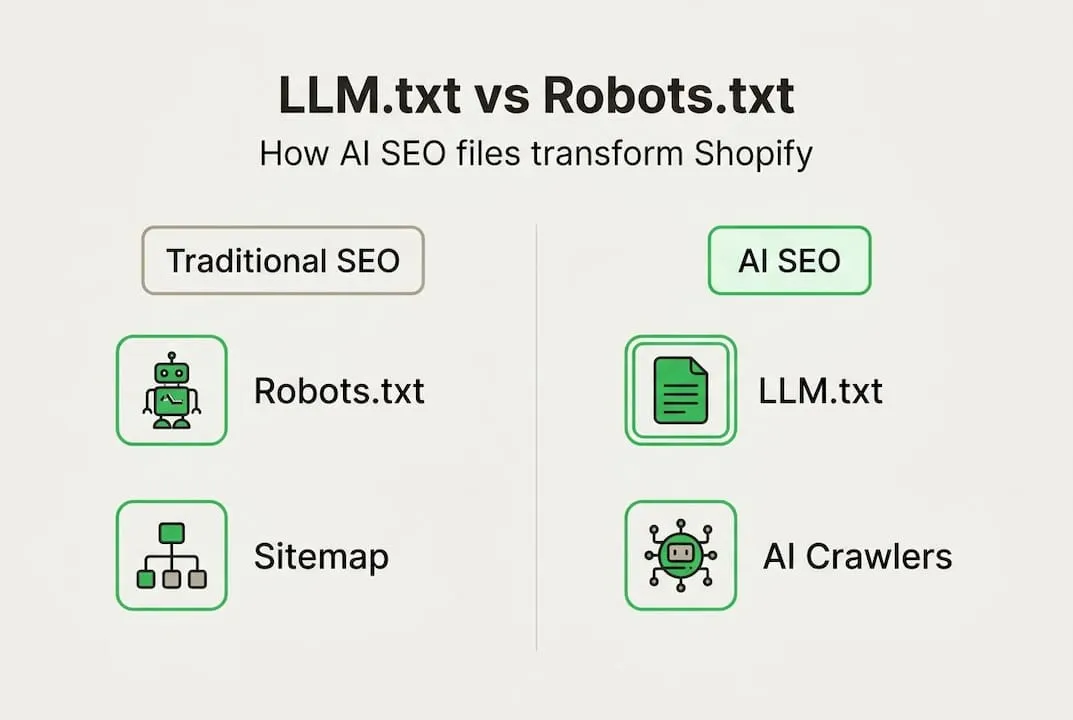
Most Shopify dropshippers know about robots.txt and sitemaps. But there’s a newer file quietly becoming essential for stores that want to appear in AI-generated search results. LLM.txt is a plain-text Markdown file placed at your website’s root (for example, yourdomain.com/llms.txt) that provides a curated map of key pages with descriptions for large language models like ChatGPT and Gemini, helping AI crawlers understand and cite your content efficiently.
Think of it this way. Google’s Googlebot reads your sitemap to index pages. AI crawlers like those powering ChatGPT or Gemini read LLM.txt to decide which pages are worth referencing in their responses. Without it, these crawlers guess. And when they guess, your competitor’s page often wins the citation instead of yours.
For Shopify dropshippers relying on AI-generated product descriptions, this matters enormously. You’re already producing unique, keyword-rich content at scale. LLM.txt ensures that content gets discovered and credited by the AI systems your customers are increasingly using to research purchases. This is what the industry now calls AEO (AI Engine Optimisation), and it sits alongside traditional SEO rather than replacing it.
Here’s a quick comparison of the three key files:
| File | Target | Purpose |
|---|---|---|
| robots.txt | Googlebot and web crawlers | Control which pages get indexed |
| sitemap.xml | Search engine crawlers | List all pages for indexing |
| llms.txt | AI language models | Guide AI to your best, most authoritative pages |
The key difference is intent. Robots.txt and sitemaps are about access and discovery for traditional search. LLM.txt is about authority for AI-driven search. It tells ChatGPT, Gemini, and similar tools: “These are the pages that represent our brand accurately.”
Why does this matter specifically for dropshippers? Because ecommerce SEO and sales growth increasingly depends on being cited in AI responses, not just ranking on page one. Shoppers are asking AI assistants for product recommendations before they ever open a search engine. If your store isn’t mapped for AI crawlers, you’re invisible in that conversation.
Key benefits of LLM.txt for Shopify dropshippers:
- Directs AI crawlers to your most important product pages and category hubs
- Highlights your returns policy, FAQs, and shipping guides as authority signals
- Reduces the chance of AI bots pulling outdated or irrelevant pages
- Supports AI Engine Optimisation alongside your existing SEO strategy
- Works passively once set up, requiring minimal ongoing maintenance
According to llms.txt analysis across multiple ecommerce sites, stores with properly structured AI-facing files see measurably stronger citation rates in AI-generated responses. That translates directly into brand visibility when shoppers use AI assistants to compare products.
How LLM.txt boosts AI search visibility, sales, and avoids duplicates
Understanding the theory is one thing. Seeing how LLM.txt fits into your actual daily workflow is where the real value appears. For most Shopify dropshippers using AI tools, the process looks like this: import products from AliExpress or competitor links, run them through an AI generator to create unique titles and descriptions, review the output, then push to Shopify. It’s fast. But it leaves a gap.
That gap is discoverability for AI-powered search. Your freshly generated, unique product pages exist, but AI crawlers don’t automatically know they’re there or that they’re trustworthy. LLM.txt improves citations in AI responses by directing large language models to your important product pages, policies, and guides, boosting your AI search visibility without touching your traditional SEO setup.
This is where the combination becomes genuinely powerful. Bulk AI product page creation gives you scale and uniqueness. LLM.txt gives those pages a direct line to AI crawlers. Together, they create a compounding advantage.

Duplicate content is the other critical issue. Many dropshippers still copy supplier descriptions word for word, which triggers Google penalties and Google Merchant disapprovals. The fix is straightforward: use canonical tags and unique AI-generated descriptions to replace supplier duplicates, and use 301 redirects for discontinued products. LLM.txt then maps your clean, unique pages so AI systems reference the right version.
Here’s how the two approaches compare:
| Approach | Duplicate risk | AI visibility | SEO impact |
|---|---|---|---|
| Copied supplier text | High | Low | Negative |
| AI-generated unique copy | Low | Medium | Positive |
| AI copy + LLM.txt | Very low | High | Strongly positive |
A practical numbered workflow for integrating LLM.txt:
- Generate unique product descriptions using an AI tool
- Apply canonical tags to handle any variant or filter pages
- Create your LLM.txt file listing key product hubs, FAQs, and policies
- Upload to your Shopify root directory
- Monitor AI citation rates and update as your catalogue grows
Pro Tip: Use AI product description ideas that include brand-specific language and long-tail keywords. These signal authority to both Google and AI crawlers, making your LLM.txt entries far more effective.
Real-world results back this up. A case study scaling 3,000 Shopify product descriptions with AI showed dramatic improvements in top-10 rankings and significant time savings. Adding LLM.txt to that workflow maps those wins directly into AI-powered search results.
Setting up LLM.txt: Best practices and Shopify apps
Knowing you need LLM.txt is one thing. Actually setting it up without technical headaches is another. The good news is that the barrier is low, especially if you use the right tools.
The simplest starting point is a dedicated Shopify app. Apps like StoreAutopilot generate compliant LLM.txt files and are specifically recommended for ecommerce stores to list product pages, FAQs, and shipping and returns information. If you’re managing a large catalogue, automation is non-negotiable. Manually updating a text file every time you add a new product line is not a sustainable workflow.
For those who prefer a more hands-on approach, Shopify’s AI SEO tools offer guidance on integrating AI-friendly files into your store setup. The key is making sure your LLM.txt is structured clearly, with concise descriptions for each listed page so AI crawlers understand the context immediately.
Here’s a practical checklist for an effective LLM.txt:
- Include your main category pages with brief, keyword-rich descriptions
- List your top-performing individual product pages
- Add your returns, shipping, and privacy policy pages
- Include your FAQ page and any buying guides
- Link to your About page to establish brand authority
- Review and update whenever you launch a major new product line
Automation is your best friend here. Set up webhook triggers so that when you add a significant batch of new SKUs, your LLM.txt updates automatically. This pairs perfectly with AI bulk product listing workflows where you’re adding dozens or hundreds of products at once.
“An LLM.txt file is most powerful when it reflects your store’s genuine authority pages, not every URL you’ve ever published. Quality over quantity is the guiding principle.”
Pro Tip: Run an A/B test when making major catalogue changes. Keep LLM.txt as-is for one month, then update it and monitor AI citation rates and organic traffic for the following month. The difference in AI-driven referral traffic can be revealing.
For ongoing maintenance, cross-reference your LLM.txt entries with Google Search Console. If GSC flags duplicate content issues on pages listed in your LLM.txt, fix those pages first before expecting AI crawlers to treat them as authoritative. Also explore top AI tools for dropshipping that integrate SEO monitoring directly into your product generation workflow.
Pitfalls, expert insights, and when LLM.txt is overkill
LLM.txt is genuinely useful, but it’s not a magic solution for every Shopify store. Understanding where it adds real value, and where it doesn’t, saves you time and prevents misplaced priorities.
The biggest mistake dropshippers make is trying to list every product variant in their LLM.txt. That defeats the purpose. AI crawlers benefit from a curated map, not an exhaustive directory. Focus on your category hubs, your best-selling product pages, and your key policy and FAQ pages. Everything else is noise.
Another common pitfall is relying entirely on raw AI output without any human review. AI-generated content at scale risks penalties if it’s generic or duplicated, and human-edited content outperforms pure AI output for long-term engagement. The traffic gap between hybrid AI-human content and unedited AI content is significant. A hybrid approach, where AI handles the heavy lifting and a human adds brand voice and nuance, consistently outperforms either extreme.
Key pitfalls to avoid:
- Listing every product URL instead of focusing on category hubs
- Skipping human review of AI-generated descriptions before adding them to LLM.txt
- Treating LLM.txt as a substitute for fixing duplicate content issues
- Neglecting structured data and schema markup in favour of LLM.txt alone
- Ignoring GSC data when deciding which pages to include
For some smaller stores, schema markup and a well-structured FAQ page will deliver more immediate SEO value than LLM.txt. If you’re still battling basic duplicate content issues or your optimised product page structure isn’t solid yet, fix those foundations first.
Pro Tip: Check Google Search Console monthly for pages that AI tools are citing unexpectedly. If a page you didn’t intend to promote is getting AI traffic, either add it to your LLM.txt intentionally or improve its content to match the authority signal it’s already sending.
Don’t overlook AI images for ecommerce SEO either. High-quality, unique product images paired with strong AI-generated descriptions and a well-structured LLM.txt creates a genuinely competitive product page. And a detailed AI product workflow that includes image generation, description writing, and LLM.txt mapping covers all the bases that most dropshippers miss.
Our take: How to actually win with AI content and LLM.txt in 2026
Here’s the honest truth that most articles won’t tell you. LLM.txt is a force-multiplier, not a foundation. Dropshippers who jump straight to LLM.txt without fixing their duplicate content, building unique product copy, and structuring their pages properly are putting the roof on before the walls.
The stores that genuinely win with AI in 2026 follow a clear sequence. First, they generate unique, keyword-rich product descriptions at scale. Second, they apply proper technical SEO: canonicals, schema, clean URL structures. Third, and only then, they use LLM.txt to guide AI crawlers to their best work. Skipping steps one and two makes LLM.txt nearly worthless.
Human judgement still matters enormously. AI handles speed and scale brilliantly. But brand voice, nuanced product positioning, and editorial decisions about which pages deserve authority signals still require a human in the loop. Treat LLM.txt as an AI site map, a tool that points crawlers in the right direction, not a crutch that compensates for weak content. Pair it with Shopify automation and avoiding penalties best practices, and you have a genuinely sustainable SEO strategy.
Accelerate your Shopify SEO with expert guidance
If you’re generating product pages with AI but still losing ground to competitors in search rankings, the gap is almost certainly in your content uniqueness, technical SEO setup, or AI crawler visibility. EcomEye is built specifically to close that gap.
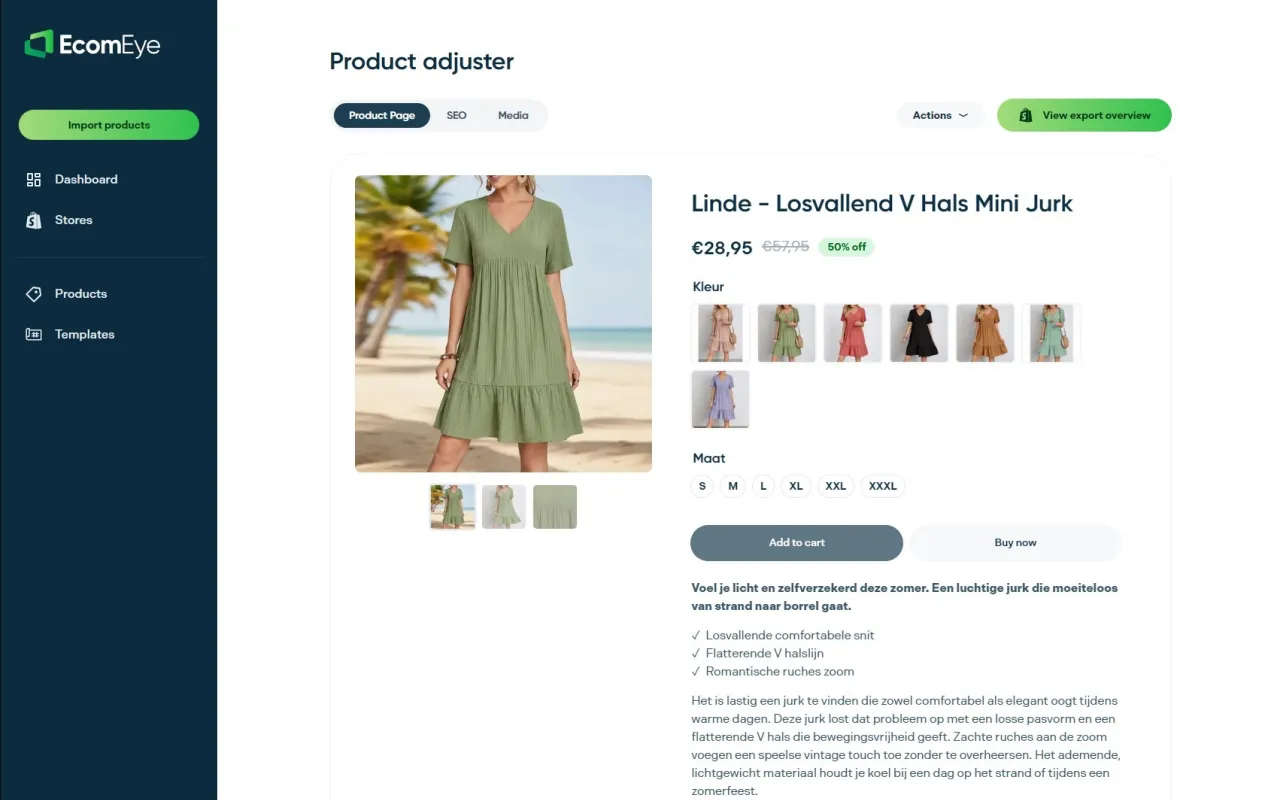
With EcomEye, you can import products in bulk from AliExpress or competitor links and automatically generate optimised titles, clean descriptions, SEO-ready content, and high-quality AI product images, then export directly to Shopify in one click. No rewriting, no copyright risk, no manual work. Combine that with the top dropshipping AI tools and LLM.txt implementation guidance available through our blog, and you have everything you need to build a penalty-proof, AI-visible Shopify store that scales.
Frequently asked questions
What pages should I include in LLM.txt for Shopify?
List your key product category pages, returns and shipping policies, FAQ pages, and top-performing individual product pages. Directing LLMs to important pages and guides gives AI crawlers the clearest picture of your store’s authority.
Will adding LLM.txt affect Google or traditional SEO ranking?
No. LLM.txt is read by AI language models, not Google’s crawler. LLM.txt improves AI citations without affecting your traditional search engine rankings in any way.
How often should I update LLM.txt for a large dropship catalogue?
Update it when you add major new product lines, launch new FAQs, or change key policies. Apps like StoreAutopilot can automate this process for large catalogues, keeping your file accurate without manual effort.
Is LLM.txt mandatory for Shopify stores using AI?
It’s not mandatory, but it’s strongly recommended for stores focused on AI search visibility. Boost AI Engine Optimisation by tackling unique descriptions and canonical tags first, then add LLM.txt to amplify those gains.
Ready to boost your product pages?
Generate high-converting, SEO-optimized product pages in bulk using AI automation used by e-commerce experts.
No credit card required