Temu Image Copyright: What Dropshippers Can Legally Use
Can you use Temu product images in your Shopify store? Here is what US copyright law and Temu's terms say, and how to get unique, listing-ready images in bulk.

Temu Image Copyright: What Dropshippers Can Legally Use

No, you cannot safely copy Temu product images into a US Shopify store. Buying or reselling an item does not give you rights to the photos on its listing, and Temu’s own terms do not licence them for commercial use. The safe route is images that are original to your store. That is what we built Ecom-eye to produce: unique AI product images and pages, generated in bulk from a Temu link and exported to Shopify in one click.
TL;DR
- A product photo is copyrighted from the moment it is taken, and it usually belongs to the photographer or whoever commissioned the shoot, not to you or to Temu.
- Reselling a product you bought is one right. Reusing the listing photos is a separate right, and the first sale doctrine does not cover it.
- Temu’s US terms grant a personal, non-commercial licence only, so scraped or imported images carry no commercial permission.
- The exposure is real: DMCA takedowns on Shopify, possible store termination, and statutory damages of up to $150,000 per work for wilful infringement.
- The fix is original media: your own sample photos, licensed assets, or unique AI-generated images per listing.
Table of Contents
- Why Temu images are a problem for dropshippers
- Who owns the photo on a Temu listing
- Does buying or reselling the item give you the photos?
- What Temu’s own terms say
- What can happen if you publish them anyway
- Worked example: a 200-product import
- How to get safe images, step by step
- What about the other marketplaces?
- Start with unique pages, not borrowed ones
- FAQ
- Sources
Why Temu images are a problem for dropshippers
A Temu listing looks like a ready-made catalogue: clean photos, descriptions, variants. Importing it into Shopify takes seconds. The trouble is that moving a file is not the same as holding the right to publish it.
Two layers are involved, and they are easy to confuse:
- Copyright law. This decides who owns the photo and who may copy it.
- Platform terms. These decide what Temu lets you do with its service and its content.
Both point the same way for a dropshipper. Neither gives you a commercial right to the pictures.
Who owns the photo on a Temu listing
The US Copyright Office says the author and first owner of a photograph is generally the person who takes it. The exception is a work made for hire, where a photographer shoots as an employee or under a written agreement for a qualifying purpose. In that case the employer or the commissioning party owns it.
In practice, for a Temu image that means one of three owners:
- the seller who shot it for that listing,
- the brand or manufacturer who commissioned it,
- or someone else entirely, if the photo was lifted from another store or a designer’s portfolio.
That last case matters. Marketplace listings often reuse pictures from elsewhere, so the party who uploaded a photo to Temu may not own it. A permission from that party would then be worth nothing.
Copyright also attaches automatically. The Copyright Office explains that protection became automatic for any work fixed in a tangible medium, and registration is optional. A photo with no watermark and no copyright notice is still protected.
Does buying or reselling the item give you the photos?
This is the argument most dropshippers lean on, and it fails. The first sale doctrine, in 17 U.S.C. § 109, lets the owner of a lawfully made copy sell or dispose of that copy without the copyright owner’s authority. It covers the physical item. It does not let you reproduce the copyrighted photographs of that item.
The American Bar Association draws the same line. Brand owners generally cannot stop the resale of genuine goods, but copying their images and text is a separate copyright question, because the images are works used to promote the product, not the product itself.
A US reselling guide from a law practice makes the same point for Temu specifically: a purchase does not automatically give permission to use a brand’s photos, logo or marketing materials, and original photos and descriptions are the safer path.
What Temu’s own terms say
Temu’s US Terms of Use say that materials on the service, including photos and images, may be protected by copyright. Users must not copy, reproduce, publish, display or sell content they do not own without the owner’s prior consent.
The licence Temu grants is narrow. Section 7.4 gives a limited, non-exclusive, non-transferable licence for personal and non-commercial use. Section 7.5 prohibits commercial use of information from the service, or use for the benefit of another business, unless explicitly permitted in advance.
A dropshipping store is a business. Showing Temu photos to sell to your own customers is a commercial use for your benefit. A browser extension or importer does not change that, because it only moves the content and passes on no licence. Temu terms are updated from time to time, so read the current version on its site before you build a catalogue on any of its content.
What can happen if you publish them anyway
There are three layers of risk, from the most likely to the most severe.
1. A DMCA takedown on your store. Shopify’s copyright policy says that on a complete and valid DMCA notice it will generally remove the reported content and notify you in your admin. You can accept the removal or file a counter notice. A valid counter notice can lead to the content being reposted after 10 to 14 business days, unless the claimant files legal action in that window.
2. Store termination. The same policy says Shopify terminates stores for repeat infringement and can disable a store for a single wilful or egregious infringement. For a store with hundreds of imported listings, one notice can multiply into many.
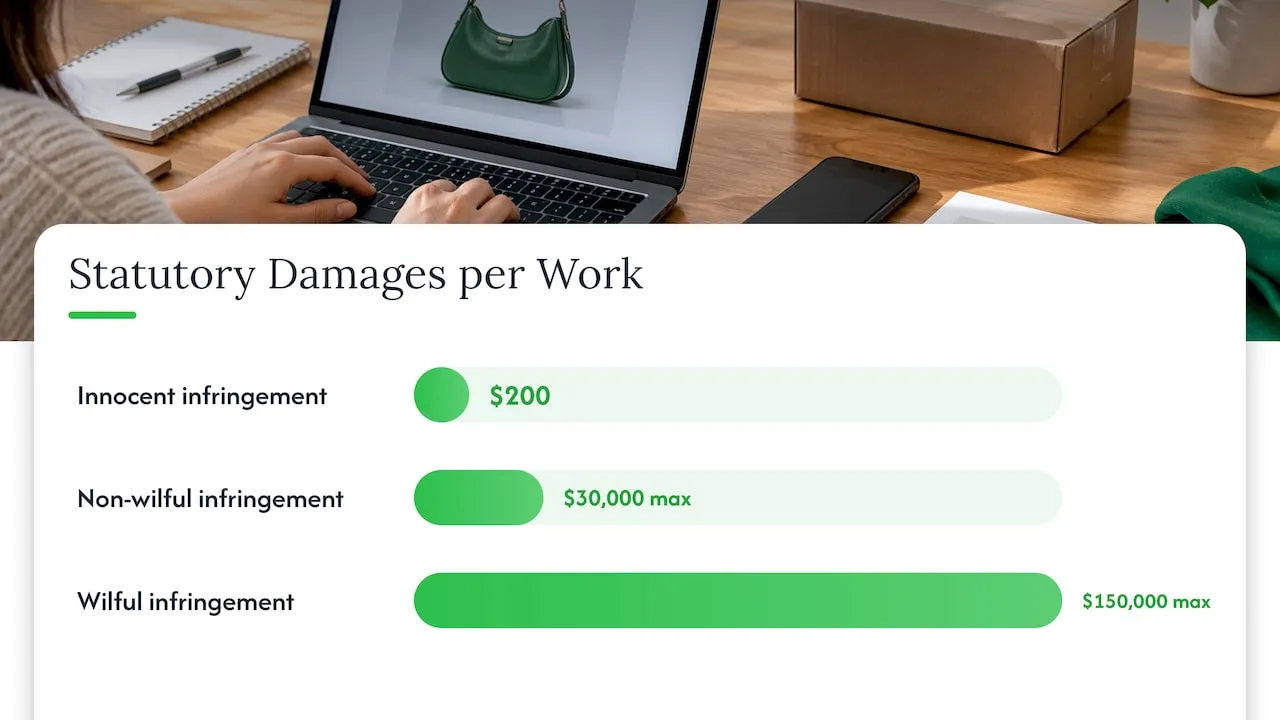
3. Legal claims. The Copyright Office notes that registration is needed to file suit and to collect statutory damages and attorney’s fees. Where it applies, statutory damages can reach $30,000 per work for non-wilful infringement and $150,000 per work for wilful infringement, and can drop to $200 for innocent infringement. Per work means per image, and a bulk import can mean hundreds of images.
There is a commercial cost too, beyond the legal one. If your pages use the same photos and near-identical text as every other store importing the same Temu product, you are competing on duplicate content, and a takedown can remove your listings overnight.
Worked example: a 200-product import
Say you import 200 products from Temu links, each with five photos. That is 1,000 images you do not own, and 1,000 potential works in a claim. If a rights holder files notices, Shopify can remove the reported listings in bulk, and you lose both the pages and the ad spend pointing at them. You also have a record on your store of the infringement. None of that depends on whether you meant any harm.
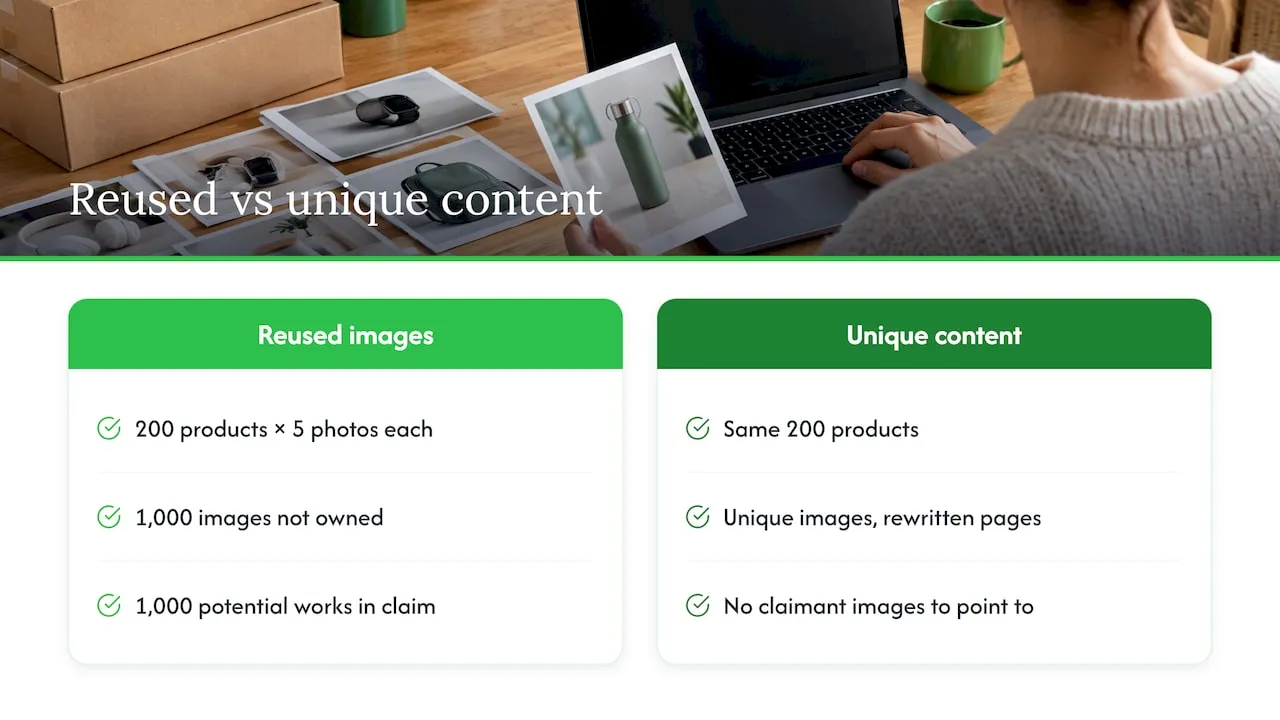
Now compare the same 200 products with unique images and rewritten pages. A claimant has nothing of theirs on your site to point to.
How to get safe images, step by step
1. Treat every Temu image as not yours
Start from the position that a listing photo is somebody’s copyrighted work. Use Temu as a source of product information such as variants, sizes and specs, not as a source of finished media.
2. Choose your image source
The options that avoid the problem are:
- Your own photographs of a sample you ordered. You own those, but you must also make sure props, packaging, logos and background art are not someone else’s protected work.
- Licensed assets from the actual rights holder, in writing, which names the products and where you will use the images.
- Unique AI-generated product images made for your store, so no one else’s photograph sits on your page.
For a bulk lister, the first two do not scale: ordering and shooting a sample for every SKU takes weeks, and licences are slow to obtain. This is where generating images per listing earns its place. Our AI product image generator is built for exactly this: high-quality AI product images, generated for each user, so the same Temu link gives each store its own result.
3. Rewrite the page as well as the pictures
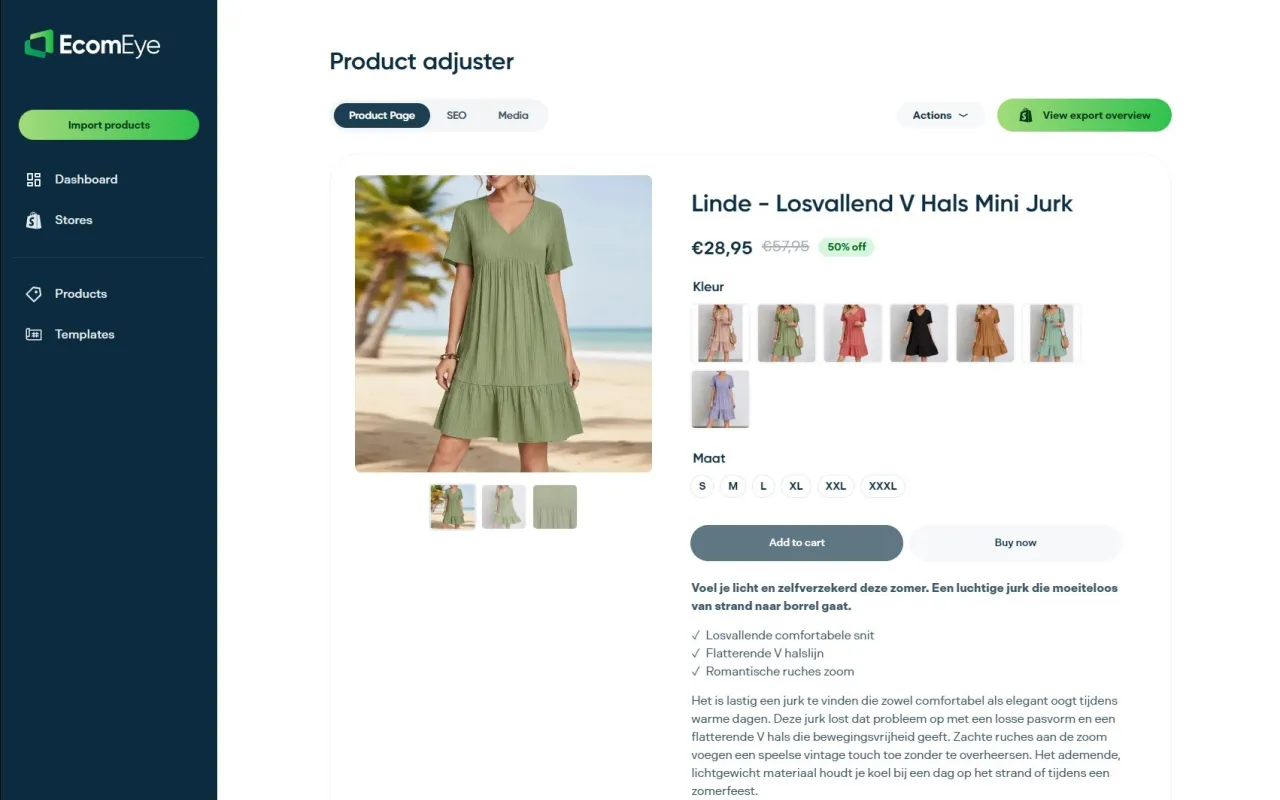
Images are half the exposure. Titles and descriptions copied from a listing are copyrightable text too, and they are the quickest way to land in duplicate-content territory. Our platform generates unique titles, descriptions and SEO-ready content together with the images, with multi-language pages if you sell beyond the US.
4. Fix variants and sizes
Imported listings often carry size charts in another system. We include size system conversion and built-in bulk editing and templates, so you can clean a batch of products in one pass rather than editing each by hand.
5. Export to Shopify and keep records
Export to Shopify in one click, then keep a record of what you did for each batch: the date, the source link and the version of the terms you reviewed. Saving a dated copy of the platform terms is advice US legal guides give resellers, and it costs nothing.
6. If a notice arrives, respond through Shopify
If you receive a DMCA notice, it appears in your Shopify admin. Take the content down and, if you believe the notice is wrong, use the counter notice form. Make a counter notice only on facts you can support, because Shopify’s policy states that false or bad-faith notices are punishable by law. If the claim is serious, speak to a US copyright lawyer before you answer.
What about the other marketplaces?
The logic is the same on every source. We cover the details in our guides to AliExpress image copyright and Amazon product image copyright. For the SEO side, see why duplicate images hurt Shopify stores, and for a wider checklist, our copyright-safe ecommerce tips. If you are on the other side and want to defend your own photos, our post on enforcing image copyright on Shopify covers it.
If you want to see which image types suit which page, our guide to ecommerce product image types walks through main shots, lifestyle images and more.
Our view
Most dropshippers who get hit do not set out to infringe. They import because the tool lets them, and the tool never asks whose photo it is. We think the fix belongs at the start of the workflow, not in a legal letter afterwards.
So we built the process around uniqueness. Every product page and every image is generated by AI for each user, which is designed to remove copyright and DMCA exposure and to avoid the duplicate content that triggers Google Merchant disapprovals. Even when two stores start from the same product link, each listing comes out unique.
You import from Temu, AliExpress, Amazon or a competitor’s Shopify link, generate titles, descriptions and images in bulk, and export to Shopify in one click. No rewriting, no manual work, and nothing of another seller’s on your page.
That is the difference between a store that scales and a store that is one notice away from losing its listings.
Koen
Start with unique pages, not borrowed ones
We offer two plans, published on our pricing page: Try-out at €39 per month and Scaler at €99 per month. Both generate unique product pages and images for your Shopify store, with import from Temu links, bulk editing, Google Merchant Center tools and one-click export.
If you are listing from Temu today, the quickest way to take the image question off the table is to replace the borrowed pictures before you publish. Start at ecom-eye.com.
FAQ
Can I use Temu product photos if I buy the product and dropship it?
Not on that basis alone. The first sale doctrine lets you resell the physical item, but it does not let you reproduce the photographs of it. You need a licence from the owner of the photo, or you need your own images.
Is it fine if the image has no watermark or copyright notice?
No. Copyright in a photo is automatic from the moment it is taken, and a notice is optional. The absence of a watermark tells you nothing about whether you may use it.
What if my supplier says I can use the images?
Get that in writing, naming the products and where you will use the images. Keep in mind that a supplier’s permission only helps if the supplier actually owns the photo or holds a licence that lets them pass it on. Marketplace photos are often copied from elsewhere, so original or generated images are the lower-risk choice.
Does Shopify check for copyright before I publish?
Shopify acts on reports. Under its copyright policy, a rights holder sends a DMCA notice, and Shopify generally removes the reported content and tells you in your admin. That is why a bulk import of images you do not own is risky: the first you hear of it is usually a takedown.
Sources
- Temu Terms of Use
- What Photographers Should Know about Copyright, US Copyright Office
- Orphan Works statement, US Copyright Office
- 17 U.S. Code § 109, Cornell Law School
- Dealing with Unauthorized Online Dealers, American Bar Association
- Shopify Help Center: Reporting copyright infringement
- Legal and Tax Guide for Reselling Temu Items in the U.S.